 English
  Українська
  Čeština
 Yirgacheffe is a coffee region within the Sidama zone of southern Ethiopia. It is widely considered one of the most prestigious coffee origins in the world, producing beans with distinctively bright, floral, and citrusy flavour profiles that have captivated the specialty coffee industry for decades.
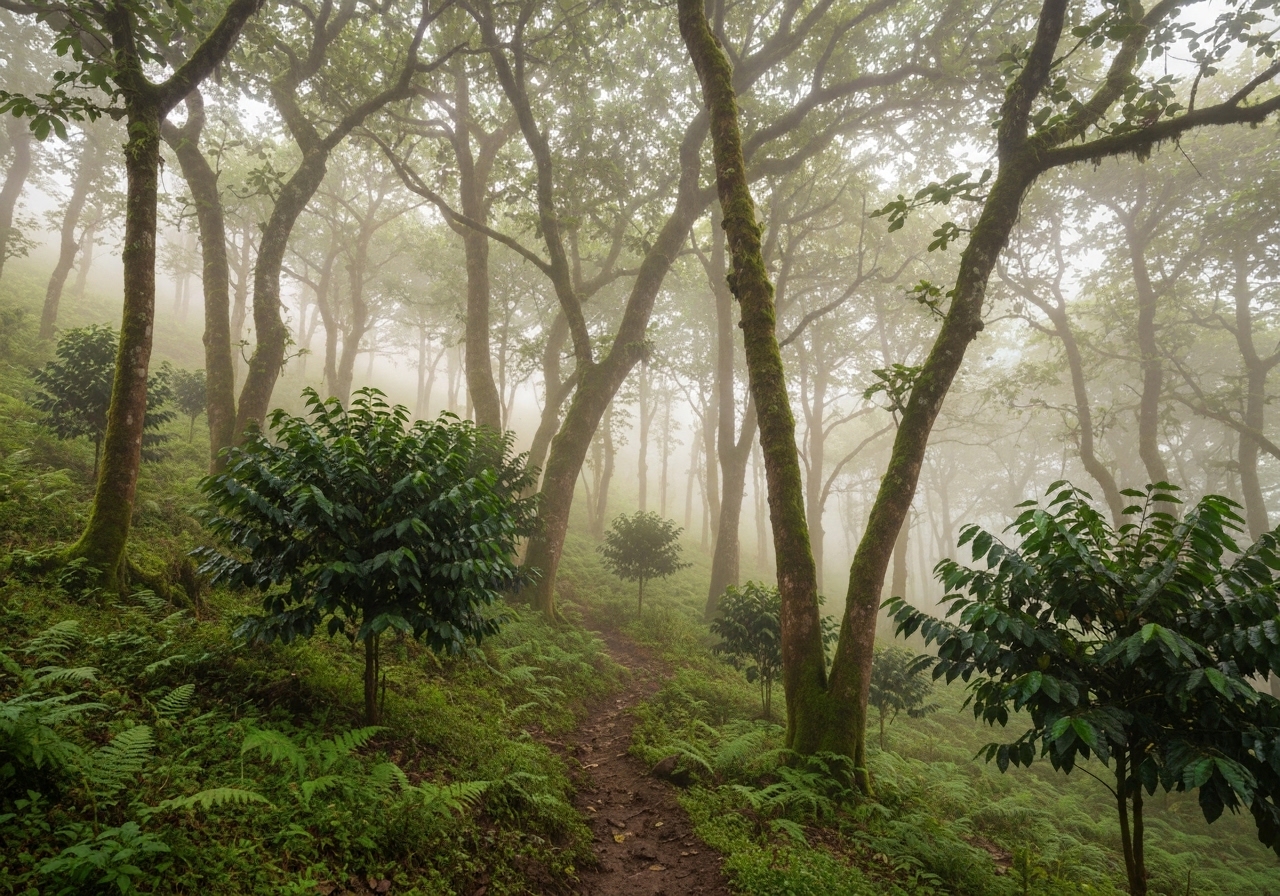
The misty highlands of southern Ethiopia, where coffee grows wild among ancient forests
The name “Yirgacheffe” itself has become synonymous with quality. When specialty roasters describe a coffee as having “Yirgacheffe character,” they mean a cup that opens with jasmine-like florals, carries bright citrus acidity, and finishes with a delicate, tea-like body. No other region on earth produces this exact combination so consistently.
Flavour Profile
- Aroma: Jasmine, bergamot, lemon blossom
- Acidity: Bright, wine-like
- Body: Light to medium
- Notes: Citrus, stone fruit, floral, tea-like
“Yirgacheffe is to coffee what Champagne is to wine — a region so distinctive that its name alone evokes a specific sensory experience.”
Processing Methods
Washed (Wet Process)
The dominant method in Yirgacheffe, and arguably the process that made this region famous. Coffee cherries are depulped, fermented in concrete tanks for 36–72 hours to dissolve the mucilage, then washed clean before drying on raised African beds. This washed process strips away the fruit, leaving nothing but the bean’s intrinsic character — clean, bright cups with pronounced floral and citrus notes that are the hallmark Yirgacheffe profile.
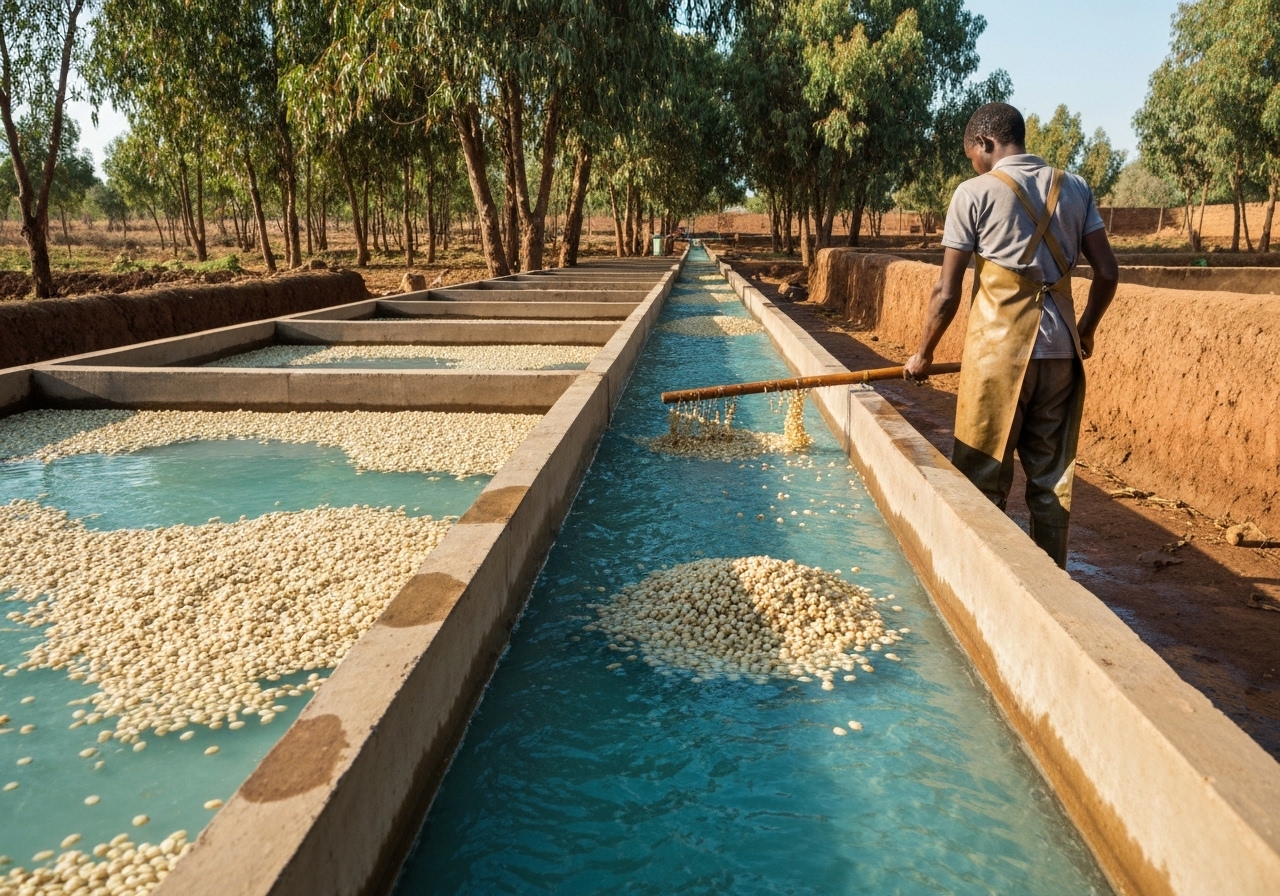
A washing station where cherries undergo wet processing — the method that defines Yirgacheffe’s clean, floral character
Natural (Dry Process)
Increasingly popular among adventurous roasters and consumers. In the natural process, whole cherries are spread on raised beds under the Ethiopian sun, where the fruit slowly dries and ferments around the seed over two to four weeks. This produces an entirely different experience — fruity, berry-like sweetness dominates, with blueberry and strawberry notes that can be almost confectionery-like in intensity.
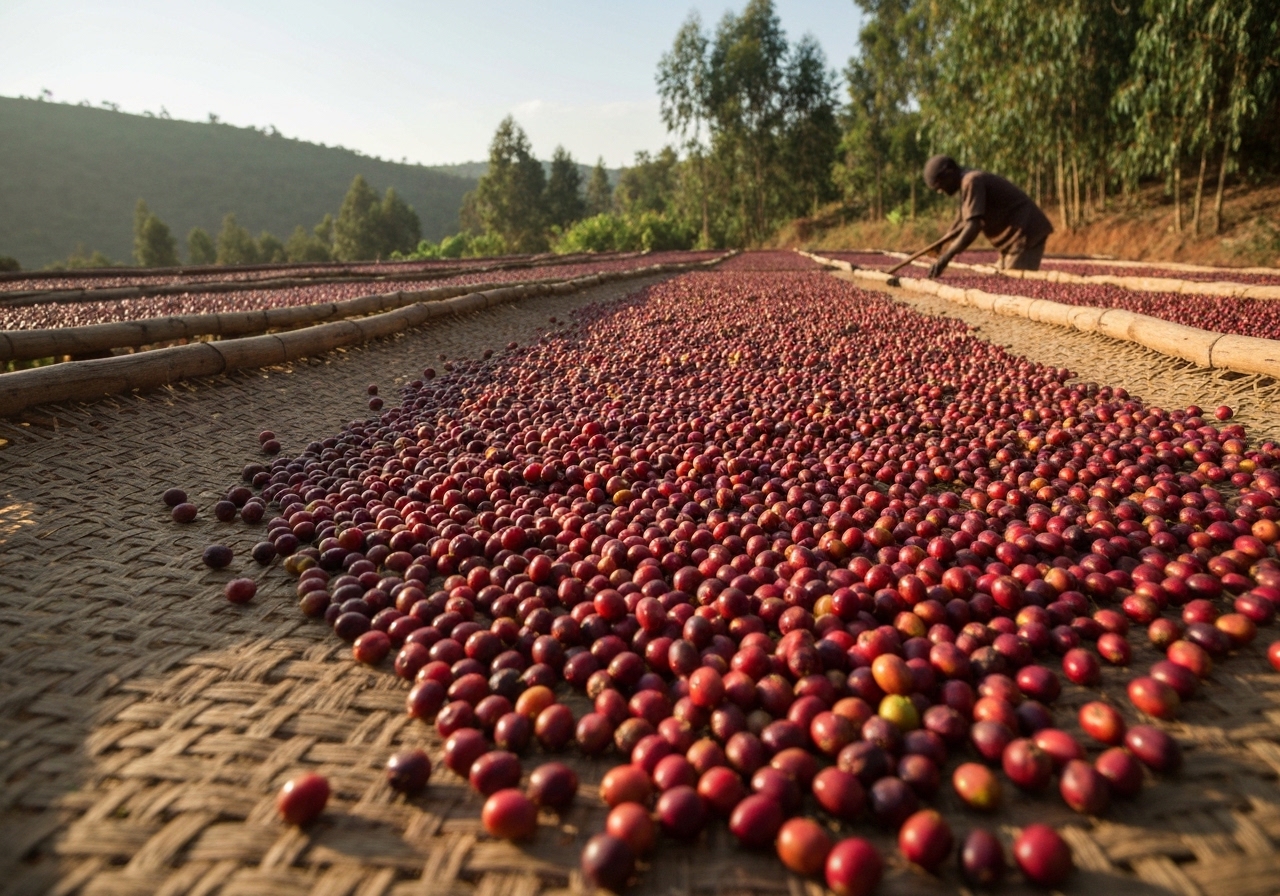
Coffee drying on raised African beds — a method that concentrates fruit sugars and intensifies flavour
Natural Yirgacheffes have gained a devoted following among third-wave roasters who prize their explosive fruitiness. The best naturals from this region achieve scores well above 90 points in professional cupping evaluations.
Growing Conditions
The Yirgacheffe terroir is uniquely suited for producing exceptional coffee:
- Altitude: 1,700–2,200 masl — among the highest coffee-growing elevations in the world, falling squarely within the coffee belt
- Soil: Rich volcanic soils, mineral-dense and well-draining
- Climate: Tropical highland with distinct wet and dry seasons, providing the stress cycle that develops complex flavours
- Harvest: October–January
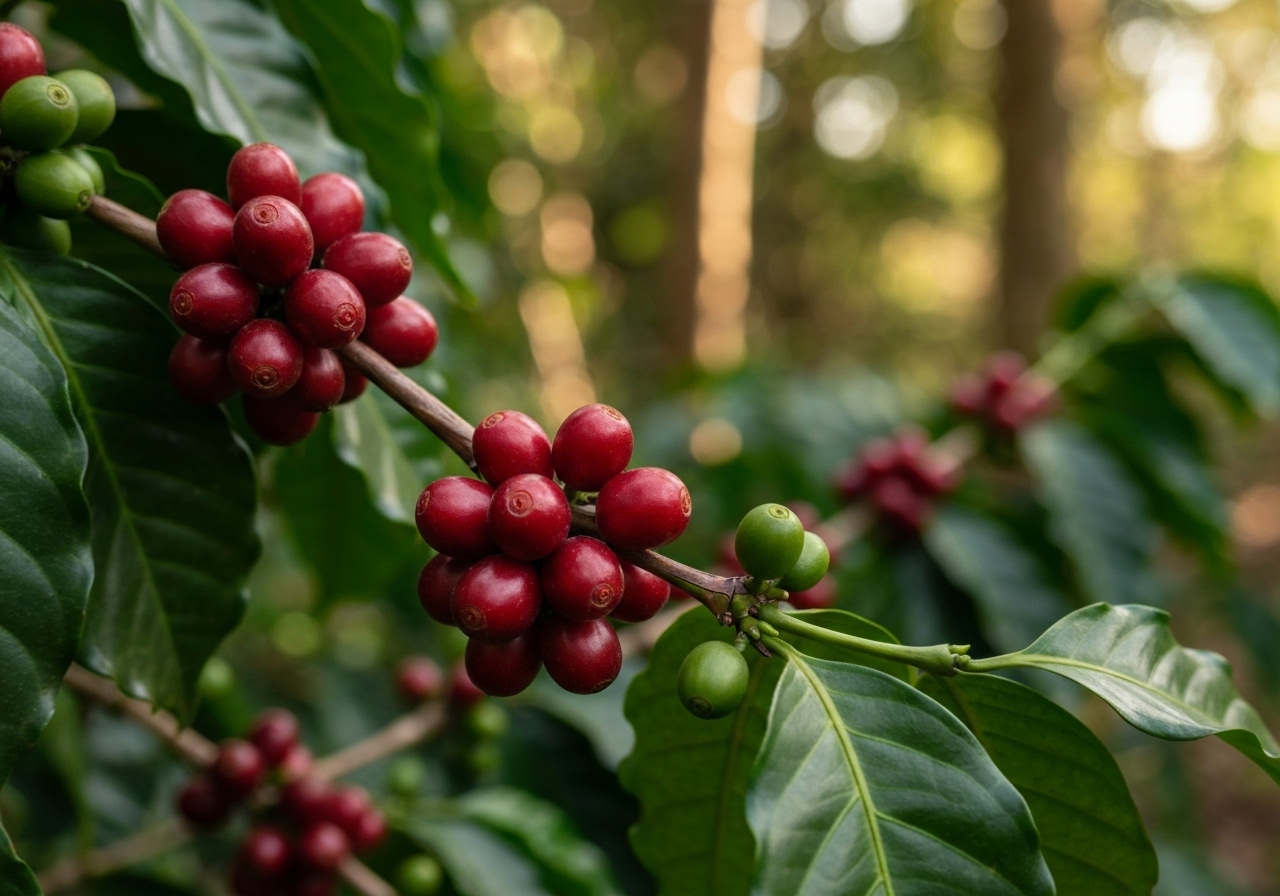
Ripe coffee cherries at peak maturity — hand-picked in the Ethiopian highlands during harvest season
The combination of extreme altitude, ancient volcanic soil, and equatorial sunlight creates conditions that no other region can replicate. Coffee grown at these elevations matures slowly, developing the complex sugar compounds that translate into the jasmine, bergamot, and stone fruit notes for which Yirgacheffe is celebrated.
Varieties
Yirgacheffe is home to numerous indigenous heirloom varieties, often simply categorized as “Ethiopian Heirloom.” These include Kurume, Dega, and Wolisho among many others — and these are only the ones that have been catalogued. Unlike the commercially propagated varieties found in Latin America (such as Typica and Bourbon), Ethiopian varieties maintain extraordinary genetic diversity — the result of thousands of years of natural evolution in coffee’s homeland.
This genetic diversity is one reason Ethiopian coffees taste unlike anything else: each farm, each hillside may harbour unique varieties found nowhere else on earth. The Gesha variety, now the most expensive coffee cultivar in the world, originated in the forests of western Ethiopia before its long journey to Panama.
Coffee Culture
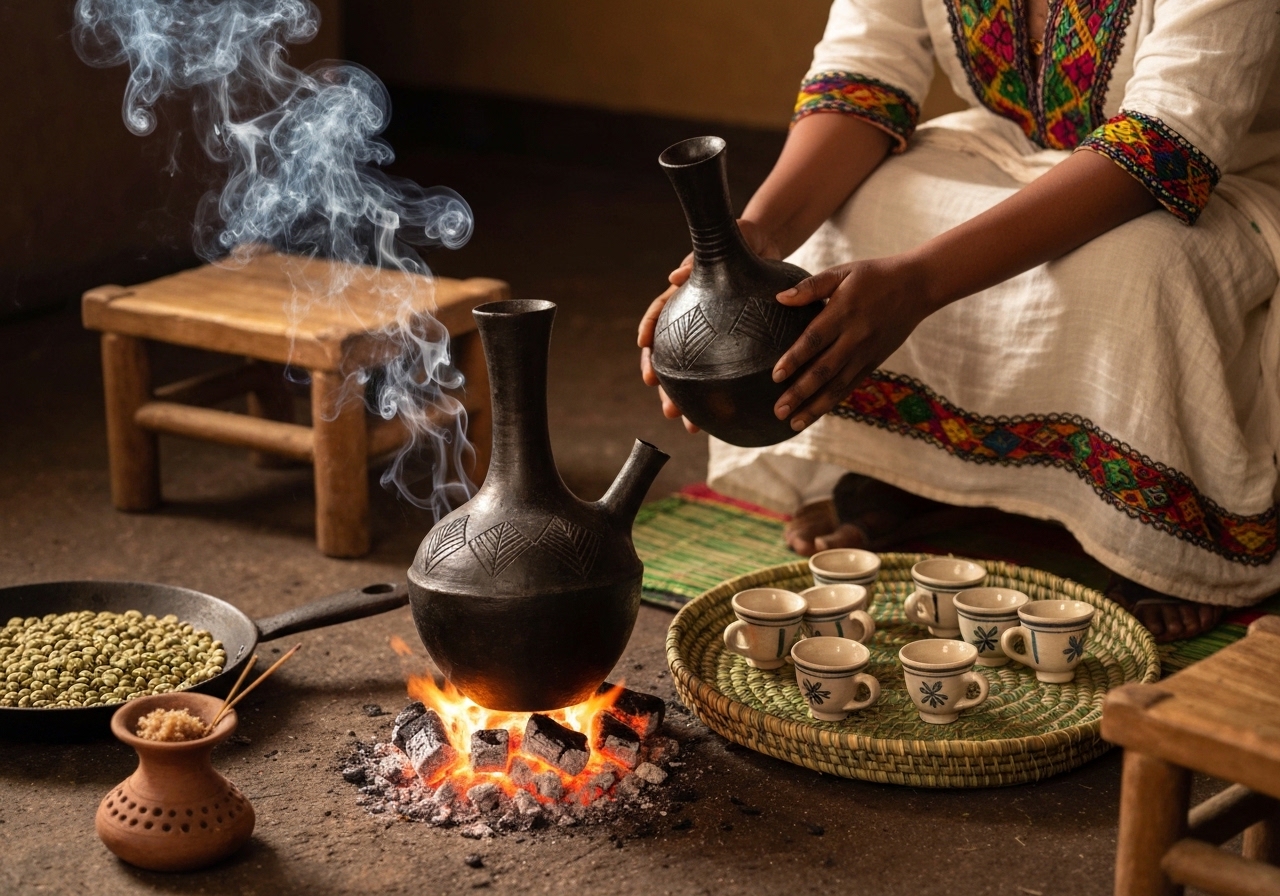
The traditional Ethiopian coffee ceremony — a social ritual that can last hours, with hand-roasted beans and a jebena clay pot
Ethiopia is the only origin country where coffee consumption rivals production. The traditional Ethiopian coffee ceremony — buna — is a cornerstone of social life. Green beans are roasted over charcoal in a flat pan, ground by hand with a mortar and pestle, and brewed in a jebena (clay pot). The ceremony can last hours, with three rounds of progressively lighter coffee: abol (the strongest), tona, and baraka (a blessing).
The ceremony is more than a drink preparation — it is a social institution, an act of hospitality, and a meditation. Incense burns alongside the roasting beans. Guests sit on low stools. Conversation flows freely. In a culture where coffee was born, it is woven into the fabric of daily life in a way that no Western café can replicate.
Why It Matters
Ethiopia is the birthplace of Arabica coffee. The legend of Kaldi — a goat herder who noticed his animals dancing after eating coffee cherries — dates back over a millennium. But beyond legend, the genetic evidence is clear: the forests of southwestern Ethiopia contain the greatest diversity of wild Arabica coffee on the planet.
Yirgacheffe represents the pinnacle of what Ethiopian coffee can be — complex, aromatic, and utterly unique. For specialty coffee professionals, it remains the benchmark origin: the coffee against which all others are measured.
No coffee atlas would be complete without it.
Related Topics
Ethiopia — Sidamo
Ethiopia Sidamo: a diverse origin producing floral washed lots and explosive naturals bursting with blueberry, dark chocolate, and berry complexity at altitude.
processWashed (Wet) Processing
Washed coffee processing removes all fruit before drying to reveal clean, bright cups — floral, terroir-transparent, and prized by the specialty world. The benchmark method.
processNatural (Dry) Processing
Natural processing dries whole coffee cherries in the sun before milling — the oldest method, and the one most responsible for fruity, wine-like, and berry-forward cups.
getting-startedArabica (Coffea arabica)
Arabica accounts for 60% of global coffee production and virtually all specialty coffee. Here is what separates it from Robusta — genetics, altitude, and cup character.