 English
  Українська
  Čeština
 More Than a Morning Ritual
Every cup of coffee is a small act of archaeology. The vessel on your counter, the water temperature you chase, the grind size you agonise over — these are not arbitrary preferences. They are the accumulated decisions of five centuries of tinkerers, chemists, engineers, and desperate caffeine-seekers who asked the same question: what is the best way to get the good stuff out of a roasted bean?
Brewing method is not a peripheral detail. It determines what compounds end up in your cup, how much oil survives the journey, whether acidity sings or shouts, and whether a coffee from Ethiopia tastes like berries or like dust. The history of coffee brewing is, in miniature, the history of human curiosity — a relay race where each generation inherited the last century’s best idea and immediately set about improving it.
The Ottoman Foundation (1555)
The story begins not in a laboratory but in a coffeehouse. When Sultan Suleiman the Magnificent ruled the Ottoman Empire, coffeehouses — called qahveh khaneh — were proliferating across Constantinople. By 1555, the cezve (also called an ibrik) had emerged as the standardised vessel for preparing coffee: a small, long-handled copper or brass pot with a tapered neck, designed to brew finely ground coffee directly in water over hot coals or sand.
The method was deceptively simple. Ground coffee and water — and sometimes cardamom — went into the pot together and were brought slowly to a near-boil, then pulled back before the foam collapsed. The process was repeated two or three times, coaxing out successive waves of flavour before the thick, unfiltered liquid was poured carefully into small cups. Drinkers let the grounds settle and sipped with patience.
What makes this remarkable is not just that it worked, but that it still works. The Turkish coffee method has remained essentially unchanged for nearly five centuries. No other brewing technique in history has shown such resilience — a testament to how well its inventors understood extraction, even without the vocabulary of chemistry to describe it.
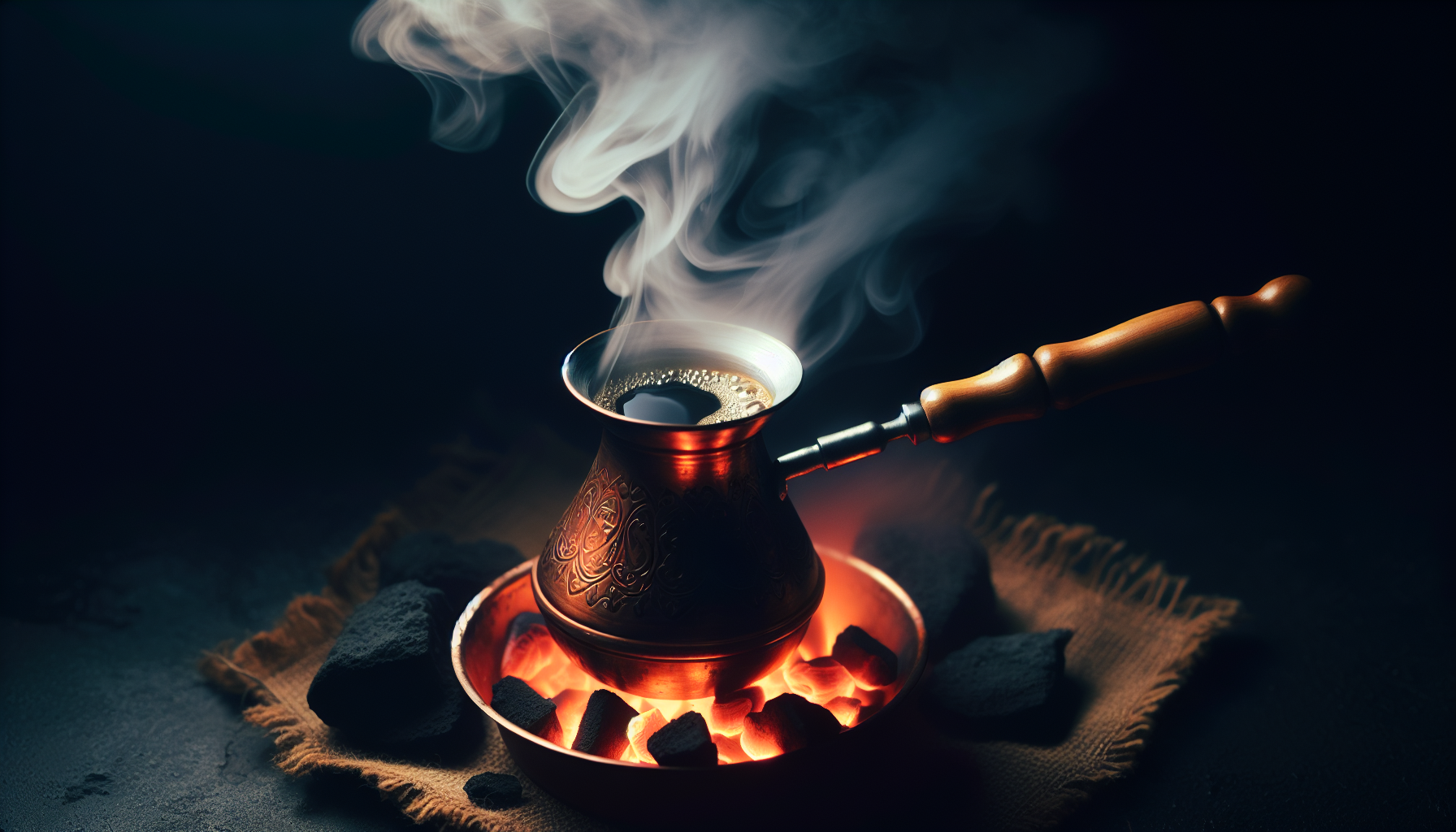
The cezve — humanity’s first standardised brewing vessel — has barely changed in 500 years
The cezve spread westward as Ottoman influence expanded and as coffee itself became a trade commodity. European merchants encountered it in Cairo and Aleppo, brought it home, and for roughly two hundred years it remained the dominant — sometimes the only — brewing technology available to most of the world.
Science Enters the Kitchen (1830–1908)
The Industrial Revolution did not just change factories. It changed kitchens. By the early nineteenth century, advances in glassblowing, metallurgy, and the new discipline of food chemistry began producing inventors who looked at the cezve and saw room for improvement.
1830 — The Syphon
The first major challenger was the syphon, or vacuum pot, invented by Loeff of Berlin around 1830 and refined by various French and Scottish engineers over the following decades. The device looks more like a chemistry set than a coffee maker: two glass chambers stacked vertically, connected by a tube. Water in the lower chamber heats and rises by pressure into the upper chamber, where it steeps with grounds. When the heat is removed, a partial vacuum forms and pulls the brewed coffee back down through a filter.
The syphon introduced a principle that would recur throughout coffee history: separation of brewing from grounds. By using physics rather than gravity or muscle to filter the coffee, it produced a remarkably clean, bright cup. It was a laboratory technique applied to a domestic ritual — and it was enormously fashionable in Victorian parlours precisely because it was theatrical.
1884 — Espresso
The next leap was industrial in ambition. At the Turin General Exhibition in 1884, Angelo Moriondo patented a machine that used steam pressure to force hot water through packed coffee grounds in a matter of seconds. This was the first espresso machine — though the term espresso (meaning “expressed” or “pressed out”) came later, and Moriondo’s device was a commercial apparatus for serving many cups quickly, not the precision instrument we know today.
Over the following decades, Luigi Bezzera and Desiderio Pavoni refined the design, reducing the single-cup brew time and developing the portafilter that remains the basis of espresso machines today. By applying pressure of seven to nine atmospheres, espresso fundamentally changed what coffee could taste like — extracting compounds unavailable to gravity-fed methods and producing the concentrated, crema-topped shot that would become the foundation of the entire modern café industry.
1908 — Paper Filtration
Across the Alps, in Dresden, a housewife named Melitta Bentz was frustrated. The linen and cloth filters used for drip coffee at the time were expensive, difficult to clean, and left grounds in the cup. In 1908, she cut a circle from her son’s school blotter, placed it in a perforated brass pot, and poured hot water over coffee grounds. The paper absorbed oils and trapped sediment. The result was a cup cleaner than anything available commercially.
Bentz patented her design, founded Melitta Bentz KG, and sold 1,200 filters at the Leipzig trade fair that same year. Paper filtration was not merely a convenience — it was a flavour philosophy. By removing the oils that a French press or cezve would retain, paper filters created a lighter, more transparent style of coffee that would eventually evolve into the modern pour-over and drip coffee traditions.
Household Icons (1929–1941)
The interwar period was remarkable for producing three objects so well-designed that they became permanent fixtures of kitchens worldwide — each with its own distinct flavour philosophy.
1929 — The French Press
Italian designer Attilio Calimani patented the French press in 1929, though a nearly identical device had been sketched (but not patented) by Frenchmen Mayer and Delforge in 1852. The mechanism is elegantly simple: coarse coffee steeps in hot water in a cylindrical glass carafe, and a metal mesh plunger is pressed down to separate grounds from liquid before pouring.
The French press is the purist’s brewer. No paper filter means no barrier between the cup and the coffee’s natural oils, producing a full-bodied, texturally rich brew with a slight sediment. Grind size and steep time are the only variables — which makes it both forgiving for beginners and deeply expressive for experts who want to dial in a specific character.
1933 — The Moka Pot
Alfonso Bialetti had a similar insight in 1933, but pushed it in a different direction. His moka pot used steam pressure — though far less than a commercial espresso machine — to force water upward through coffee grounds packed into a metal filter basket. The result was a concentrated, intense brew that Italians immediately adopted as their domestic espresso substitute.
The Bialetti Moka Express became one of the best-selling consumer products in Italian history, with an estimated 330 million units sold worldwide. Its design — the octagonal aluminium body, the safety valve, the expressionist figure of “l’omino con i baffi” (the little man with the moustache) — is so recognisable that it has been exhibited in the Museum of Modern Art in New York. Form and function achieved in aluminium, unchanged since 1933.
1941 — The Chemex
Peter Schlumbohm was a German-American chemist with a gift for design and a contempt for mediocre coffee. In 1941, he created the Chemex — a single piece of heat-resistant borosilicate glass shaped like an hourglass, with a wooden collar and leather tie as its only concession to domesticity. It used proprietary paper filters twenty to thirty percent thicker than standard filters, removing even more oils than Melitta’s design and producing a strikingly clean, light-bodied cup.
The Chemex was immediately recognised as a design object. It entered the permanent collection of the Museum of Modern Art in 1943, two years after its invention. But it was also a flavour statement: Schlumbohm believed that the purest extraction came from slow, controlled pouring over heavy paper, a principle that anticipated the third-wave pour-over movement by six decades.
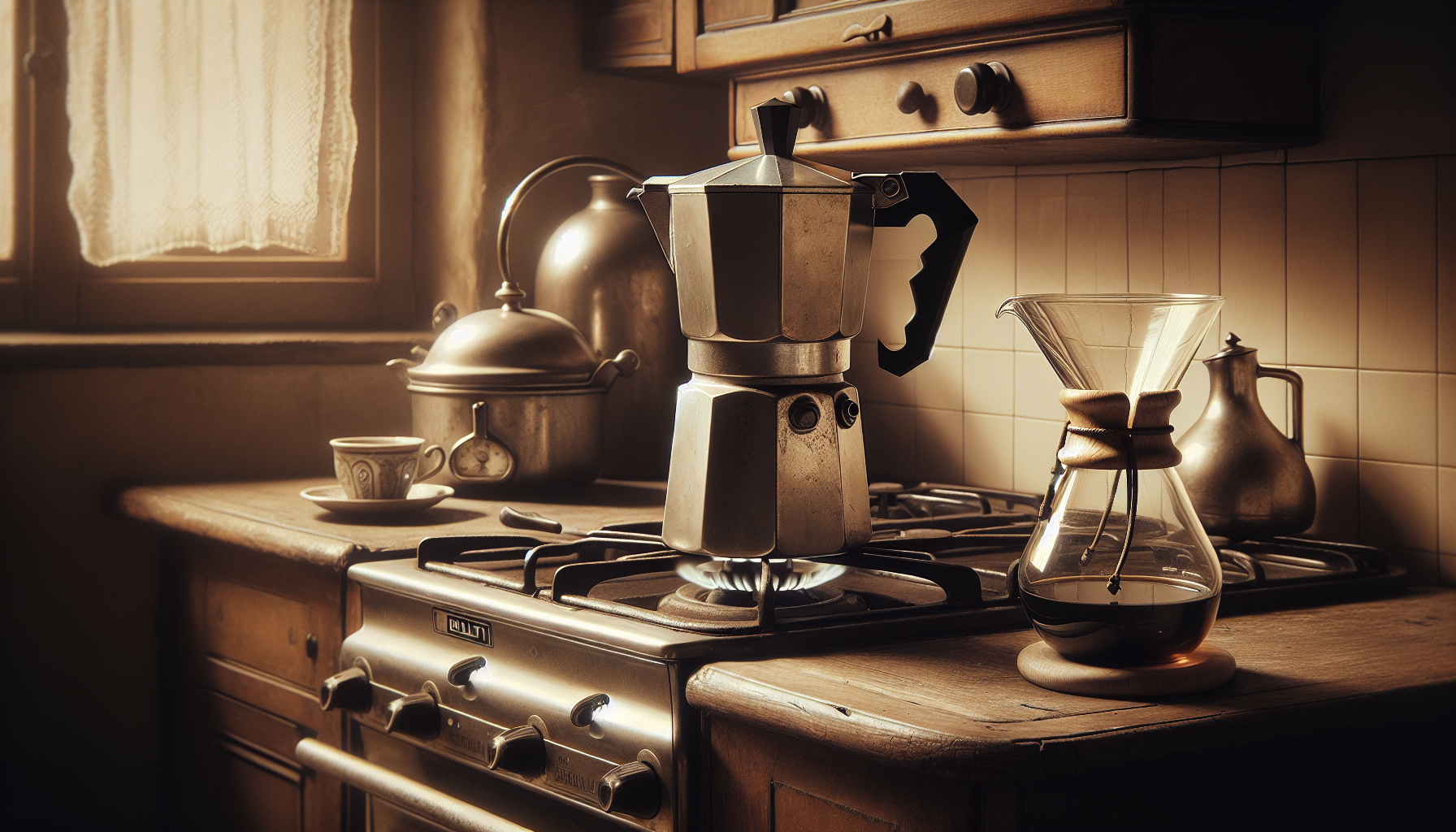
The moka pot and the Chemex — born within eight years of each other, representing opposite ends of the body-versus-clarity spectrum
The Modern Era (2005 and Beyond)
For six decades after the Chemex, the fundamental vocabulary of brewing changed very little. Espresso machines grew more sophisticated and more expensive. Drip coffee makers became ubiquitous. The French press found its way into every student flat in Europe. But no genuinely new brewing principle emerged — until 2005.
2005 — The AeroPress
Alan Adler was sixty-nine years old and had already invented the Aerobie flying ring. Dissatisfied with how poorly his drip machine brewed a single cup, he spent a year experimenting in his garage and arrived at a device that combined immersion steeping with air-pressure filtration: the AeroPress. A plastic tube, a plunger, and a paper or metal microfilter — the entire apparatus fits in a coat pocket and costs less than forty dollars.
What nobody anticipated was how radically versatile it would be. By adjusting grind size, water temperature, steep time, and whether to brew upright or inverted, you can produce anything from a clean, bright cup resembling a light pour-over to a thick, concentrated shot approaching espresso. The World AeroPress Championship — held annually since 2008 — regularly features recipes that push the device’s parameters to extremes its inventor never imagined.
The AeroPress did not just add a new tool to the kit. It demonstrated that the established methods were not the only possible methods — that a garage inventor with no background in coffee could rethink an ancient problem and produce something genuinely new.
Third Wave and Precision Brewing
The AeroPress arrived alongside the third-wave coffee movement, which reframed specialty coffee as an agricultural product with terroir rather than a commodity. This cultural shift produced new investment in technique: refined pour-over methods (the V60, the Kalita Wave), dialled-in water chemistry, single-dose grinders with flat burrs, and precise temperature control. Tools that had always been available to professionals — refractometers measuring extraction yield, scales accurate to a tenth of a gram — moved into home kitchens.
What Comes Next
The trajectory is clear: brewing is becoming more precise, more data-informed, and — paradoxically — more accessible. Several trends are converging.
Cold brew science has moved beyond simple overnight immersion. Pressurised cold extraction and nitro infusion are producing cold coffees with flavour profiles and textures previously impossible at low temperatures.
Precision espresso is undergoing a revolution driven by flow profiling — the ability to vary pressure throughout a shot rather than holding it constant at nine bars. Machines that graph extraction in real time, and AI systems that analyse shot variables and suggest adjustments, are moving from research labs into serious home setups.
Automated pour-over machines like the Ratio and the Fellow Aiden now replicate hand-pour technique — bloom, pulsed pours, precise timing — with consistency that rivals trained baristas. They represent a synthesis of the Chemex’s flavour philosophy and modern engineering.
None of these innovations invalidate the cezve. The same method that served the coffeehouses of sixteenth-century Constantinople still produces a cup that no pressure-profiling espresso machine can replicate. The history of coffee brewing is not a story of obsolescence. It is a story of accumulation — each century adding tools to a kit that grows richer without discarding what came before.
The perfect cup has always been the goal. The methods are just the centuries’ attempts to find it.
Related Topics
Turkish Coffee (Cezve/Ibrik)
One of the oldest brewing methods in existence, Turkish coffee is prepared in a cezve with ultra-fine grounds and earned UNESCO Intangible Heritage status in 2013.
brewingSiphon (Vacuum Brewer)
Part science experiment, part theatrical performance, the siphon brewer uses vapor pressure to create an exceptionally clean and complex cup of coffee.
getting-startedFrench Press
French press coffee steeps ground beans in hot water for 4 minutes, producing rich, full-bodied cups with velvety texture and deep, rounded chocolate flavour.
getting-startedEspresso
Espresso forces near-boiling water through finely ground coffee at 9 bars of pressure — producing concentrated, crema-topped shots in 25 to 30 seconds.