 English
  Українська
  Čeština
 The Laboratory on Your Countertop
Few brewing methods can stop a room full of people mid-conversation the way a siphon brewer does. With its twin glass globes, open flame, and coffee that appears to defy gravity — rising, steeping, and then draining back down as if pulled by an invisible hand — the siphon (also called a vacuum brewer or vac pot) occupies a singular place in coffee culture. It is simultaneously one of the oldest mechanical brewing devices and one of the most visually spectacular, producing a cup of remarkable clarity and complexity that rewards the extra effort it demands. Where a French press embraces simplicity and body, the siphon chases transparency and nuance — every volatile aromatic compound laid bare in the cup.
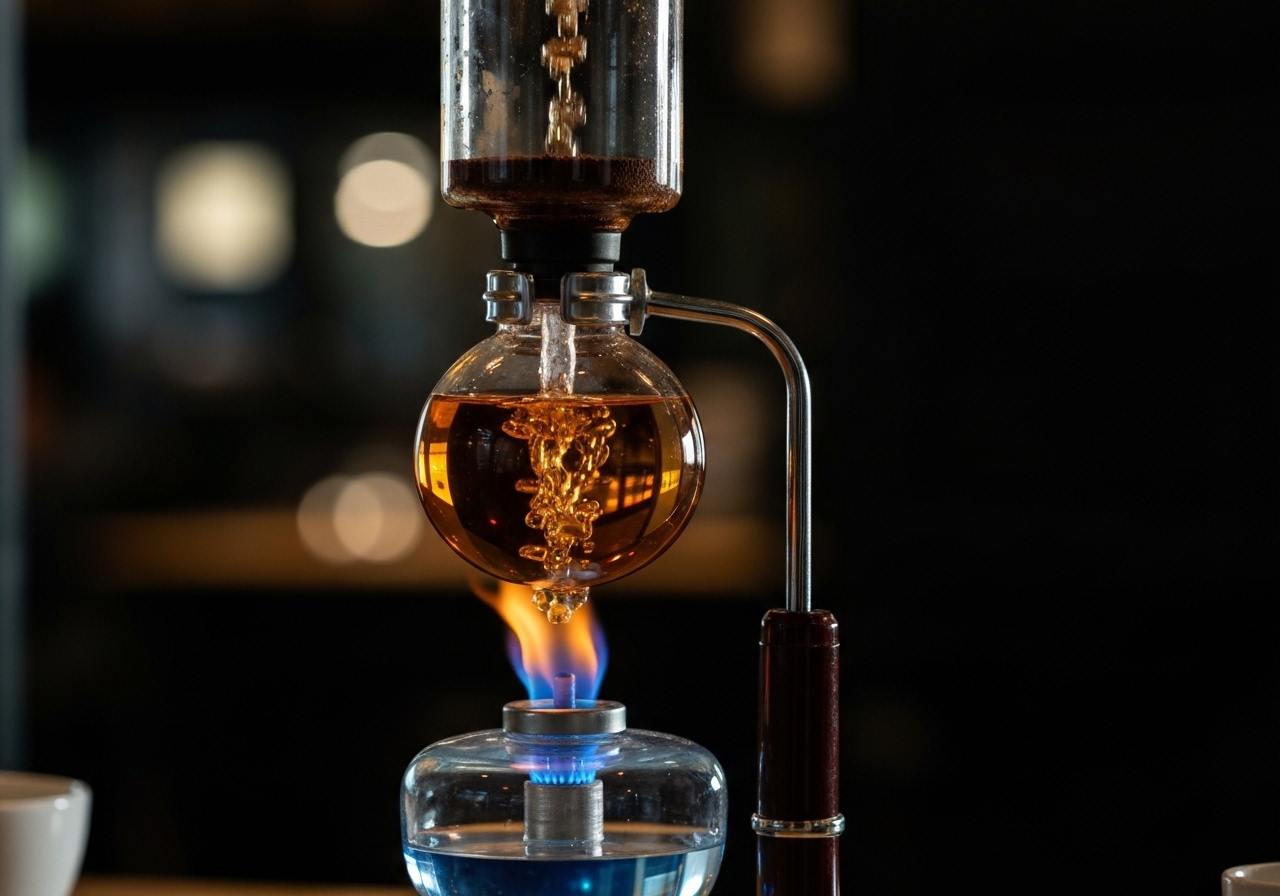
The siphon brewer — equal parts chemistry apparatus and coffee maker, it transforms brewing into performance
From 1830s Germany to Modern Japan
The vacuum brewing principle was first patented by Loeff of Berlin in the 1830s, though it was a French woman, Marie Fanny Amelne Massot (known as Madame Vassieux), who received a widely recognised patent for a two-chamber vacuum brewer in 1840. Throughout the nineteenth century, variations proliferated across Europe — ornate tabletop models in silver and brass graced Viennese coffeehouses and English drawing rooms alike. The design fell out of everyday favour in the West as drip machines and espresso took hold in the twentieth century, but Japan embraced the siphon with a devotion unmatched anywhere else in the world. By the mid-twentieth century, siphon brewers had become the defining symbol of the Japanese kissaten — the traditional coffee house where precision, craft, and quiet ritual are paramount.
The Physics of Vapor Pressure
Understanding how a siphon works requires only a passing acquaintance with basic physics, but watching it happen feels like witnessing something close to magic. The device consists of two chambers: a lower globe filled with water and an upper chamber fitted with a cloth or paper filter. A heat source — traditionally a spirit burner or halogen lamp — heats the water in the lower globe. As the water temperature rises, the increased vapor pressure in the sealed lower chamber forces the water upward through a narrow tube into the upper chamber, where the ground coffee waits. Once the heat is removed, the lower chamber cools, the vapor pressure drops, and the resulting vacuum draws the brewed coffee back down through the filter into the lower globe, leaving the spent grounds behind. The entire cycle — ascent, immersion, descent — takes roughly five to eight minutes and produces a brew of extraordinary cleanliness.
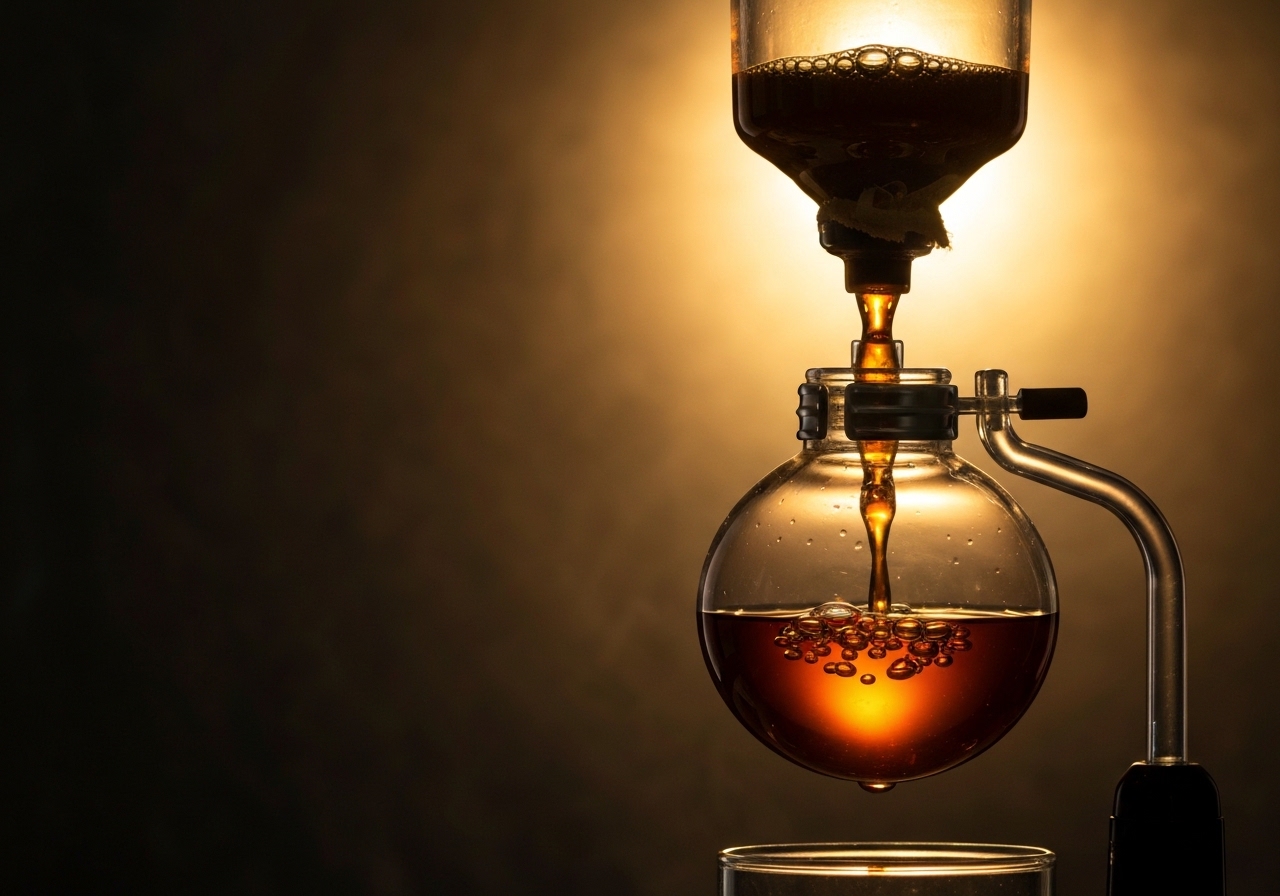
Water rises into the upper chamber through vapor pressure — the same physics that governs steam engines, now making your morning cup
Full Immersion, Clean Extraction
The siphon is technically a full-immersion brewer, like the French press, because the coffee grounds are fully submerged in water during the steeping phase. Yet the resulting cup tastes nothing like a press pot. The cloth filter (or fine paper filter in some models) removes virtually all sediment and most of the oils, producing a body closer to a pour-over or Chemex than to an immersion brew. What distinguishes the siphon is the combination of full immersion contact time with aggressive filtration and a relatively high brewing temperature — typically 92°C to 96°C maintained throughout the steep. This combination extracts a wide spectrum of flavour compounds while keeping the cup impeccably clean. Light-roasted single origins from Ethiopia or Kenya shine in the siphon, their floral and citrus notes emerging with startling clarity. As James Hoffmann writes in The World Atlas of Coffee, the siphon “produces a strikingly clean cup, closer to a cupping bowl than any other brewer — a useful quality when you want to taste a coffee honestly.”

The siphon cup — crystalline clarity, vibrant aromatics, and a body that is present but never heavy
Japanese Kissaten Culture
Nowhere has the siphon been more revered than in the kissaten — Japan’s traditional coffee houses, many of which have operated continuously since the 1950s and 1960s. In a kissaten, the siphon is not a novelty; it is the standard. A single barista may tend to a row of halogen-heated siphons with meticulous focus, adjusting flame height, stirring technique, and steep time for each coffee. The ritual is unhurried, precise, and deeply respectful of the bean. Shops like Chatei Hatou in Tokyo and Café de Lambre in Ginza have become pilgrimage sites for coffee enthusiasts worldwide, their siphon-brewed cups setting a benchmark for what clean, carefully prepared coffee can be. The kissaten tradition influenced the broader third-wave movement and remains a quiet reminder that specialty coffee did not begin in Portland or Melbourne — Japan was decades ahead.
Halogen vs. Spirit Burner
The heat source matters more than most siphon beginners expect. Traditional alcohol spirit burners are inexpensive, portable, and atmospheric — the dancing blue flame is part of the theatre — but they offer imprecise temperature control and can produce soot on the lower globe. Halogen beam heaters, popularised in Japanese kissaten, provide far more consistent and adjustable heat. The beam targets the bottom of the globe directly, producing a more even and controllable rise. Some modern siphon enthusiasts use butane micro-burners or even electric heating elements for laboratory-grade control. The choice of heat source does not dramatically alter the cup profile, but it affects the brewer’s ability to reproduce results consistently — and consistency, as any seasoned barista will tell you, is where craft meets discipline.

The kissaten tradition — where siphon brewing is not performance but quiet daily practice, repeated with care for decades
Why It Matters
The siphon brewer will never be the most convenient way to make coffee. It requires specialised equipment, careful attention, and a willingness to clean cloth filters and handle fragile glass. It is slower than a pour-over and more involved than any drip machine. But that is precisely the point. The siphon asks you to be present — to watch water rise, to stir gently, to listen for the moment the vacuum pulls the brew back down. In return, it delivers a cup of coffee that reveals layers of flavour most methods simply cannot access: clean, aromatic, complex, and utterly transparent. For those who believe that the process of making coffee is as meaningful as drinking it, the siphon is not an inconvenience. It is the destination.
Further Reading
- The World Atlas of Coffee by James Hoffmann — covers siphon brewing principles and Japanese coffee culture
- Craft Coffee: A Manual by Jessica Easto — practical guidance on siphon technique, grind, and temperature
- Coffee Obsession by Anette Moldvaer — includes siphon recipes and the history of vacuum brewing
- SCA Brewing Standards — extraction targets applicable to siphon and all manual brewing methods
Related Topics
What is Coffee Brewing?
Coffee brewing extracts soluble flavour from roasted grounds using water — and grind size, temperature, time, and ratio all determine whether the cup sings or disappoints.
brewingPour Over
Pour-over is a manual coffee brewing method using paper filters and controlled water flow, producing clean, nuanced cups that reveal single-origin character.
getting-startedFrench Press
French press coffee steeps ground beans in hot water for 4 minutes, producing rich, full-bodied cups with velvety texture and deep, rounded chocolate flavour.
brewingChemex
A design icon since 1941, the Chemex uses thick bonded filters to produce an ultra-clean, bright cup that highlights the delicate nuances of light-roasted coffee.