 English
  Українська
  Čeština
 Before the roaster touches a coffee, before the picker selects a cherry, before the farmer even plants a seed, the land is already writing the coffee’s flavour. Altitude imposes itself on sugar development. Soil chemistry shapes what minerals the roots can access. Rainfall patterns determine cherry density. The angle of the sun at harvest determines what acids have time to develop. All of this — the full physical and climatic context of where a coffee grows — is what we mean by terroir, a word borrowed from wine but no less apt for coffee.
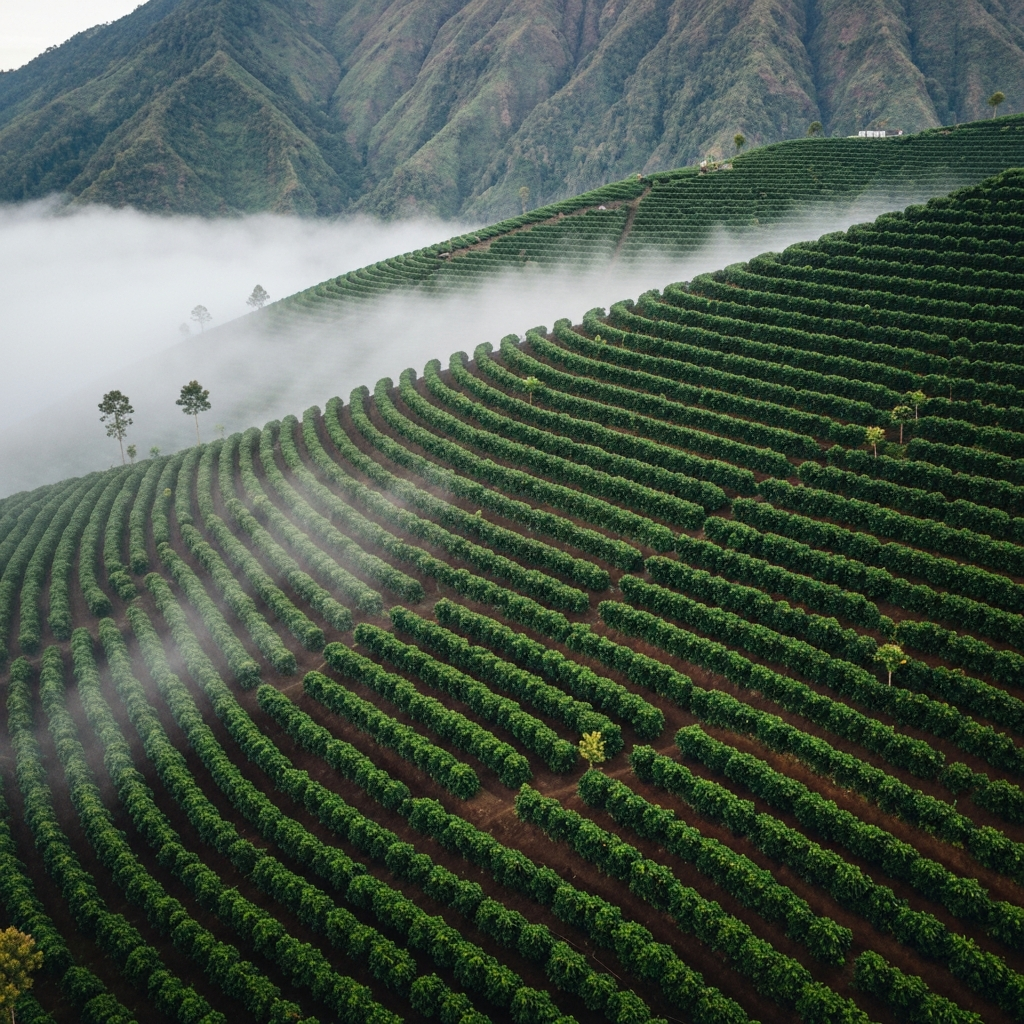
The slope, the mist, the volcanic soil beneath — everything visible in this landscape is influencing the flavour of the coffee growing in it
Altitude: The Single Biggest Variable
Of all the factors that constitute terroir, altitude is the most reliable predictor of cup character and the most frequently cited on specialty coffee packaging. The reason is straightforward thermodynamics: as altitude increases, temperature decreases. For every 100 metres of elevation gain in tropical regions, temperatures drop roughly 0.5–0.65°C. This temperature reduction slows the ripening of coffee cherries, extending the maturation period from what might be six months at low altitude to nine or more months at 2000 metres.
This extended slow ripening has profound consequences. Sugars accumulate more gradually and in greater complexity. Organic acids — citric, malic, tartaric — have time to develop fully without being degraded by heat. The cherry builds density: high-altitude beans are typically harder, denser, and more soluble than their low-grown counterparts, which means they extract more readily and produce more complex cups. The SCA’s quality grading does not formally include altitude, but in practice, the highest-scoring lots almost invariably come from high-grown farms.
The commonly cited thresholds are: below 1200 metres (lower-altitude, lower-complexity — more suited to commercial grades), 1200–1500 metres (good quality, moderate complexity), and above 1500 metres (specialty quality, high potential). Truly exceptional coffees — the lots that score 90 or above — are often grown above 1800 metres, sometimes above 2000. Ethiopia’s best Yirgacheffe and Guji lots, Colombia’s Huila and Nariño departments, and Kenya’s Aberdare Range all operate at these elevations.
Soil: Chemistry Beneath the Surface
Soil composition influences which minerals coffee plants can access, which affects cellular structure, biochemistry, and ultimately flavour. Volcanic soils — common in Ethiopia, Kenya, Guatemala, Costa Rica, and Colombia — are typically rich in potassium, phosphorus, and trace minerals, and they drain well while retaining moisture: conditions that stress the plant productively, encouraging root depth and nutrient uptake. Coffee grown in volcanic soils often shows unusual clarity and mineral brightness in the cup.
Loamy, well-drained soils with good organic matter content support steady root growth. Sandy or compacted soils tend to produce weaker root systems and less consistent results. Soil pH matters too: coffee prefers a mildly acidic soil around 6.0–6.5 pH. This is not incidental — it affects how the plant metabolises nutrients and what organic acids it produces.
The relationship between soil and cup is harder to isolate than altitude because so many other variables operate simultaneously. But side-by-side tastings of coffees from adjacent farms at the same altitude, sharing the same variety and processing method but sitting on different soil types, can reveal distinct differences — a finding that informs why farmers and importers increasingly track and publish soil analysis data alongside cup scores.
Climate and Microclimate
Rainfall distribution across the year shapes the coffee plant’s growth cycles. Most coffee-growing regions experience distinct wet and dry seasons; the dry season encourages flowering, and the subsequent rains trigger cherry development. Regions with well-defined seasonal patterns tend to produce more uniform harvests than those with erratic rainfall.
Temperature range matters as much as absolute temperature. Regions with cool nights and warm days — typical of highland tropical zones — create a diurnal temperature variation that many producers believe stresses the plant beneficially, slowing development and increasing sugar concentration. This is part of why coffees from countries like Colombia, where both sides of the Andes create microclimatic complexity, can show such remarkable diversity: two farms separated by a single ridge may have significantly different temperature profiles.
Shade cover creates microclimate within a farm. Traditional shade-grown coffee, planted under a canopy of native trees, experiences more stable temperatures, higher humidity, and different wind exposure than sun-grown coffee. Beyond environmental benefits, shade has sensory implications: slower development, more complex acids, less reliance on chemical inputs. Many of the world’s most celebrated single-origin coffees come from farms that manage shade deliberately as part of their quality approach.
Terroir and Processing
It is important to understand what terroir is not: it is not the whole story. The same farm, growing the same variety at the same altitude, can produce dramatically different cups depending on processing method, harvest timing, and post-harvest handling. Terroir sets the ceiling of what a coffee can become; everything that happens after the cherry is picked determines whether that ceiling is reached.
This is why washed processing is often described as terroir-transparent — by removing the fruit’s influence, it allows the farm’s inherent character to express itself most directly. Natural and honey processing are terroir-translating — they add layers of flavour that can amplify or complement the origin character, but can also obscure it.
Where to Go Next
- Coffee Altitude and Terroir — a deeper exploration of how elevation shapes cup character
- Coffee Processing Methods — understand what terroir expression looks like through different processing lenses
- What Is a Coffee Cherry? — the biology of the plant that translates terroir into flavour
Related Topics
Coffee Altitude & Terroir: How Elevation Shapes Flavor
Altitude is the single most reliable predictor of coffee quality. Learn how elevation shapes bean density, acidity, sugar development, and why terroir matters in the cup.
getting-startedThe Coffee Belt
The Coffee Belt spans the tropics between Cancer and Capricorn, home to all 70 coffee-growing nations and every Arabica and Robusta variety on Earth.
getting-startedWhat Is a Coffee Cherry?
Before it becomes a bean, coffee is a fruit — a bright, sweet cherry that grows on trees, takes nine months to ripen, and contains the seeds we roast. Here is the full biology.
getting-startedCoffee Processing Methods: Washed, Natural, Honey
How coffee is processed after harvest — whether the fruit is removed before or after drying — is one of the most powerful shapers of flavour in the cup.