 English
  Українська
  Čeština
 Grind Size Guide: How Particle Size Shapes Your Cup
Every brew method has a dial hidden in plain sight. It is not the water temperature, the ratio, or the pour technique — it is the grind. Particle size is the primary lever governing how fast water extracts coffee’s soluble compounds, which compounds it extracts first, and what you taste in the cup. Get it right and a mediocre coffee can punch well above its weight. Get it wrong and even exceptional beans will disappoint.
This guide covers what grind size actually does to your coffee, which grinder type you need, the right setting for every major brew method, and how to diagnose and fix a bad grind.
Why Particle Size Controls Extraction
Coffee extraction is a diffusion process: water dissolves and carries away soluble compounds from the surface of each coffee particle. The smaller the particle, the greater the total surface area exposed to water — and the faster extraction proceeds.
Consider two extremes: grind your coffee to coarse sea-salt chunks and water barely penetrates the interior of each particle, pulling only the most soluble compounds from the surface. Grind to a fine powder and water is in contact with an enormous surface area simultaneously, dissolving compounds rapidly — including the bitter, high-molecular-weight ones that extract last.
This is why grind size and brew time are inseparable. Every brew method is calibrated for a specific contact time between water and coffee. Change the grind and you change the rate of extraction; if you do not compensate by adjusting contact time or flow rate, you shift from the extraction sweet spot.
The specialty coffee target is an extraction yield of 18–22% of the coffee’s dry mass dissolved into the cup. Grind size is the fastest way to move that number.
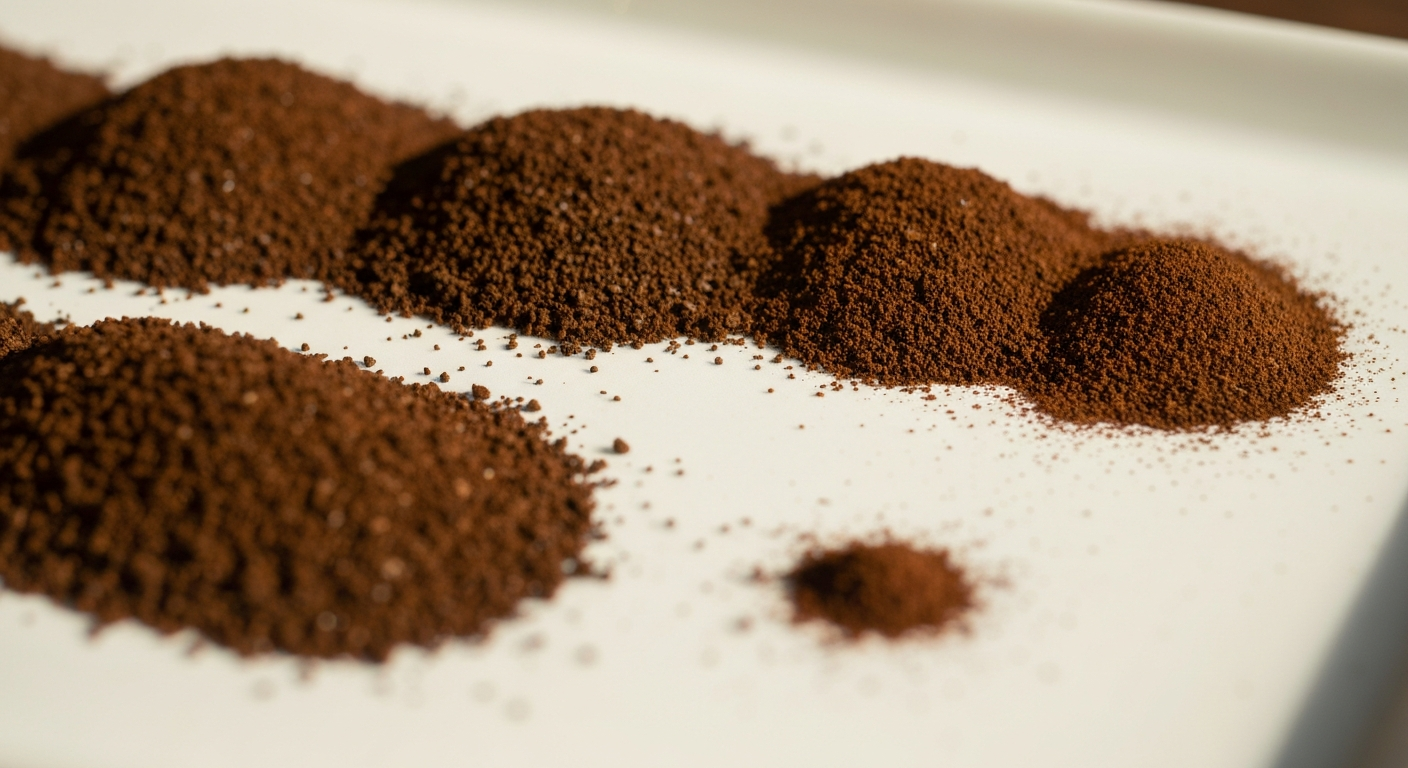
From coarse French press grounds on the left to fine espresso powder on the right — each size is optimised for a specific contact time and flow rate
Grinder Type: Why It Matters as Much as the Setting
Before discussing specific grind sizes, the tool you use to achieve them matters enormously.
Burr Grinders
A burr grinder crushes coffee between two abrasive surfaces — one fixed, one spinning — that are separated by a precise, adjustable gap. The result is a relatively uniform particle size distribution. Both flat burrs (two parallel rings) and conical burrs (a cone inside a ring) produce grounds with a predictable peak size and manageable fines content.
Burr grinders are the only grinders suitable for dialling in grind size with any consistency. The gap between burrs is your grind size setting: widen it for coarser grounds, narrow it for finer.
Blade Grinders
A blade grinder chops coffee like a blender — random, uncontrolled, and inconsistent. The result is a mix of powder and chunks in the same batch. This mixed particle distribution brews chaotically: fine particles over-extract while large chunks under-extract simultaneously, producing a cup that is simultaneously bitter and sour. There is no meaningful grind size setting to dial in; there is only duration, which you cannot translate reliably to extraction quality.
If you own a blade grinder, every other investment you make in coffee quality — better beans, better water, a gooseneck kettle — will be limited by it. A mid-range burr grinder is the single upgrade with the highest return on cup quality.
The Grind Size Spectrum
Extra-Fine (Finer Than Espresso)
Used for: Turkish coffee
Turkish coffee is boiled directly in a small pot (cezve) with no filtration. The grounds settle to the bottom of the cup after brewing. This requires a powder-fine grind — finer than espresso — so particles are small enough to sink completely and quickly. At this grind size, extraction is almost instantaneous on contact with hot water, which is why Turkish coffee is never boiled for long.
Target texture: talcum powder, barely gritty between fingertips.
Fine (Espresso Range)
Used for: espresso, moka pot
Espresso forces hot water through a compacted puck of coffee at 9 bars of pressure in 25–30 seconds. This extremely short contact time demands a very fine grind to achieve full extraction in that window. Espresso grind size is also the most sensitive to small adjustments — a change of a single grind step on a quality burr grinder can shift extraction yield by several percentage points and dramatically alter flavour.
The moka pot operates on similar principles without the pressure, and benefits from a grind slightly coarser than espresso — fine enough for good extraction in its short brew time, but not so fine it clogs the filter basket.
Target texture: fine sand, just slightly gritty. Not a powder, but it clumps when pressed.
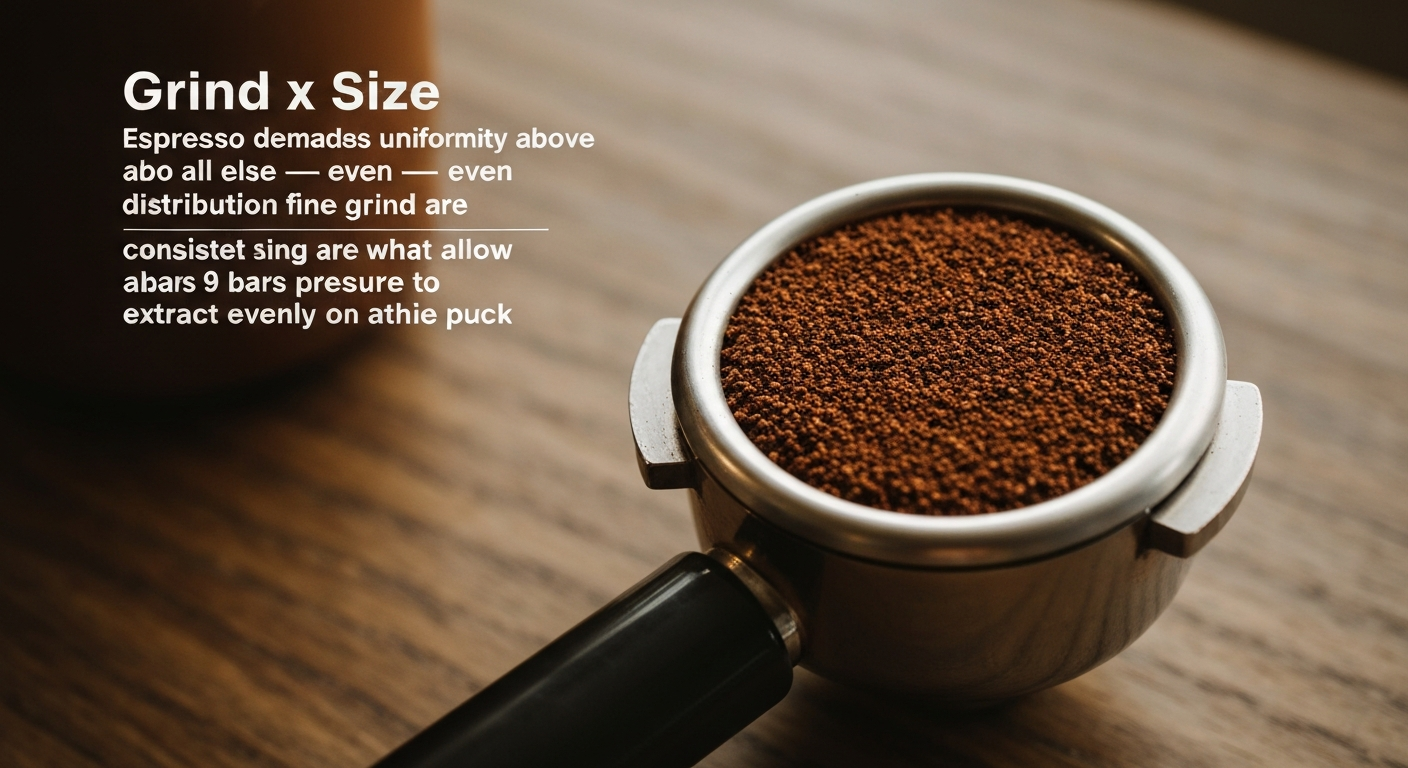
Espresso demands uniformity above all else — even distribution and a consistent fine grind are what allow 9 bars of pressure to extract evenly across the entire puck
Medium-Fine
Used for: V60, AeroPress (short brew), cone filter drippers
The V60 and similar cone drippers rely on gravity flow through a paper filter. Grind too coarse and water drains before extraction completes; too fine and the filter restricts flow, over-extracting into a bitter, slow brew. Medium-fine hits the sweet spot: a 2.5–3.5 minute total brew time for a 250ml cup.
AeroPress brewed on the shorter end (1–1.5 minute steep) also suits this range, though the AeroPress is exceptionally flexible and rewards experimentation.
Target texture: table salt. Distinct grains, not clumping.
Medium
Used for: flat-bed filter brewers (Kalita Wave, Chemex, batch brewers), AeroPress (longer steep)
The Chemex uses a thick paper filter that restricts flow more than a V60, so the grind is slightly coarser to maintain good flow rate. Flat-bed filter brewers like the Kalita Wave distribute water more evenly and are more forgiving of grind variation, but still benefit from this medium range.
Home batch brewers and drip machines — when using quality, fresh coffee — also target medium grind. Most drip machines cannot reach ideal brew temperatures anyway (93°C is the target; many cheaper machines max out at 80°C), so fine-tuning grind is especially important to compensate.
Target texture: coarse table salt or fine sea salt. Clearly distinct, dry-feeling grains.
Coarse
Used for: French press, cold brew, cupping
French press steeps coffee in direct contact with water for 4 minutes and uses a metal mesh filter that does not remove fine particles. A coarse grind minimises how much sediment passes through the mesh and keeps extraction in range over the long contact time. Grind too fine for a French press and you will over-extract — the result is bitter, heavy, and muddy.
Cold brew steeps for 12–24 hours at room temperature or refrigerator temperature. The cold water dramatically slows extraction, so an extremely long contact time is needed. Coarse grounds help ensure extraction does not overshoot into harsh territory during that extended steep.
Cupping (the professional evaluation method) also uses a coarse grind — roughly equivalent to French press — because the grounds steep directly in the bowl for 4 minutes and the method is standardised to isolate coffee quality rather than extraction skill.
Target texture: coarse sea salt or coarse breadcrumbs. Clearly chunky, airy.
Dialling In: How to Find Your Setting
Dialling in means systematically adjusting grind size until extraction is in the target range and the cup tastes the way the coffee should. Here is a method that works for any brew:
Step 1: Taste first, measure second. Brew with a starting grind, taste the result, and listen to what the cup is telling you. Under-extracted coffee (too coarse a grind) tastes sour, hollow, and watery — the sweet and bright compounds extracted, but the body-building and balancing compounds did not follow. Over-extracted coffee (too fine a grind) tastes bitter, harsh, dry, and astringent — everything extracted, including compounds that should have stayed in the grounds.
Step 2: Adjust one variable at a time. If the cup is sour and thin, move one grind step finer. If it is bitter and harsh, move one step coarser. Do not change ratio, water temperature, or pour technique at the same time — you will not know what caused the change.
Step 3: Bracket your target. Make the cup too fine (bitter), then too coarse (sour), then find the centre. This gives you the range specific to your grinder, your water, and your coffee’s roast level.
Step 4: Account for roast level. Light roasts are denser and require finer grinding than dark roasts to achieve equivalent extraction. If you switch from a dark to a light roast without adjusting, expect under-extraction. Move your setting finer by one or two steps and re-evaluate.
Step 5: Account for bean age. Fresh coffee (within two weeks of roast date) contains dissolved CO₂ that repels water slightly, slowing extraction. You may need to grind slightly finer for very fresh beans. As beans age and degass, extraction accelerates slightly — you may need to adjust coarser over weeks.
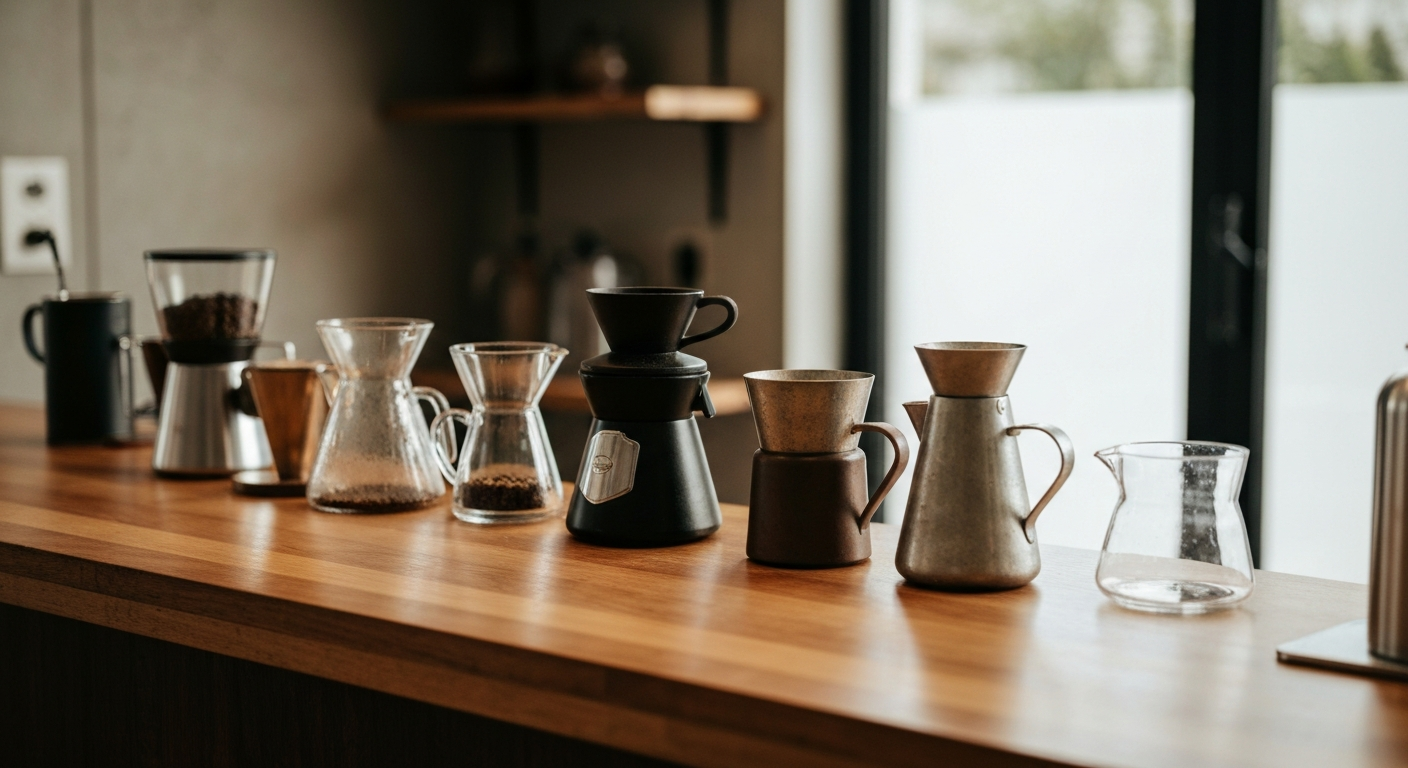
Each brew method in your rotation will likely need its own grind setting saved or memorised — track your settings and cup notes to build your personal dial-in log
Common Grind Problems and Fixes
Problem: The brew drains too fast (filter methods) or tastes sour and thin. Cause: Grind too coarse. Water passes through before extracting fully. Fix: Move grinder one step finer. If you hit resistance at the far fine end, check your dose — an underdosed brew also drains quickly.
Problem: The brew drains too slowly or chokes (espresso). Cause: Grind too fine. Resistance is too high. Fix: Move one step coarser. For espresso, also check that the puck is evenly distributed and not channelling.
Problem: The cup tastes simultaneously bitter and sour. Cause: Inconsistent grind — likely a blade grinder or worn burrs producing a bimodal distribution of very fine and very coarse particles. Both over- and under-extraction happen in the same brew. Fix: Upgrade to a quality burr grinder. If already using a burr grinder, check for worn or damaged burrs, and clean the grinder — old coffee oils build up on burrs and cause irregular grinding.
Problem: The grind sticks together or clumps. Cause: Static electricity (common in low-humidity environments) or high-moisture coffee. Fix: The Ross Droplet Technique: add a single drop of water to the beans before grinding. This grounds static and dramatically reduces clumping without affecting extraction.
Grind Size as a Starting Point
Grind size is powerful, but it never acts alone. It interacts with water chemistry, dose, brew ratio, water temperature, and time in a web of variables. Experienced brewers understand that grind is usually the first thing to adjust because it has the most immediate and legible effect on extraction — but the goal is always to read the cup and respond to what it tells you.
Master the relationship between grind size and extraction, and you will have an intuitive model for troubleshooting any brew method, with any coffee, from any origin.
Further Reading
- Hoffmann, J. (2014). The World Atlas of Coffee — Chapter 4: grinding and its effect on brewing
- Perger, M. Barista Hustle — extraction theory and grind distribution analysis
- Specialty Coffee Association — brew protocols including recommended grind parameters per method
- Extraction Yield — the science behind the 18–22% sweet spot and how to measure it
Related Topics
What is Coffee Brewing?
Coffee brewing extracts soluble flavour from roasted grounds using water — and grind size, temperature, time, and ratio all determine whether the cup sings or disappoints.
scienceExtraction Yield: The Science Behind a Perfect Cup
What extraction yield actually means, why 18–22% is the target, how TDS and brew ratio fit together, and how to diagnose and fix over- and under-extraction.
brewingPour Over
Pour-over is a manual coffee brewing method using paper filters and controlled water flow, producing clean, nuanced cups that reveal single-origin character.
getting-startedEspresso
Espresso forces near-boiling water through finely ground coffee at 9 bars of pressure — producing concentrated, crema-topped shots in 25 to 30 seconds.