 English
  Українська
  Čeština
 The Patience Method
Cold brew is the slowest, most hands-off way to make coffee — and for millions of drinkers, it is also the most refreshing. The concept is almost comically simple: combine coarsely ground coffee with cold or room-temperature water, wait half a day or longer, then strain. No kettle, no timer anxiety, no pouring technique. What you get in return is a concentrate that is remarkably smooth, naturally sweet, and so low in perceived acidity that people who find hot coffee harsh on the stomach often discover they can drink cold brew without complaint. It is the brewer that rewards patience over skill, and it has become the fastest-growing segment of the specialty coffee market for good reason.

Cold brew over ice — the long, slow steep produces a concentrate that is diluted to taste and served chilled
Time Replaces Heat
In every other brewing method — from espresso to pour-over — heat is the engine of extraction. Hot water dissolves flavour compounds from ground coffee quickly, which is why a pour-over takes three to four minutes and an espresso shot takes about thirty seconds. Cold brew flips that equation entirely. Without heat to accelerate dissolution, the water must work slowly, relying on time alone to coax flavour from the grounds. A typical cold brew steeps for 12 to 24 hours, and some recipes push even longer. The trade-off is spectacularly rewarding: the extended contact time extracts sweetness and body while leaving behind many of the compounds responsible for bitterness and sharp acidity.
The basic recipe is forgiving. Use a coarse grind — similar to what you would use for a French press — at a ratio of roughly 1:5 to 1:8 by weight (coffee to water) for a concentrate, or 1:12 to 1:15 for a ready-to-drink strength. Combine in any large vessel — a mason jar, a pitcher, a purpose-built cold brew tower — stir gently to ensure all grounds are saturated, cover, and refrigerate (or leave at room temperature for a slightly faster, fuller extraction). After steeping, strain through a fine-mesh sieve, cheesecloth, or paper filter to remove the grounds. The resulting liquid keeps well in the refrigerator for up to two weeks, though flavour is best within the first seven days.
Cold Extraction Chemistry
The smoothness of cold brew is not just a subjective impression — it has a chemical basis. Research published in Scientific Reports (2018) by Niny Rao and Megan Fuller at Thomas Jefferson University found that hot-brewed coffee contained higher concentrations of titratable acids than cold brew made from the same beans. Without heat to drive rapid extraction, certain chlorogenic acid compounds and other bitter-tasting molecules are extracted at significantly lower rates. The result is a beverage with a rounder, mellower flavour profile: less perceived acidity, more chocolate and caramel sweetness, and a syrupy body that feels almost dessert-like when made as a concentrate.
This reduced acidity is one reason cold brew has attracted drinkers who previously avoided coffee altogether. It is also why cold brew pairs beautifully with milk, cream, or plant-based alternatives — its inherent smoothness blends without the sharp, tannic clash that can occur when adding dairy to a bright, acidic hot brew.

Milk swirling into cold brew concentrate — the low acidity and heavy body make cold brew an exceptionally smooth base for milk drinks
Concentrate vs Ready-to-Drink
An important distinction that trips up beginners: cold brew concentrate and ready-to-drink cold brew are not the same thing. Concentrate is brewed at a high coffee-to-water ratio (1:5 or so) and is meant to be diluted before drinking — typically cut with equal parts water, milk, or ice. Drinking concentrate undiluted is not dangerous, but it is intensely strong and caffeine-dense. Ready-to-drink cold brew is brewed at a more conventional ratio (around 1:12 to 1:15) and can be enjoyed straight from the jar. Most commercial bottled cold brews are ready-to-drink, while most home recipes produce a concentrate because it stores more efficiently and offers flexibility — you can adjust the strength to taste with each glass.
Cold Brew vs Iced Coffee
Cold brew and iced coffee are frequently confused, but they are fundamentally different beverages. Iced coffee is simply hot-brewed coffee — made with any standard method — that is cooled and served over ice. It retains the full acidity and brightness of a hot brew, which can be delightful but also means it can taste thin or sour when the ice melts and dilutes it. Cold brew, by contrast, was never heated at all. Its flavour profile is distinct from the start: heavier, sweeter, less acidic. Neither method is superior — they serve different cravings. If you want a bright, complex iced drink that highlights origin character, iced coffee (or Japanese iced coffee, below) is the better path. If you want something smooth, strong, and low-acid, cold brew wins.

Cold brew (left) and iced coffee can look identical in the glass but taste remarkably different — one is brewed cold, the other brewed hot and cooled
Japanese Iced Coffee: The Bright Alternative
For those who love the convenience of a cold drink but miss the acidity and aromatic complexity that cold brew suppresses, Japanese iced coffee offers an elegant solution. The technique is straightforward: brew a pour-over or AeroPress at double strength directly onto a bed of ice, which flash-chills the coffee on contact. Because the coffee is brewed hot, it retains all the volatile aromatics and bright acid notes that cold extraction leaves behind — but because it is cooled instantly rather than left to oxidise and stale, the result is a clean, vibrant iced drink. As James Hoffmann writes in The World Atlas of Coffee, Japanese iced coffee is “the best way to experience the full spectrum of a coffee’s flavour in a cold format.” If your favourite beans are a light-roasted washed Ethiopian or a floral Gesha, Japanese iced coffee will showcase them far better than cold brew ever could.
Best Beans for Cold Brew
Cold brew’s gentle extraction and emphasis on sweetness and body mean it flatters certain coffees more than others. Medium to dark roasts work beautifully — their developed sugars and chocolate notes are amplified by the cold steep, while any roast-driven bitterness is softened. Natural-process coffees, which carry inherent fruitiness and heavy body from drying inside the cherry, are a spectacular match: expect deep blueberry, dark chocolate, and wine-like sweetness. Brazilian coffees — particularly those processed as naturals from regions like Cerrado or Sul de Minas — are a classic cold brew choice, offering nutty, chocolatey, low-acid profiles that the method amplifies into something approaching liquid dessert.
Light-roasted, high-acid single origins from Kenya or Ethiopia can be used for cold brew, but expect a muted version of their hot-brewed character. The sparkling citrus and jasmine notes that make these coffees famous require heat to fully extract — which is exactly why Japanese iced coffee exists.
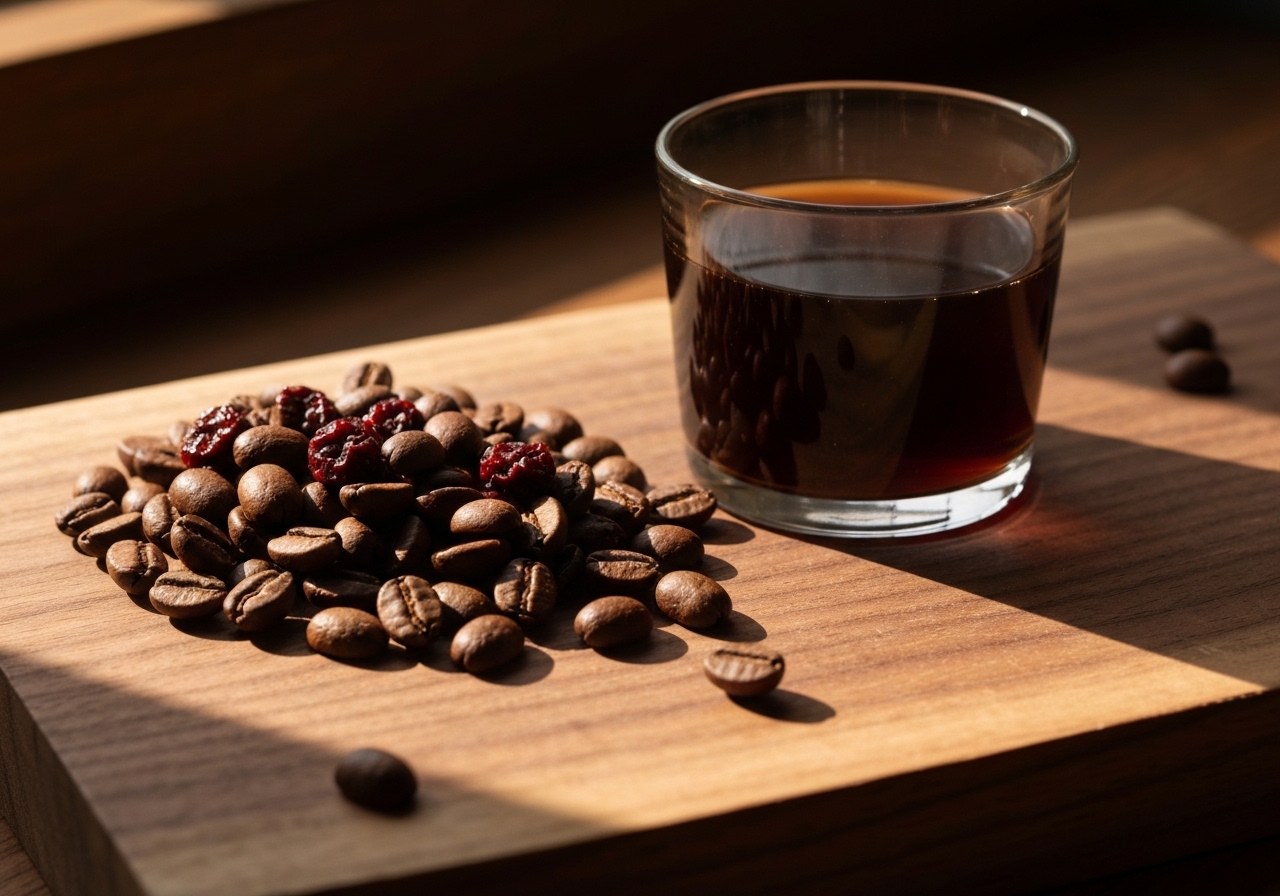
Natural-process beans with chocolatey, fruity profiles are the ideal starting point for cold brew
Why It Matters
Cold brew has done something quietly revolutionary: it has made coffee accessible to people who thought they did not like coffee. Its smoothness, its sweetness, its gentle stomach-friendliness have opened the door for millions of new drinkers. It has also reshaped the commercial coffee landscape — ready-to-drink cold brew is now a multi-billion-dollar category, available in supermarkets, petrol stations, and convenience stores worldwide. For home brewers, it remains the most forgiving method imaginable: no expensive equipment, no temperature precision, no learning curve beyond the ability to wait. That patience is the only ingredient that separates you from one of the most satisfying ways to drink coffee — especially when the weather turns warm and the thought of a hot kettle feels like an act of self-punishment.
Further Reading
- The World Atlas of Coffee by James Hoffmann — covers cold brew, Japanese iced coffee, and the science of extraction temperature
- Craft Coffee: A Manual by Jessica Easto — practical cold brew ratios and comparisons with other iced methods
- “Effect of brewing conditions on the antioxidant properties and pH of cold brew coffee” — Rao and Fuller, Scientific Reports (2018), the key study comparing cold and hot extraction chemistry
- SCA Brewing Standards — extraction targets that provide useful benchmarks for dialling in cold brew strength
Related Topics
What is Coffee Brewing?
Coffee brewing extracts soluble flavour from roasted grounds using water — and grind size, temperature, time, and ratio all determine whether the cup sings or disappoints.
getting-startedFrench Press
French press coffee steeps ground beans in hot water for 4 minutes, producing rich, full-bodied cups with velvety texture and deep, rounded chocolate flavour.
brewingAeroPress
Invented in 2005 by a Stanford engineer, the AeroPress combines immersion brewing with air pressure to produce a remarkably clean, versatile cup of coffee.
processNatural (Dry) Processing
Natural processing dries whole coffee cherries in the sun before milling — the oldest method, and the one most responsible for fruity, wine-like, and berry-forward cups.