 English
  Українська
  Čeština
 India occupies a singular position in the coffee world. It is one of the few countries with a genuinely dual heritage — producing significant volumes of both Arabica and Robusta, and doing so across dramatically different landscapes, from the misty Western Ghats to the rolling hills of the Eastern Ghats. India is the sixth-largest coffee producer globally, harvesting roughly 5 to 6 million 60-kilogram bags annually, and yet much of the specialty community overlooks it. That is a mistake. Indian coffee, at its best, offers a flavour experience unlike anything else on the planet — and the country’s most famous processing method, Monsooned Malabar, has no equivalent anywhere.
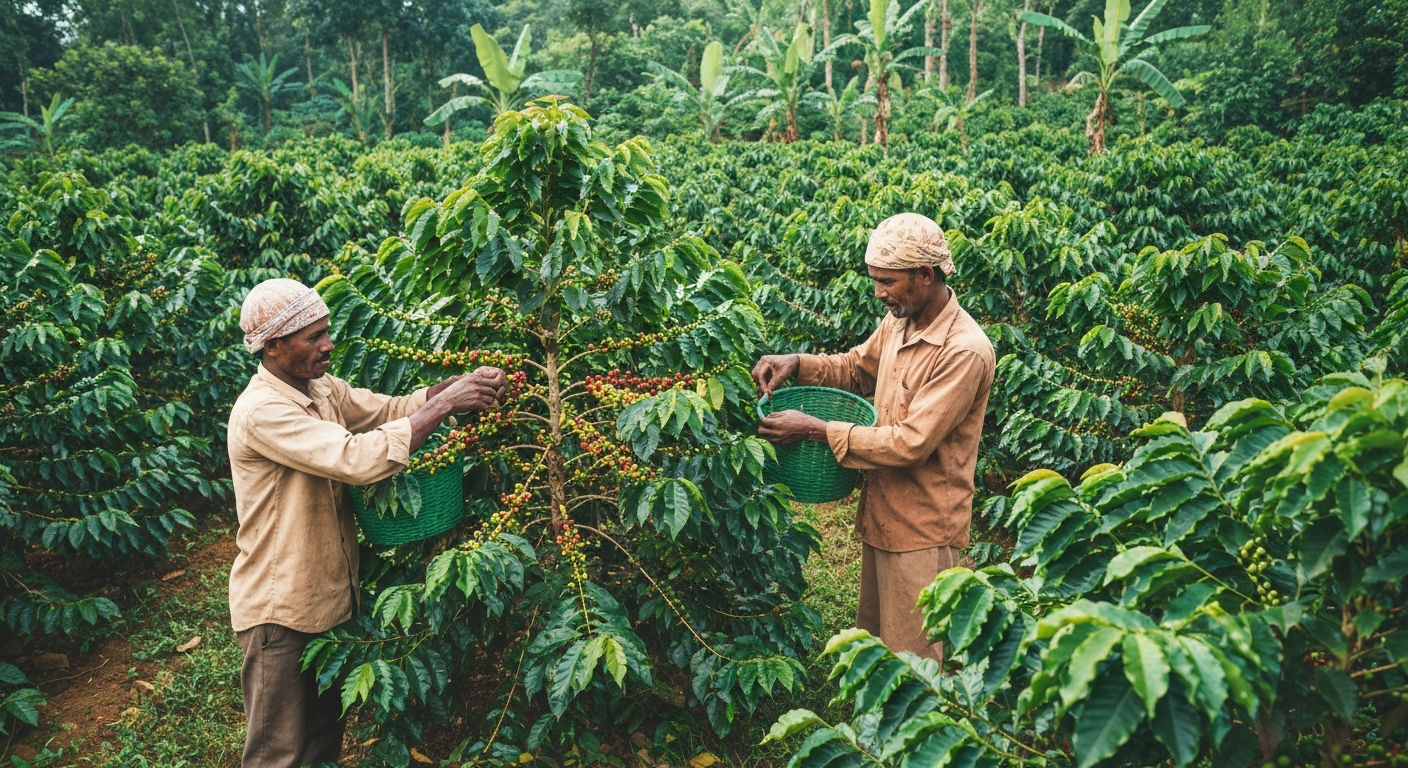
The Western Ghats — India’s primary coffee-growing region, where shade-grown Arabica thrives under a canopy of tropical forest
Coffee legend holds that an Indian Sufi saint named Baba Budan smuggled seven coffee seeds from Yemen in the 17th century, strapping them to his chest during the journey home. He planted them in the hills of what is now Chikmagalur, Karnataka — and those seven seeds became the foundation of an industry that today employs over 3 million people. Whether the story is precisely true matters less than what it reveals: India’s coffee roots run deeper than almost any other Asian producer.
Growing Regions
India’s coffee geography is dominated by three southern states — Karnataka, Kerala, and Tamil Nadu — which together account for over 95 per cent of production.
Chikmagalur and Coorg (Kodagu) in Karnataka are the historic heartlands. Chikmagalur, where Baba Budan’s original plantings took root, sits between 1,000 and 1,500 metres in the Western Ghats, and its estates produce the country’s most celebrated Arabica lots. Coorg, slightly to the south, is lush and intensely green, with heavy monsoon rainfall and dense shade canopies of silver oak and jackfruit trees. Indian coffee is almost universally shade-grown — a practice that slows cherry maturation, improves flavour complexity, and supports remarkable biodiversity.
Wayanad in Kerala is India’s Robusta heartland — lower-altitude, warmer, and wetter, producing full-bodied, earthy Robusta that forms the backbone of much of South India’s traditional filter coffee (kaapi). The Nilgiris and Shevaroy Hills in Tamil Nadu add higher-altitude Arabica with brighter acidity and more delicate aromatics.
India is one of the few origins where shade-grown, biodiverse coffee estates are the norm, not the exception. Many estates function as de facto wildlife corridors, supporting elephants, leopards, and hundreds of bird species alongside coffee production.
Varieties
India’s varietal landscape reflects its colonial and post-independence history. Kent, selected from Typica stock by an English planter named Mr. Kent in the 1920s on his Doddengooda estate, was India’s first major improved variety — prized for its disease resistance and clean, balanced cup. S795, a hybrid of Kent and an Ethiopian cultivar called S288, became the country’s most widely planted Arabica and produces a sweet, full-bodied cup with low acidity and notes of chocolate and spice.
Selection 9 (Sln.9), a cross between Ethiopian Tafarikela and the Timor Hybrid, offers rust resistance along with complex, fruity characteristics. Cauvery (Catimor), developed by India’s Coffee Board, provides high yields and disease resistance for smallholders. On the Robusta side, the CxR (Congensis x Robusta) selections and local Peridenia clones dominate, delivering the earthy, woody, grain-like intensity that characterises Indian Robusta.
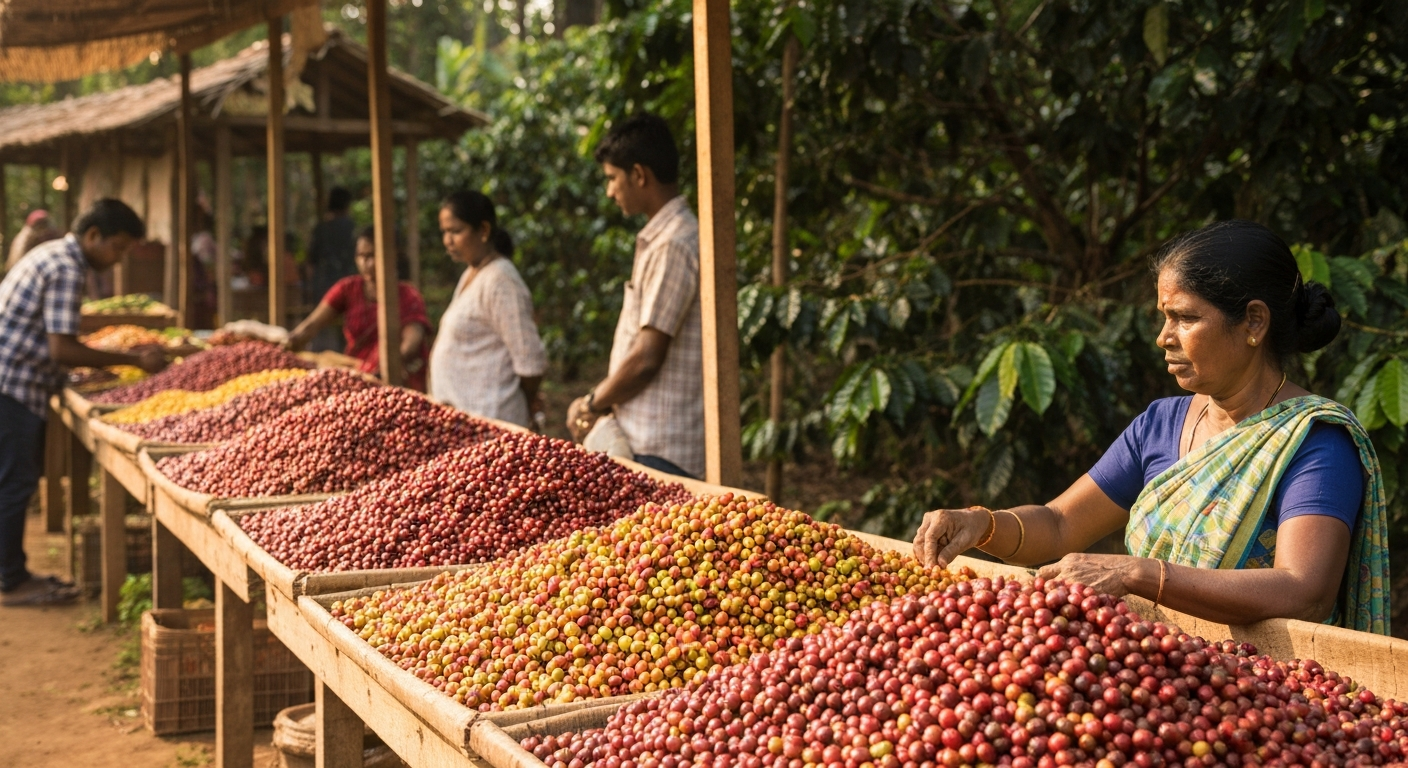
Arabica cherries ripening under shade canopy on a Chikmagalur estate — India’s shade-grown tradition is central to its flavour identity
Monsooned Malabar — A Process Like No Other
India’s most distinctive contribution to coffee is the Monsooned Malabar process, born from a historical accident. During the age of sail, green coffee shipped from India’s Malabar Coast to Europe spent months in the holds of wooden ships, exposed to constant moisture and sea air. By the time the beans reached their destination, they had swollen, turned pale gold, and developed a musty, pungent, low-acid character that European roasters grew to love. When steamships shortened the voyage and eliminated the effect, Indian producers deliberately replicated it.
Today, Monsooned Malabar is produced by exposing dried green Arabica beans to the moisture-laden southwest monsoon winds in open-sided warehouses along the Kerala and Karnataka coast for 12 to 16 weeks, typically June through September. The beans are spread on raised beds and raked regularly as they absorb atmospheric moisture, swelling to nearly double their original size and turning from green to a distinctive pale straw gold. The result is a heavy, syrupy cup with almost zero acidity — earthy, tobacco-like, with notes of cedar, dark chocolate, and dried fruit. It is utterly unlike any other coffee on Earth.
Monsooned Malabar has a devoted following among espresso blend builders, who use it to add body and roundness, and among drinkers who prefer a mellow, low-acid cup.
Flavour Profile and Buying Tips
Beyond Monsooned Malabar, Indian washed and natural Arabicas from high-altitude estates in Chikmagalur and the Nilgiris offer surprisingly elegant cups — medium body, gentle acidity, and flavour notes of milk chocolate, cardamom, sandalwood, and stone fruit. Indian Robusta, when well-processed, delivers a bold, earthy intensity that makes exceptional South Indian filter coffee and adds muscle to espresso blends.
When buying Indian specialty coffee, look for estate names (Ratnagiri, Bababudangiris, Sethuraman) and altitude designations. Washed Arabica from estates above 1,200 metres will offer the most complexity. For Monsooned Malabar, seek out Grade AA (the largest, most evenly monsoon-treated beans) from reputable exporters.
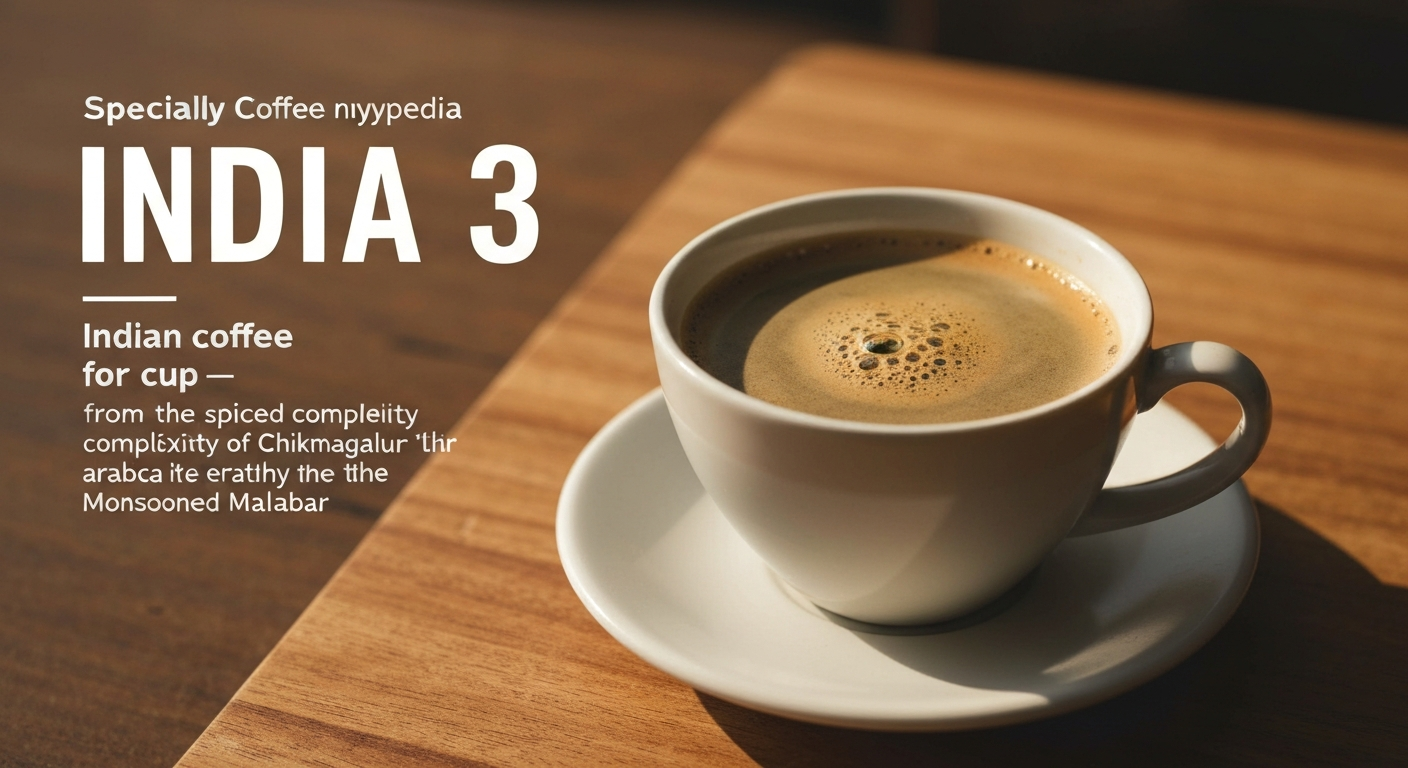
Indian coffee brewed for the cup — from the spiced complexity of Chikmagalur Arabica to the earthy depth of Monsooned Malabar
Why India Matters
India’s coffee industry stands at an inflection point. A new generation of estate owners and smallholder cooperatives is investing in specialty processing — honey lots, anaerobic fermentation, and single-variety micro-lots — that push Indian Arabica into territory previously associated with Central American and East African origins. At the same time, the country’s Robusta is gaining recognition in the fine Robusta movement, with carefully processed lots scoring well above 80 points.
As James Hoffmann observes in The World Atlas of Coffee, India “produces coffee that is genuinely unique, and the Monsooned Malabar process alone makes it one of the most interesting origins in the world.” For drinkers willing to look beyond the usual suspects, India offers depth, history, and a flavour palette all its own.
Further Reading
- The World Atlas of Coffee by James Hoffmann — overview of Indian growing regions, varieties, and the monsooning process
- Uncommon Grounds by Mark Pendergrast — historical context for Indian coffee and the colonial trade routes
- Coffee Board of India — production data, research, and estate profiles
- Specialty Coffee Association of India — industry news and specialty grading standards
Related Topics
Indonesia
The world's fourth-largest coffee producer, known for earthy Sumatran coffees and the unique wet-hulled processing method.
varietyRobusta (Coffea canephora)
Often dismissed but increasingly respected, Robusta is coffee's resilient workhorse — powering espresso blends, instant coffee, and a growing fine Robusta movement.
getting-startedWhat is Coffee Origin?
Coffee origin is the story of place — altitude, soil, and climate shape every flavour note. From Ethiopian florals to Colombian caramel and Kenyan citrus.
processNatural (Dry) Processing
Natural processing dries whole coffee cherries in the sun before milling — the oldest method, and the one most responsible for fruity, wine-like, and berry-forward cups.