 English
  Українська
  Čeština
 Colombia is synonymous with coffee. The country’s mountainous geography — three parallel Andean cordilleras running north to south, laced with river valleys and capped by volcanic peaks — provides an extraordinary range of microclimates and altitudes that make it one of the most versatile origins in the world. With production spread across 22 departments and roughly 540,000 coffee-farming families, Colombia is the third-largest global producer and the single largest producer of washed Arabica. The fictional character Juan Valdez, created by the Federacion Nacional de Cafeteros (FNC) in 1958, helped cement Colombia’s image as the gold standard of approachable, high-quality coffee — and that reputation endures today.
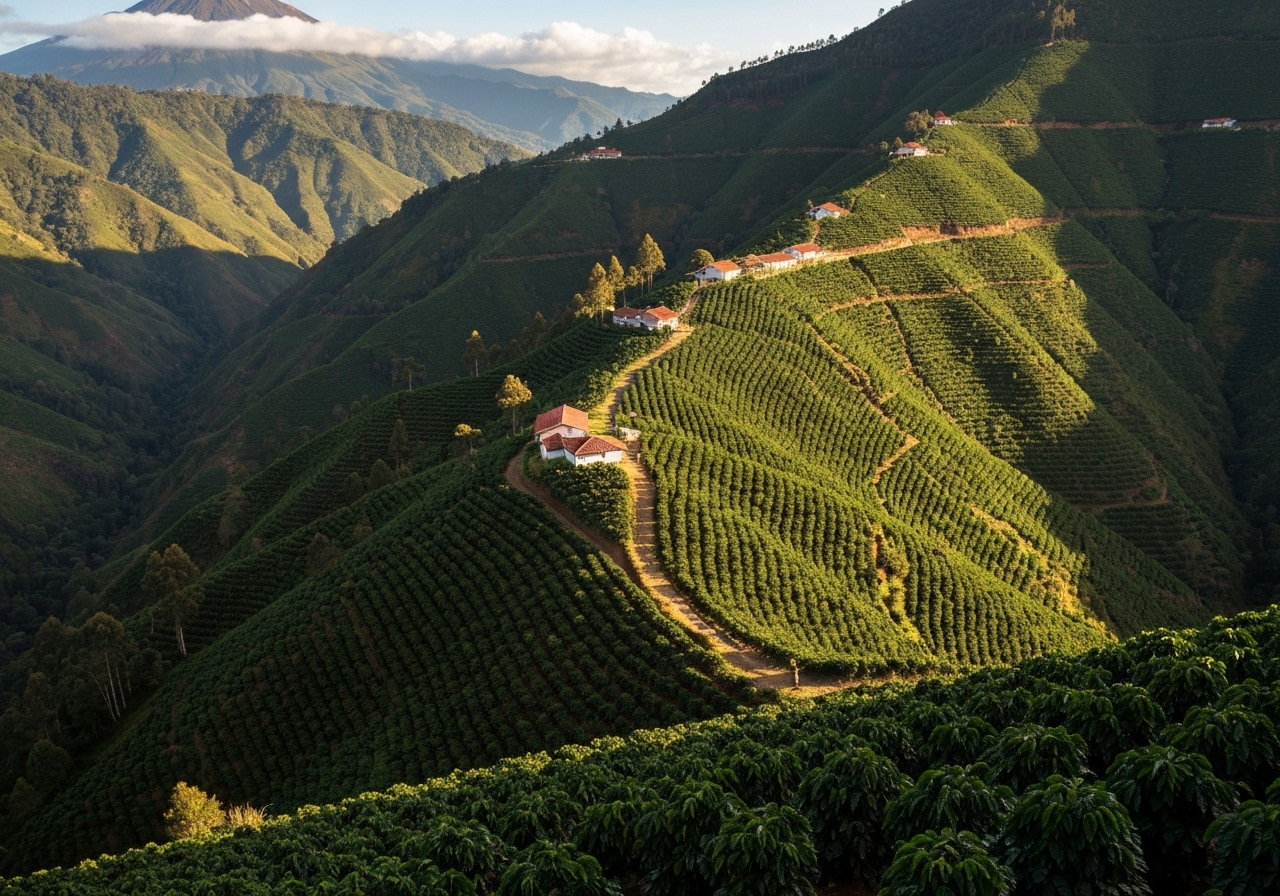
The Colombian Andes — three cordilleras create a mosaic of microclimates ideal for growing exceptional coffee
As James Hoffmann writes in The World Atlas of Coffee, Colombia “produces coffees of extraordinary diversity, from the tropical fruit of Huila to the bright citrus of Nariño,” a range made possible by geography that few other countries can match.
Growing Regions
Colombia’s coffee diversity is rooted in its topography. Each department offers distinct growing conditions — altitude, rainfall, soil composition — and therefore a different flavour fingerprint.
Huila, in the southwest, has become the darling of specialty buyers. Its municipalities of Pitalito, Acevedo, and Garzón produce sweet, fruity, and layered cups — many Colombian Cup of Excellence winners come from Huila’s farms, where altitudes reach 1,800 metres and volcanic soils are rich in organic matter.
Nariño, near the Ecuadorian border, grows coffee at extreme altitudes — up to 2,300 metres, among the highest in all of South America. The result is dense beans with sparkling, almost electric acidity and notes of mandarin, lime, and white grape. Nariño’s limited volume makes its best lots highly sought after.
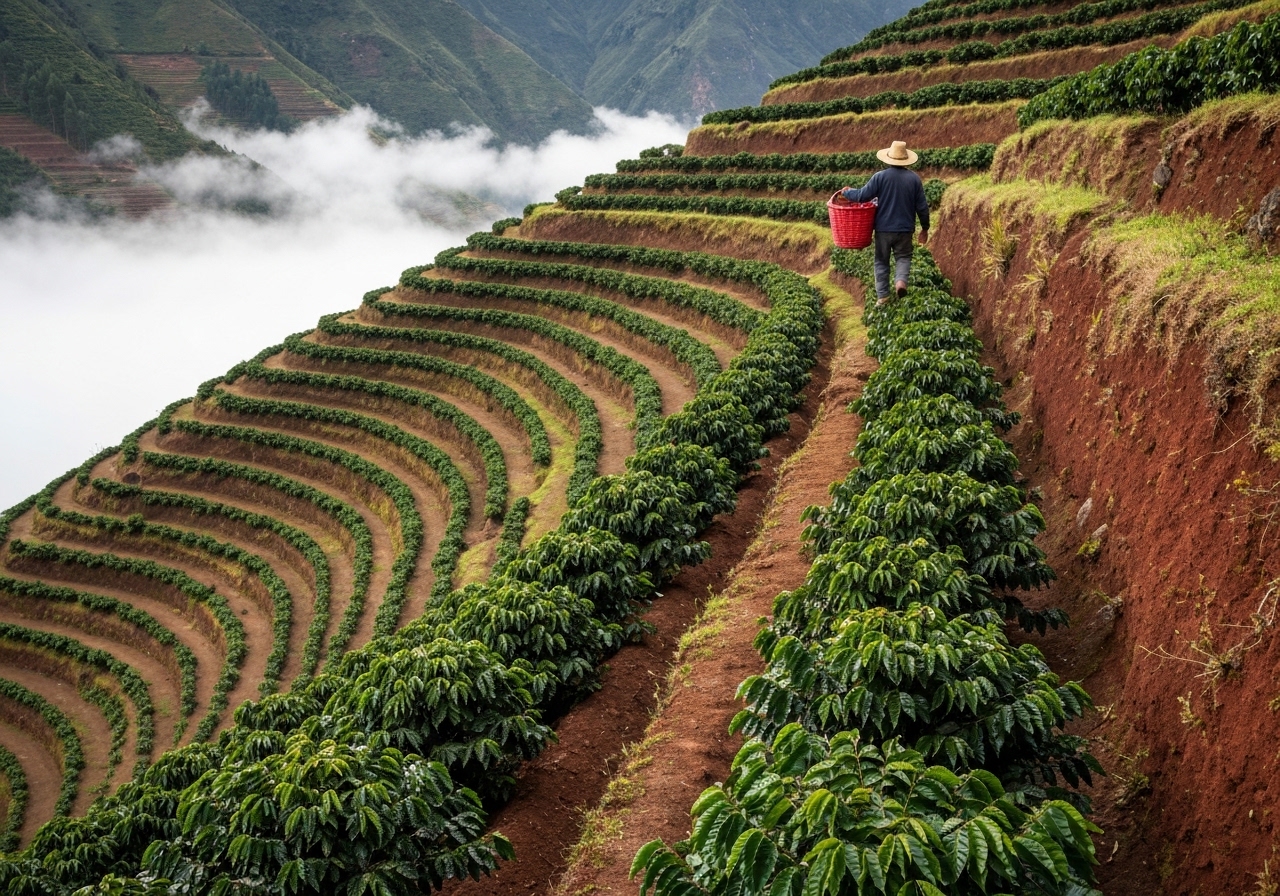
Colombia’s steep mountain terrain — smallholder farms carved into hillsides at altitudes up to 2,300 metres
Antioquia, the traditional heartland of Colombian coffee, offers rounder, nuttier profiles with caramel sweetness and a medium body. Tolima and Cauca contribute their own distinct signatures — Tolima with tropical fruit and honey sweetness, Cauca with bright acidity and floral notes. Santander, in the northeast, produces heavier, earthier cups at lower altitudes.
Colombia harvests coffee nearly year-round. The main harvest (mitaca in the south, principal in the north) runs April to June, while a secondary harvest (traviesa) occurs October to December — ensuring a steady supply of fresh crop throughout the year.
Varieties and Innovation
Caturra, a compact Bourbon mutation ideally suited to Colombia’s steep hillsides, has been a workhorse variety for decades, producing clean, sweet cups with bright acidity. Castillo, developed by Cenicafe (Colombia’s world-class coffee research centre) for resistance to coffee leaf rust (Hemileia vastatrix), is now the most widely planted variety and has largely won over initial sceptics with its solid, clean cup quality.
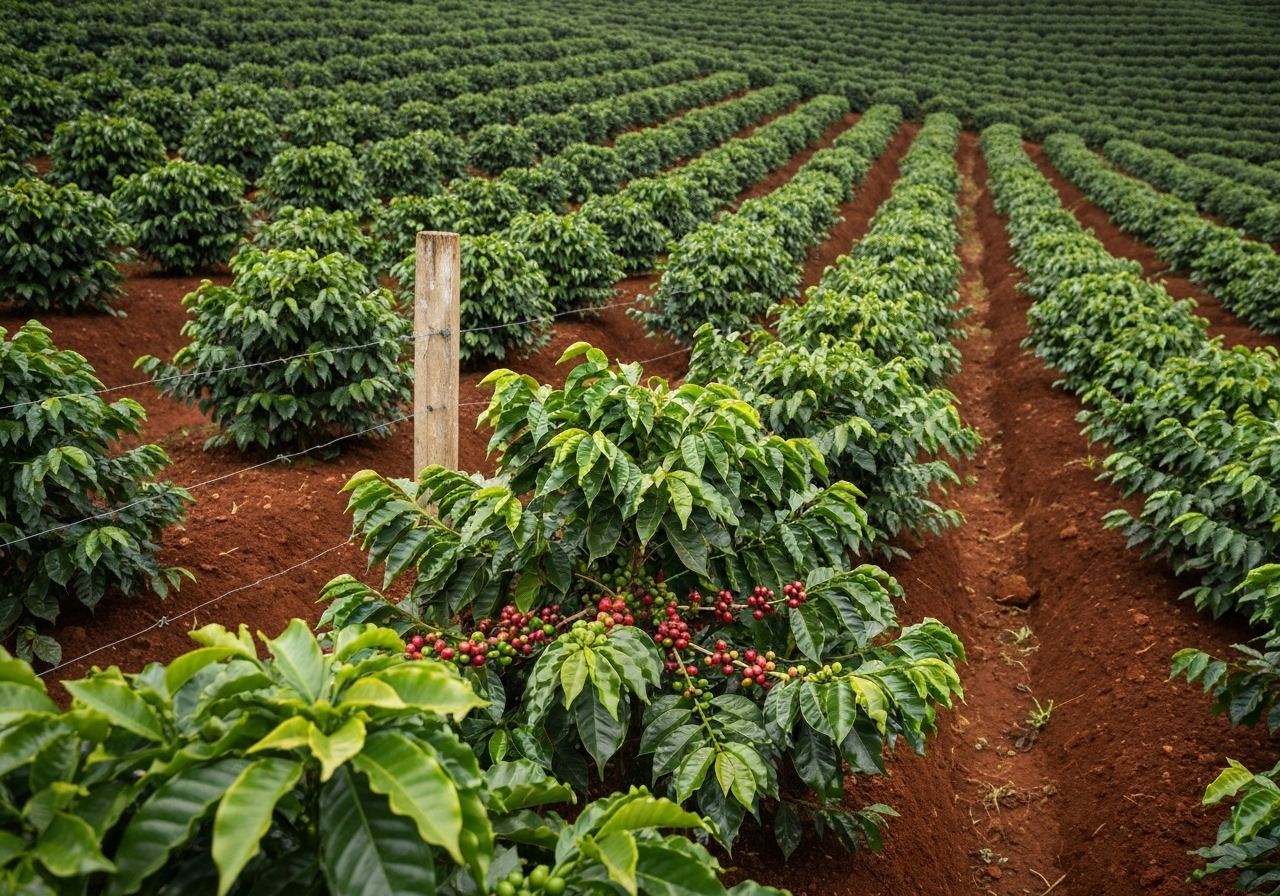
Caturra and Castillo varieties planted in tight rows on a Colombian hillside — compact plants that thrive on steep terrain
The Colombia variety, another rust-resistant hybrid, rounds out mainstream production. But in recent years, experimental lots of Gesha, Pink Bourbon, Tabi, and other exotic varieties have emerged from forward-thinking farmers in Huila, Nariño, and Cauca, pushing Colombian coffee into the ultra-premium segment. These micro-lots routinely command prices above $50 per pound at auction.
Processing and Flavour
The vast majority of Colombian coffee is fully washed, producing the clean, balanced, and sweet profile the country is known for. Typical tasting notes include panela (raw cane sugar), caramel, red apple, and stone fruits like peach and plum — a profile that has made Colombian coffee the backbone of specialty blends worldwide.
However, a growing wave of innovation has brought honey and natural processing to Colombian farms, expanding the flavour range with tropical fruit, wine-like body, and fermentation-driven complexity. Extended and anaerobic fermentation techniques — where cherries or mucilage-covered beans ferment in sealed tanks without oxygen — are gaining traction, particularly among competition-oriented producers in Huila and Nariño.
As Mark Pendergrast notes in Uncommon Grounds, Colombia’s coffee infrastructure has long been one of the most organised in the producing world — and that organisation is now channelling innovation as effectively as it once channelled volume.
The Role of the FNC
The Federacion Nacional de Cafeteros (FNC) has shaped Colombian coffee for nearly a century. Founded in 1927, it operates as both a trade association and a social institution. Through programs like the Garantia de Compra (purchase guarantee), the FNC ensures a minimum price for farmers, providing a safety net that few other origins can match. Its research arm, Cenicafe — one of the most advanced coffee research centres in the world — has developed disease-resistant varieties, sustainable farming practices, and processing innovations that have helped Colombia adapt to climate change more proactively than many competitors.
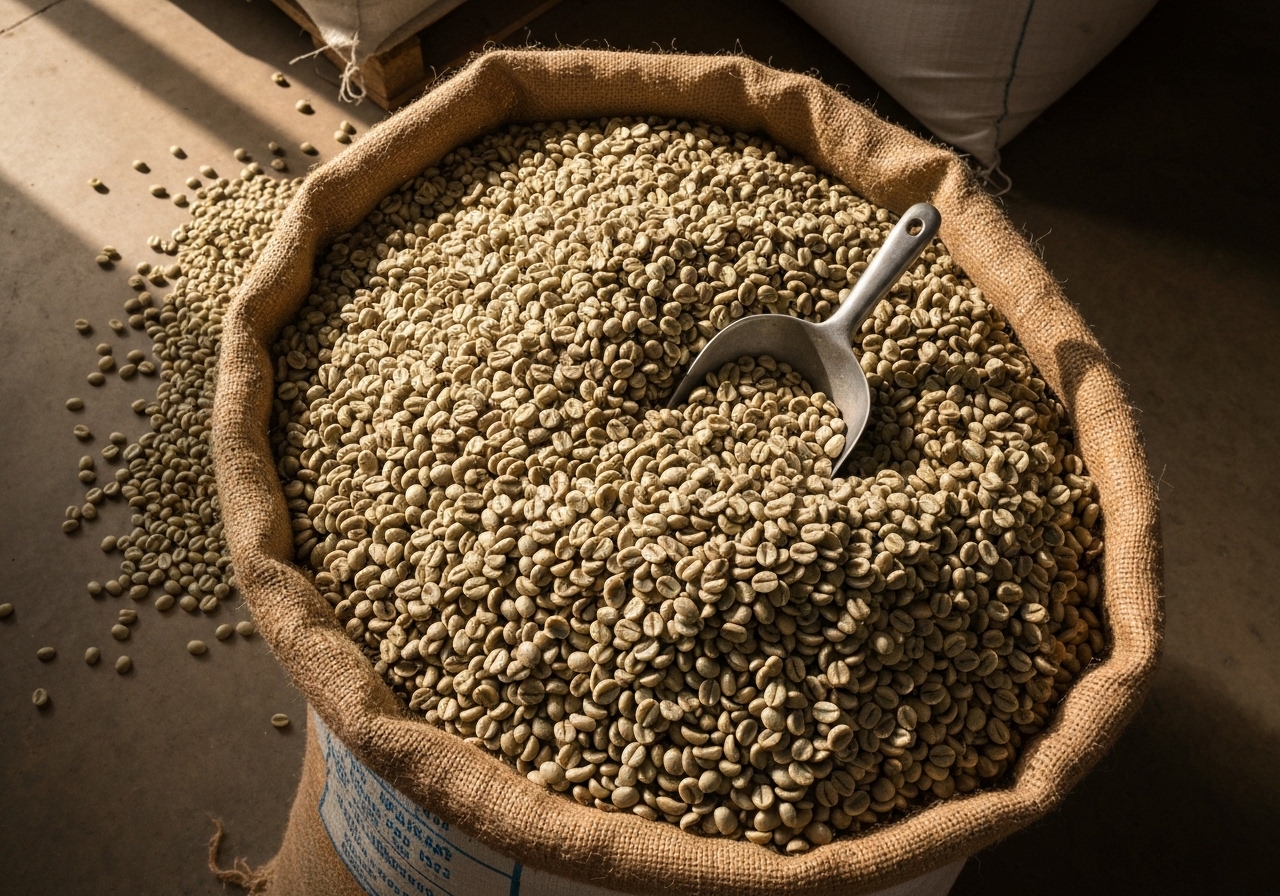
Colombian green coffee ready for export — the country ships over 12 million bags annually to markets worldwide
While the FNC system has its critics — particularly around traceability limitations in the commodity segment — it remains one of the most effective coffee institutions in the producing world, and Colombia’s consistent quality is in no small part a testament to its work.
Further Reading
- The World Atlas of Coffee by James Hoffmann — profiles of Colombian departments and their distinctive flavour signatures
- Uncommon Grounds by Mark Pendergrast — the history of Colombian coffee and the FNC’s influence
- Cenicafe — Colombia’s national coffee research centre, publications on varieties and agronomy
- Cup of Excellence Colombia — annual quality competition showcasing the country’s best lots
Related Topics
Brazil
The world's largest coffee producer by far, Brazil supplies one-third of global output — low-acid naturals and pulped naturals with nutty, chocolate, and caramel profiles.
processWashed (Wet) Processing
Washed coffee processing removes all fruit before drying to reveal clean, bright cups — floral, terroir-transparent, and prized by the specialty world. The benchmark method.
getting-startedWhat is Coffee Origin?
Coffee origin is the story of place — altitude, soil, and climate shape every flavour note. From Ethiopian florals to Colombian caramel and Kenyan citrus.