 English
  Українська
  Čeština
 The Engineer’s Brewer
In a world of century-old brewing traditions, the AeroPress is a striking anomaly — a device invented in 2005 by a seventy-year-old aerodynamics engineer, made of cheap plastic, and yet capable of producing one of the cleanest, most flavourful cups of coffee you will ever taste. Where the French press delivers body and the pour-over offers clarity, the AeroPress somehow manages both. It is light enough to toss in a backpack, forgiving enough for a beginner’s first brew, and precise enough to win world championships. No other brewer in the history of coffee has inspired such a devoted, experimental, and slightly obsessive following in so short a time.
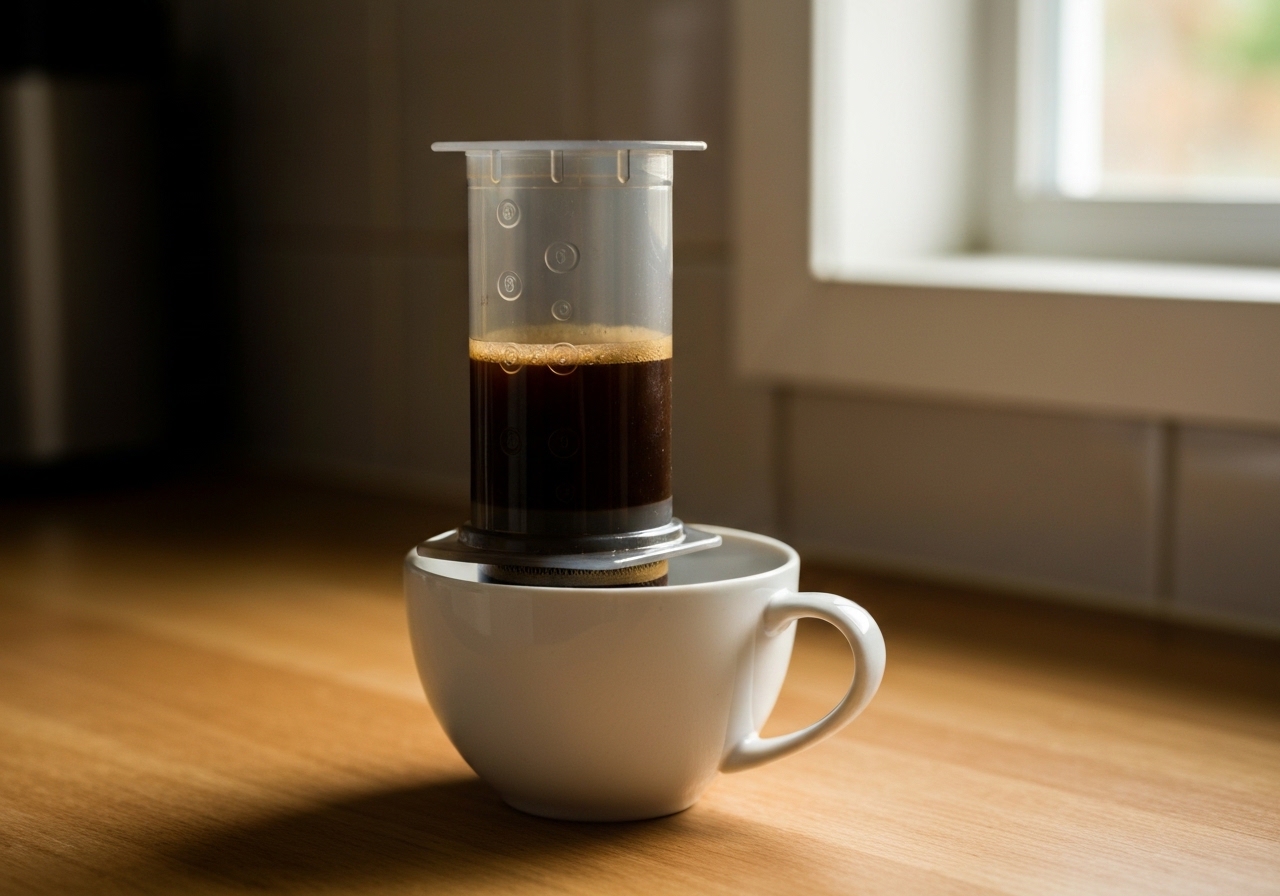
The AeroPress — a plastic tube that changed how a generation thinks about brewing coffee
Alan Adler and the Invention
Alan Adler is not, by any traditional measure, a coffee person. He is a Stanford mechanical engineering lecturer best known for inventing the Aerobie — the flying ring that holds a Guinness World Record for the longest thrown object. In 2004, dissatisfied with the bitter, over-extracted coffee his drip machine produced for a single cup, Adler began experimenting in his garage. His breakthrough was combining two principles that most brewers treat as mutually exclusive: immersion steeping, where grounds sit in water like a French press, and pressure filtration, where air forces the brew through a fine paper or metal filter. The result, released in 2005 under his company Aerobie Inc., was the AeroPress — a $30 plastic syringe that brewed a single cup in about ninety seconds. The specialty coffee world was sceptical at first. Then people tasted the coffee.
How It Works
The AeroPress is a hybrid brewer, and understanding that hybrid nature is the key to understanding its remarkable versatility. Coffee grounds steep in hot water inside the cylindrical chamber — this is the immersion phase, similar to a French press. But unlike a French press, the brew is then forced through a paper or metal filter by manually pressing a plunger down, creating gentle air pressure — roughly 0.35 to 0.75 bar, far less than espresso but enough to accelerate extraction and push the liquid through a much finer filter than a metal mesh would allow.
The paper micro-filter removes nearly all oils and fine sediment, producing a cup with pour-over-level clarity but with the fuller extraction that immersion contact time provides. Brew time is typically one to two minutes — far shorter than the French press’s four — and the lower temperature often recommended (80°C to 85°C) reduces bitterness. The result is a concentrate that can be drunk straight for an intense, clean shot or diluted with hot water for something closer to an Americano. Variables like water temperature, grind size, steep time, and pressure can all be adjusted independently, which is why the AeroPress has become a playground for recipe experimentation.
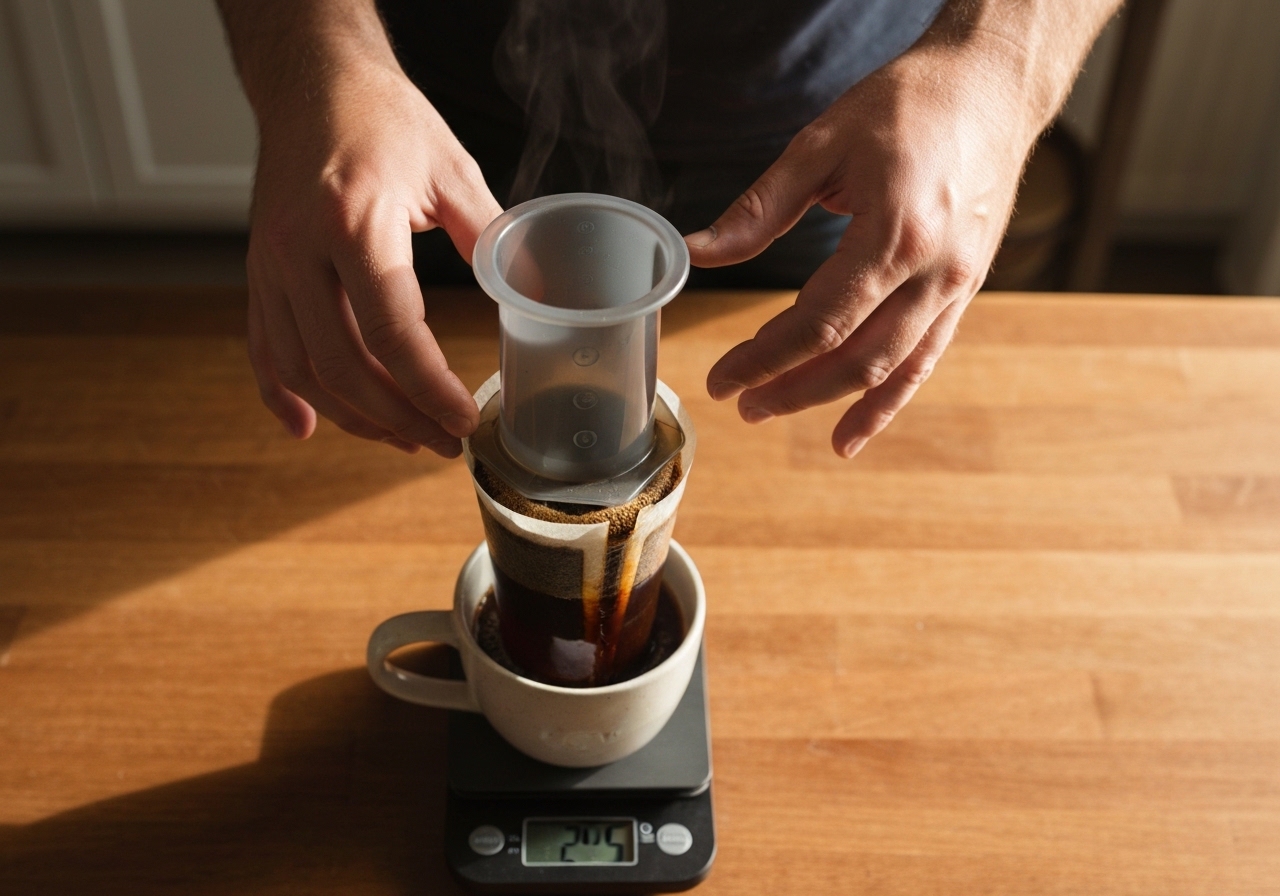
The brewing process — immersion steeping followed by a gentle press through a paper filter yields a remarkably clean cup
Standard vs. Inverted Method
The AeroPress ships with instructions for the standard method: place the filter cap on the bottom, set it on your mug, add coffee and water, stir, and press. This is simple and effective, but it has a flaw — liquid begins dripping through the filter as soon as water touches the grounds, meaning you cannot fully control steep time.
Enter the inverted method, discovered and popularised by the AeroPress community within a few years of the brewer’s release. By flipping the AeroPress upside down — plunger at the bottom, open end facing up — you create a sealed chamber where coffee and water can steep without any premature dripping. When the desired brew time is reached, you attach the filter cap, flip the whole assembly onto your mug, and press. The inverted method gives the brewer total control over contact time, which is why the vast majority of competition recipes use it. It does carry a small risk of spilling hot coffee during the flip, which Adler himself has acknowledged with dry amusement, but with practice the motion becomes second nature.
The AeroPress World Championship
Few things illustrate the AeroPress’s unique position in coffee culture better than the World AeroPress Championship (WAC). Founded in 2008 by Tim Wendelboe and Tim Varney as a casual, fun alternative to the often-intense World Barista Championship, the WAC has grown into a global event held in a different city each year, with national qualifying rounds in over sixty countries. Competitors are judged in blind taste tests — no theatre, no presentation scores, just the cup. Each competitor submits a unique recipe, and the winning recipes are published openly, creating an extraordinary public archive of brewing innovation.
The competition has driven real discoveries: the benefits of finer grinds with shorter steep times, the use of water temperatures well below boiling, the effectiveness of bypass brewing (pressing a concentrate and diluting it), and the surprising impact of agitation techniques. As James Hoffmann writes in The World Atlas of Coffee, the WAC has “done more for our collective understanding of extraction variables than many formal studies.”
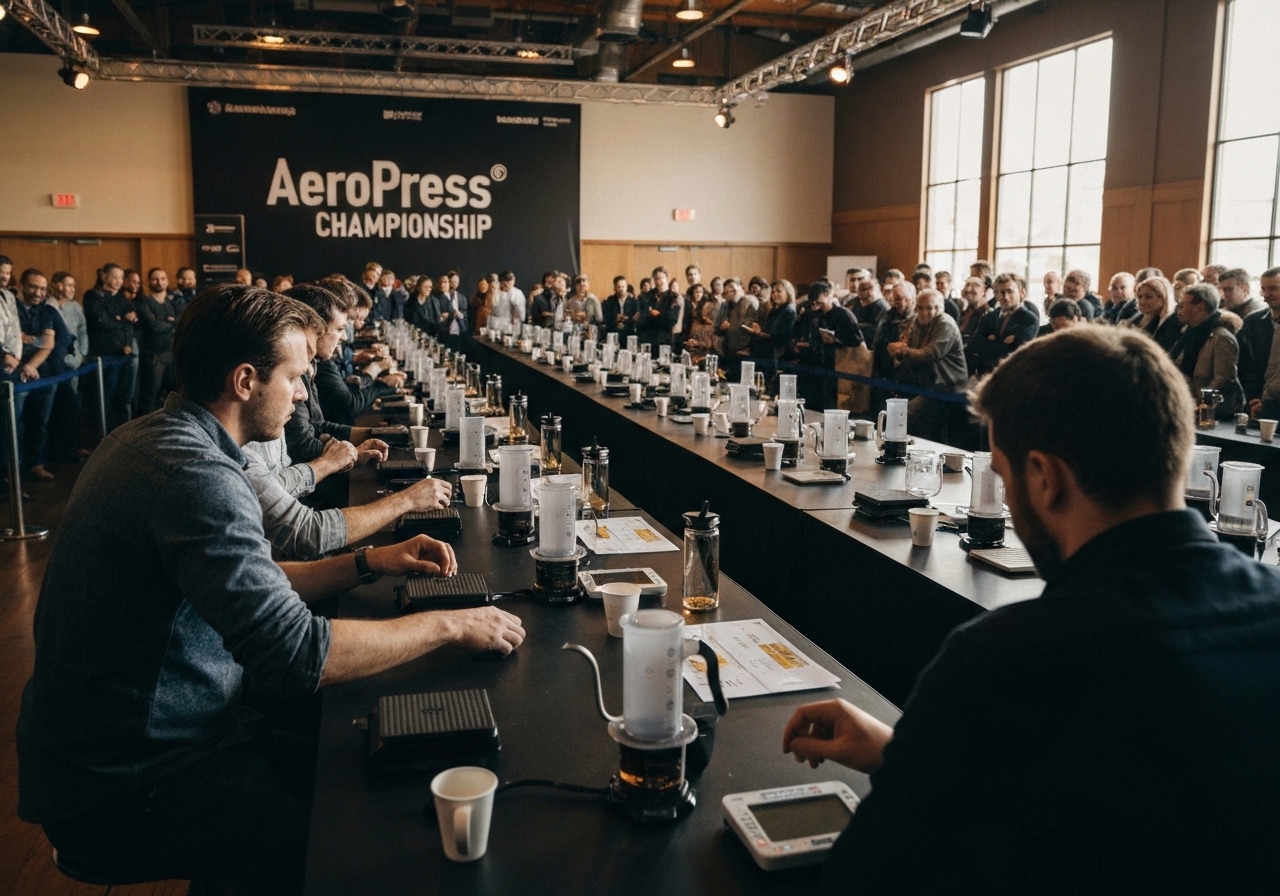
From garage invention to global competition — the AeroPress has earned its place among serious brewing methods
Travel-Friendly Brewing
The AeroPress weighs barely 200 grams, is virtually indestructible, and fits inside a jacket pocket. It requires no electricity, no fragile glass components, and no elaborate setup. For travellers, campers, hotel-dwellers, and anyone who has stared at a bad drip machine in a conference room with quiet despair, the AeroPress is liberation. Pair it with a compact hand grinder like the Timemore C2 or 1Zpresso Q2, a small digital scale, and a bag of freshly roasted single-origin beans, and you have a complete specialty coffee kit that fits in a toiletry bag. Many professional cuppers and Q-graders carry an AeroPress when travelling — not as a novelty, but as a genuinely reliable tool for evaluating coffee quality on the road.
Why It Matters
The AeroPress matters because it democratised excellent coffee. Before its invention, achieving a clean, well-extracted, flavourful single cup required either an espresso machine costing hundreds or thousands of dollars, or the patience and technique demanded by pour-over methods. The AeroPress eliminated those barriers. It costs less than two bags of specialty coffee, brews in under two minutes, cleans up in seconds, and produces a cup that can genuinely compete with far more expensive methods. It proved that great brewing does not require ritual, expense, or tradition — sometimes it just requires an engineer in a garage who refuses to accept a bad cup of coffee.
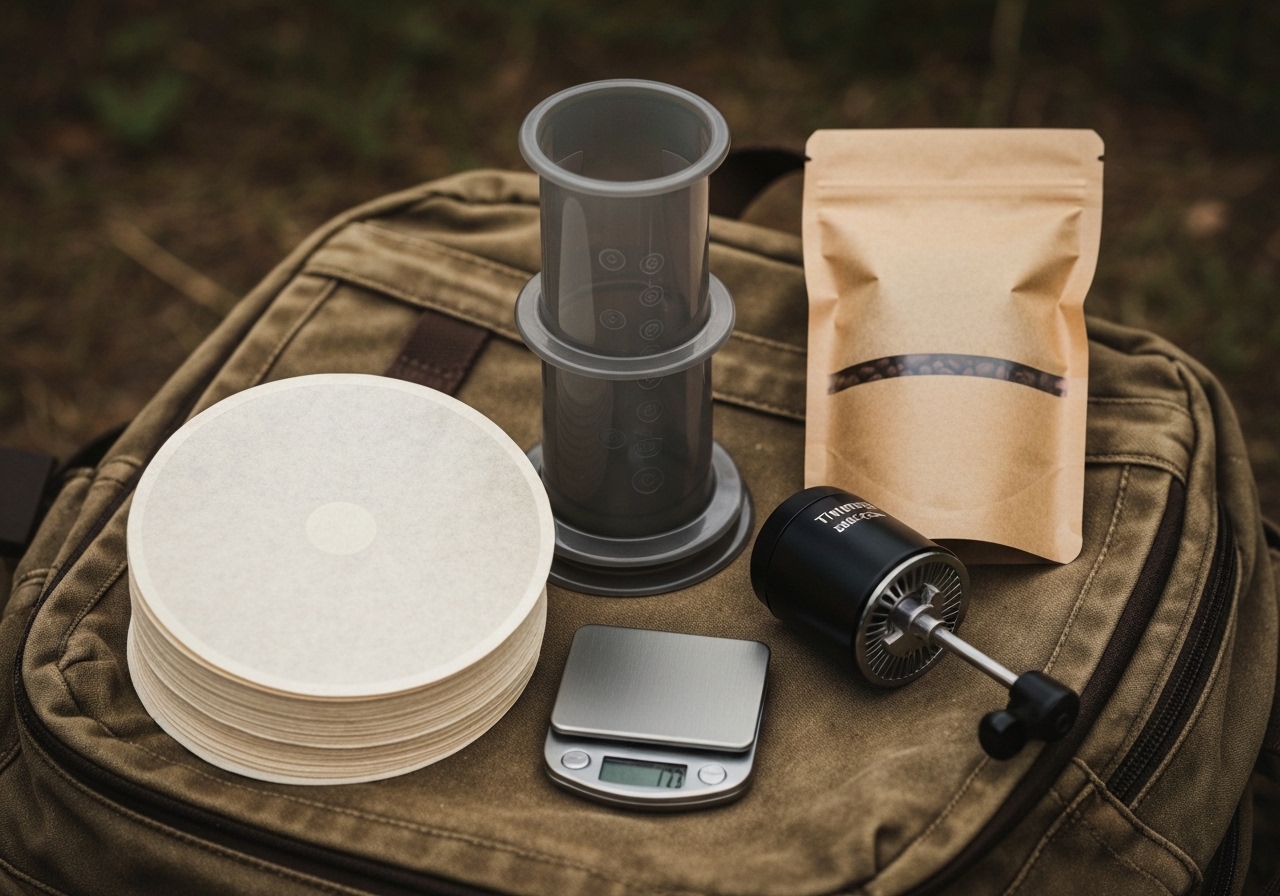
Twenty years after its invention, the AeroPress remains one of the best value propositions in all of coffee brewing
Further Reading
- The World Atlas of Coffee by James Hoffmann — covers AeroPress technique alongside its broader context in modern brewing
- Craft Coffee: A Manual by Jessica Easto — includes AeroPress recipes and the science of pressure-assisted immersion brewing
- AeroPress World Championship Archives — every winning recipe from 2008 to the present, a treasure trove of brewing data
- SCA Brewing Standards — gold cup extraction targets applicable to AeroPress and all brewing methods
Related Topics
What is Coffee Brewing?
Coffee brewing extracts soluble flavour from roasted grounds using water — and grind size, temperature, time, and ratio all determine whether the cup sings or disappoints.
getting-startedFrench Press
French press coffee steeps ground beans in hot water for 4 minutes, producing rich, full-bodied cups with velvety texture and deep, rounded chocolate flavour.
brewingPour Over
Pour-over is a manual coffee brewing method using paper filters and controlled water flow, producing clean, nuanced cups that reveal single-origin character.
getting-startedEspresso
Espresso forces near-boiling water through finely ground coffee at 9 bars of pressure — producing concentrated, crema-topped shots in 25 to 30 seconds.