 English
  Українська
  Čeština
 Two species account for nearly all the coffee on earth, and they could scarcely be more different. One is fastidious, altitude-dependent, and genetically delicate — capable of extraordinary complexity but vulnerable to disease, climate, and poor handling. The other is hardy, productive, high-caffeine, and grows at sea level under conditions that would ruin its cousin — but at the cost of a coarser, more bitter cup character that suits industrial processing far better than it suits a Saturday morning ritual. Understanding Arabica and Robusta is not just botanical trivia. It shapes every cup you drink.
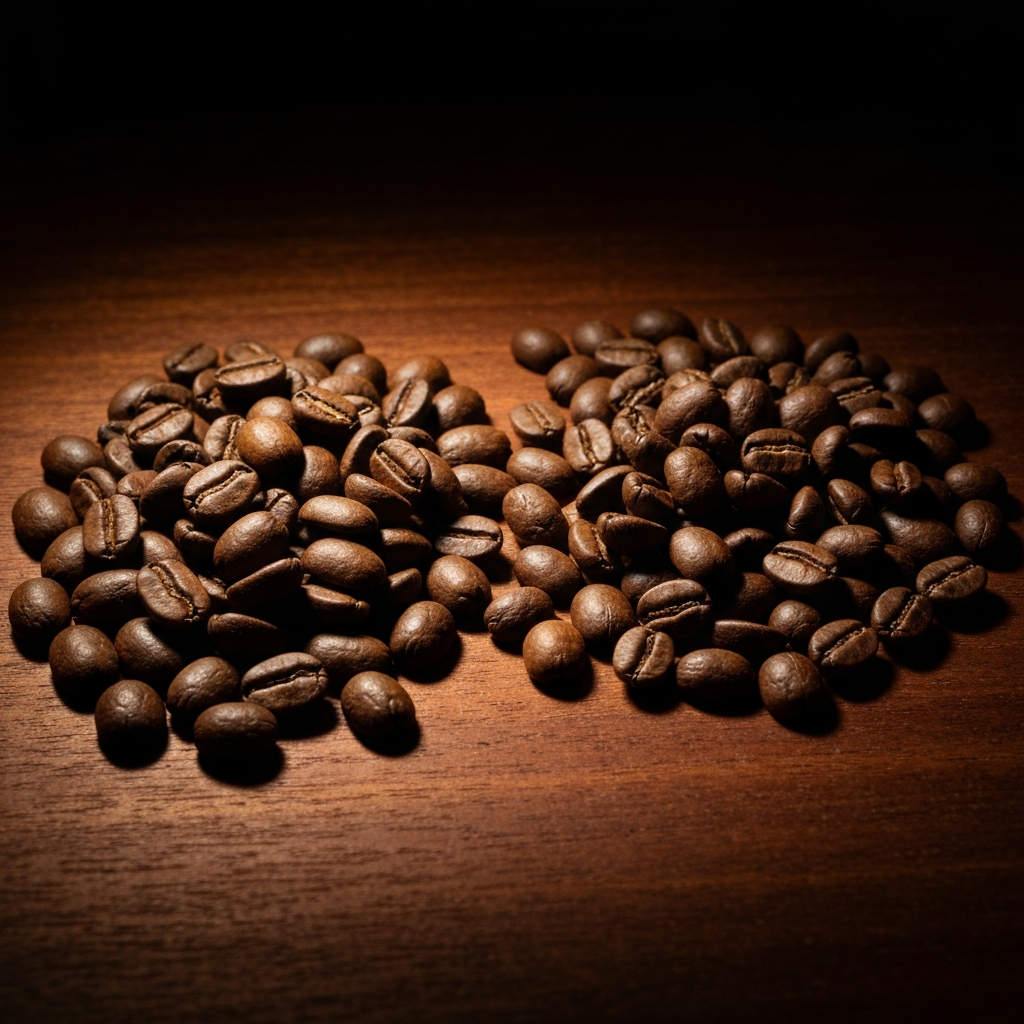
Arabica beans are larger and more oval; Robusta beans are smaller and rounder — a physical difference that mirrors the gulf in their flavour profiles
The Species
Coffea arabica originated in the highland forests of Ethiopia and South Sudan, where it grew wild beneath the canopy at elevations between 1000 and 2000 metres. It arrived on the Arabian Peninsula via Yemen, gave coffee its name, and became the basis of the entire global coffee trade. Today, Arabica accounts for roughly 60–70% of world coffee production and virtually all specialty coffee. It is a tetraploid — carrying four sets of chromosomes — and is unique among coffee species in being largely self-fertilising, which means varieties bred through selection tend to breed true.
Coffea canephora, universally called Robusta for the commercial variety that dominates production, originated in Central and West Africa — the lowland equatorial regions that sit far below Arabica’s preferred altitude range. Robusta thrives at sea level to about 800 metres, tolerates heat and humidity that would devastate Arabica, and is significantly more resistant to the coffee leaf rust fungus that has devastated Arabica crops across the world. It accounts for roughly 30–40% of global production and is grown primarily in Vietnam (the world’s largest Robusta producer), Uganda, Côte d’Ivoire, and parts of Indonesia and India.
Flavour and Cup Character
This is where the gap between the species becomes most tangible. Arabica, at its best, offers extraordinary aromatic complexity — florals, stone fruits, citrus, chocolate, caramel, berries — with a range of acidity profiles from gentle and round to bright and electric. The tasting notes that specialty roasters print on their bags are written almost exclusively about Arabica, because Arabica’s genetic and biochemical complexity genuinely supports that kind of nuance.
Robusta’s cup character is fundamentally different. It tends toward rubbery, woody, or grainy notes, with higher bitterness and lower acidity. The flavour profile is often described as harsher or coarser, and in cupping evaluations, unblended Robusta rarely exceeds scores of 75–78 on the SCA scale — below the 80-point threshold for specialty. There are exceptions: some high-grown Ugandan and Indian Robustas achieve genuine complexity and have inspired a small but growing specialty Robusta movement. But these are outliers in an otherwise industrially-oriented species.
Caffeine: The Robusta Advantage
Robusta contains roughly twice the caffeine of Arabica — typically 2.7% caffeine by weight compared to Arabica’s 1.2–1.5%. This is not a coincidence; caffeine is a natural insect repellent, and growing at lower altitudes where pest pressure is higher, Robusta evolved more of it. For consumers, this means Robusta-heavy blends deliver more of the stimulant effect per gram. For flavour, however, caffeine is bitter — so higher caffeine content contributes to Robusta’s characteristic bitterness and makes it harder to balance in the cup.
Price and Industrial Use
Robusta is significantly cheaper than Arabica — typically trading at 30–60% of Arabica prices on commodity markets. This is why it dominates instant coffee production, where the beans are extracted under high pressure and the flavour nuances that distinguish Arabica are largely destroyed anyway. Many espresso blends, particularly Italian-style ones, include 10–30% Robusta for one specific reason: crema. Robusta’s higher lipid content and different protein composition produce a denser, more persistent crema foam on espresso — a visual quality that many consumers associate with quality, even when the flavour contribution of the Robusta component is neutral at best.
Can Robusta Be Specialty?
The short answer is: rarely, and the definition is contested. The SCA’s cupping protocol was designed with Arabica in mind, and many Q Graders argue that the attributes it measures — particularly brightness and acidity — inherently disadvantage Robusta. The Coffee Quality Institute has developed a separate Q Robusta certification program with its own protocol, acknowledging that quality Robusta deserves its own evaluative framework rather than being measured against Arabica standards.
In practice, when you encounter specialty coffee — in a good café, from an artisan roaster, on a bag that lists an origin and a farm name — you are almost certainly drinking Arabica. The rare specialty Robusta will typically be labelled as such and positioned as an explicit curiosity.
A Third Species Worth Knowing
Coffea liberica and its close relative Coffea stenophylla are minor species with growing niche interest. Liberica produces large, asymmetrical beans with a distinctly smoky, woody, sometimes floral character; it is the dominant species in the Philippines and parts of West Africa. Stenophylla, recently rediscovered as a potential climate-resilient crop, has reportedly produced cup qualities comparable to Arabica in early trials — an important development as climate change threatens to shrink Arabica’s viable growing regions over the coming decades.
The two-species story is already more complicated than it appears, and it will likely become more so.
Where to Go Next
- What Is Specialty Coffee? — understand how Arabica’s quality potential is formally evaluated
- Arabica (Coffea arabica) — go deeper on the species that produces virtually all specialty coffee
- Coffee Roast Levels — understand how roasting affects both species differently
Related Topics
Arabica (Coffea arabica)
Arabica accounts for 60% of global coffee production and virtually all specialty coffee. Here is what separates it from Robusta — genetics, altitude, and cup character.
getting-startedWhat Is Specialty Coffee?
The 80-point SCA scale separates extraordinary coffee from commodity. Here is what that number actually means, how it is scored, and why it matters in the cup.
getting-startedThe Coffee Belt
The Coffee Belt spans the tropics between Cancer and Capricorn, home to all 70 coffee-growing nations and every Arabica and Robusta variety on Earth.
varietyWhat are Coffee Varieties?
Coffee varieties — Typica, Bourbon, Gesha, SL28 — are the genetic blueprints behind every cup. A guide to what they are, how they differ, and why variety matters for flavour.