 English
  Українська
  Čeština
 Tanzania is a country of icons — Kilimanjaro, the Serengeti, Zanzibar — and its coffee, grown on the slopes of Africa’s tallest peak and across the highlands of the Great Rift Valley, carries its own quiet fame. For decades, Tanzanian coffee has been sought after by roasters who prize its bright, sparkling acidity, its wine-like complexity, and its distinctive berry and citrus notes. Yet Tanzania remains somewhat underrated in the specialty world, overshadowed by its East African neighbours Kenya and Ethiopia. This is a shame, because the best Tanzanian coffees — particularly the famous Peaberry lots — are among the most vibrant and elegant cups Africa produces.

Tanzania’s coffee highlands — volcanic soil and high altitude create the conditions for bright, complex Arabica
Coffee was introduced to Tanzania (then Tanganyika) by German colonists in the late 19th century, who established plantations on the fertile volcanic slopes north of what would become the country’s most recognisable landmark. The crop found a natural home: rich volcanic soil, reliable rainfall, and altitudes between 1,200 and 2,000 metres provided ideal conditions for Arabica. Today, Tanzania produces around 900,000 to 1.2 million bags annually — modest by global standards, but with a quality-to-volume ratio that punches well above its weight.
Growing Regions
Tanzania’s coffee geography divides into two broad zones: the northern highlands and the southern highlands, with distinct growing conditions and flavour signatures.
The Northern Highlands — particularly the slopes of Mount Kilimanjaro and Mount Meru — are the historic centre of Tanzanian coffee. The Kilimanjaro region, encompassing districts like Moshi, Hai, and Rombo, produces the coffee that made Tanzania’s reputation: bright, juicy, and intensely flavoured, with volcanic soil contributing a mineral depth that supports the acidity. Altitudes here range from 1,200 to over 1,800 metres, and the combination of equatorial latitude with highland elevation creates the slow cherry maturation that concentrates sugars and acids in the bean.
Arusha, on the slopes of Mount Meru, offers a similar profile — perhaps slightly softer in acidity than the best Kilimanjaro lots, but with excellent sweetness and body. The Ngorongoro area nearby has gained attention for micro-lots with floral complexity.
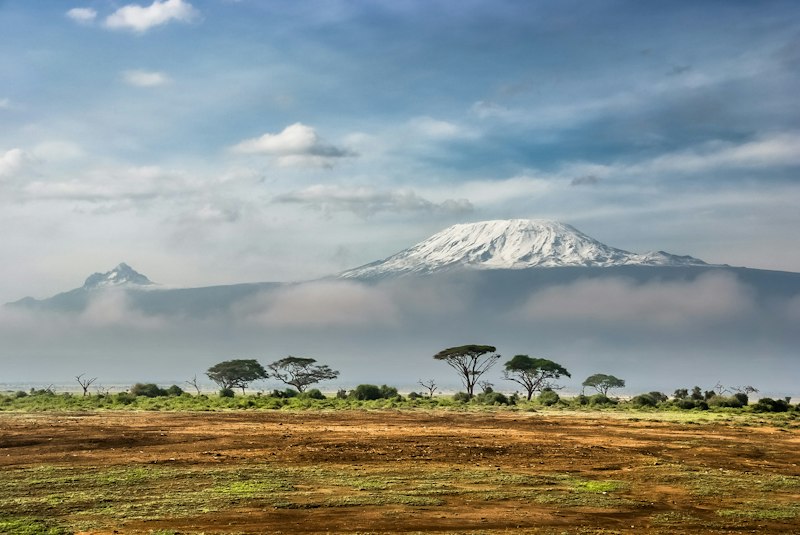
Mount Kilimanjaro — Africa’s highest peak and the backdrop for Tanzania’s most celebrated coffee-growing region
The Southern Highlands — Mbeya, Ruvuma, and Songwe — produce a growing share of Tanzania’s specialty coffee, often with a rounder, more chocolatey profile and slightly less assertive acidity than northern lots. The Mbeya region, particularly around Mbozi and the Rungwe volcanic area, is increasingly recognised by specialty buyers as a source of excellent value lots with stone fruit and caramel sweetness.
Tanzania also produces Robusta in the western lowlands near Lake Victoria — the Kagera region — though this accounts for a small fraction of total output and enters the commodity stream rather than the specialty market.
Varieties
Tanzania’s varietal mix is shaped by its colonial history and its proximity to Kenya. Bourbon is the dominant variety and produces the sweet, bright, fruit-forward cups the country is known for. Kent, an old Typica selection originally developed in India for rust resistance, is widely planted in the Kilimanjaro region and contributes a balanced, clean profile with good body.
N39 and KP423, selections derived from Kenyan breeding programmes, appear on some estates and cooperatives, bringing the intense acidity and blackcurrant character associated with Kenyan coffee. The recently introduced Compact variety, bred for disease resistance and smaller stature suited to smallholder plots, is gaining ground but has yet to establish a clear cup identity.
Tanzania Peaberry — The Specialty Star
Tanzania is perhaps most famous for its Peaberry coffee — and with good reason. In a normal coffee cherry, two seeds develop side by side, each with one flat face. In roughly 5 to 10 per cent of cherries, only a single seed develops, growing into a small, round, dense bean — the peaberry. Tanzanian producers have long sorted and sold these separately, and the resulting lots have earned a devoted following.

Tanzania Peaberry — small, round, and dense, these single-seed beans are prized for their concentrated flavour intensity
Peaberry advocates argue that concentrating an entire cherry’s nutrients into a single bean produces a more intense, concentrated cup — brighter acidity, more vivid fruit notes, and a snappier finish. Whether the difference is due to the bean’s shape affecting roast dynamics or genuine concentration of flavour compounds is debated, but Tanzania Peaberry has become a recognised category in its own right. The best examples — a Kilimanjaro Peaberry washed lot, light-roasted and brewed as a pour-over — deliver an electric acidity with blackcurrant, blood orange, and a finish like dry red wine.
Processing
The majority of Tanzanian specialty coffee is fully washed, processed through a network of central pulping units (CPUs) operated by cooperatives or private estates. The washed process accentuates Tanzania’s natural acidity and produces the clean, transparent cups that specialty buyers seek. Fermentation times typically range from 18 to 36 hours, and drying on raised African beds can take two to three weeks.
Natural processing is less common but growing, particularly in the southern highlands, producing sweeter, fruitier, more wine-like cups. A small but increasing number of producers are experimenting with honey process and extended fermentation techniques to differentiate their lots in a competitive market.
Flavour Profile
Tanzanian coffee at its best is bright, vivid, and layered. The hallmark acidity is often compared to blackcurrant or black tea — assertive but clean, more winey than citric. Supporting that acidity, look for notes of blood orange, ripe plum, and sometimes a bergamot-like floral lift. The body is typically medium — lighter than a Brazilian or Indonesian coffee, but with enough weight to carry the acidity without thinness.
The best lots have a finish that lingers — dry, slightly tannic, like the aftertaste of a good Pinot Noir. This makes Tanzanian coffee a natural partner for light-to-medium roasts and slower brewing methods where the acidity can fully express itself.
Buying Tips
Look for region-specific lots — “Kilimanjaro” or “Mbeya” on the label is a good start. Peaberry designations indicate the sorted single-bean lots that command a premium. Cooperative names (Machare, Uru, Burka) and estate names (Blackburn, Mondul) signal traceability. Tanzanian coffee peaks in freshness within a few months of harvest (typically July to December for the main crop), so check roast dates and crop years. For the brightest, most vibrant cups, seek out washed lots from the northern highlands at altitudes above 1,500 metres.
Further Reading
- The World Atlas of Coffee by James Hoffmann — Tanzanian growing regions, Peaberry discussion, and tasting profiles
- Uncommon Grounds by Mark Pendergrast — colonial coffee history in East Africa
- Tanzania Coffee Board — production statistics, auction results, and quality standards
- Cup of Excellence — Tanzania’s participation in international quality competitions
Related Topics
Kenya
Kenyan coffee delivers intense blackcurrant, grapefruit, and tomato-like acidity from SL28 and SL34 cultivars grown at high altitude near Mount Kenya.
originEthiopia
The birthplace of Arabica and still its most genetically diverse origin — Ethiopia produces florals, berries, and citrus from thousands of heirloom varieties across its highlands.
originRwanda
The 'Land of a Thousand Hills' has undergone a remarkable coffee renaissance, producing bright, complex, floral-citrus cups.
varietyBourbon
Bourbon is Arabica's second foundational cultivar — named after Réunion island, prized for rich sweetness, chocolate notes, full body, and complex fruit.