 English
  Українська
  Čeština
 The thing we call a coffee bean is not a bean at all. It is a seed — the pit of a small, bright fruit that grows on a woody shrub in the tropics, ripens over the course of nine months, and looks, when ready to pick, something like a large red cherry. The journey from this fruit to the roasted coffee in your grinder involves more steps, more hands, and more decisions than almost any other agricultural product in the world. It begins with understanding what the plant actually is.
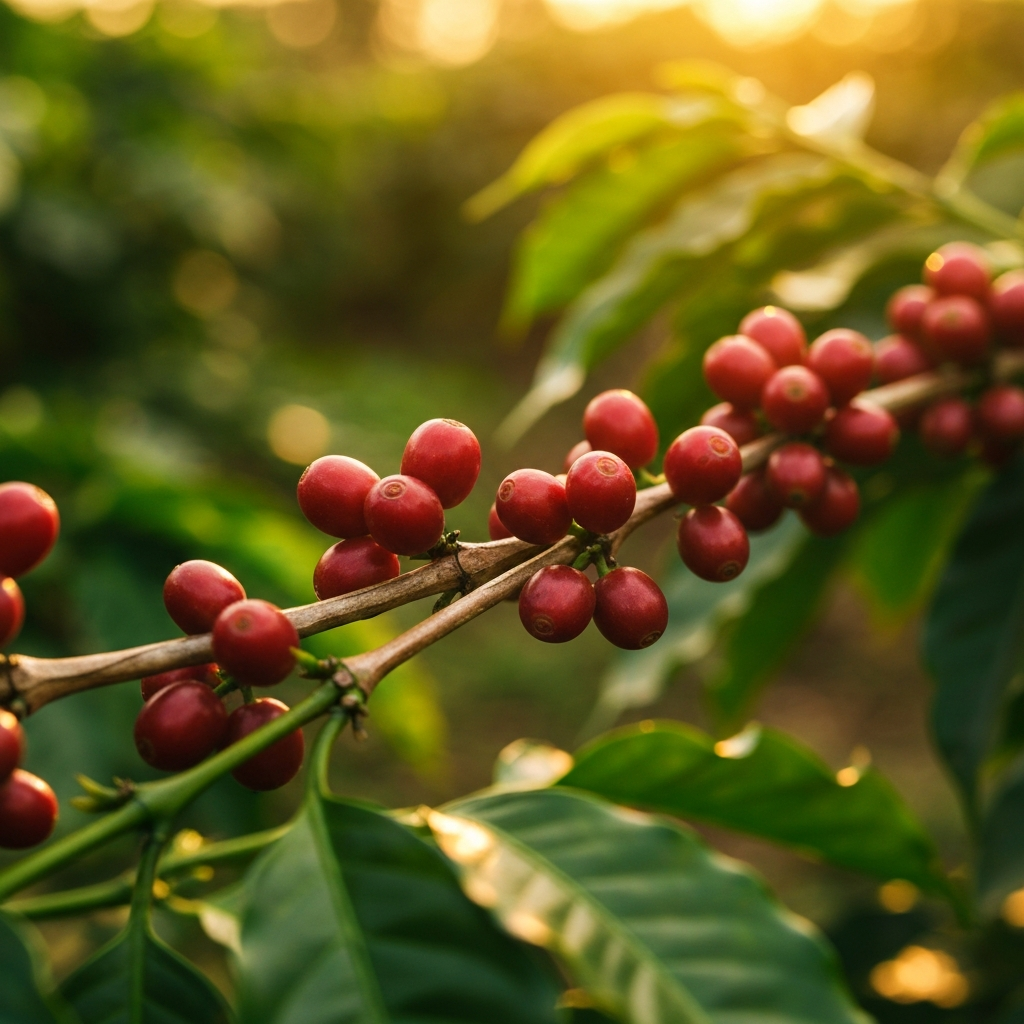
A coffee cherry at peak ripeness — the moment when the sugars have fully developed and the seeds inside are ready to become the specialty coffee you drink
The Coffee Plant
Coffea arabica in its natural form is a small tree or large shrub reaching five to eight metres in height. In cultivation, it is almost always pruned to a height of two to three metres for ease of harvesting — a daily compromise between botanical preference and agricultural practicality. The plant has glossy, dark green leaves, produces delicate white flowers with a jasmine-like fragrance, and in the right conditions will fruit continuously on different parts of the same branch: ripe red cherries, unripe green cherries, and new white blossoms can appear simultaneously on a single stem.
Coffea arabica grows naturally in the understorey of Ethiopian highland forests, which is why it thrives with shade cover, moderate rainfall (approximately 1500–2000mm annually), and temperatures between 15°C and 24°C. Too hot and the cherries ripen too quickly, reducing complexity. Too cold and growth stalls or frost damage occurs. The narrow climate envelope that suits Arabica defines the coffee belt — the band between the Tropics of Cancer and Capricorn where the world’s coffee is grown.
Anatomy of the Cherry
A ripe coffee cherry is roughly 15–18mm in diameter and consists of several distinct layers, each of which plays a role in how the seed inside develops and how it is processed after harvest.
The outermost layer is the exocarp, or skin — the bright red, yellow, or purple skin that gives the cherry its colour. Beneath it lies the mesocarp: a thin, sweet layer of fruit pulp, mucilage-rich and sticky, that adheres to the seed. This pulp is the source of the sugars that influence flavour during natural and honey processing. Below the mucilage sits the parchment layer (endocarp), a papery protective shell that encases the seed through most of its processing journey. Inside the parchment is the silver skin — a delicate membrane that clings to the seed — and finally the seed itself: two flat-sided beans facing each other, each enclosed in its own silverskin.
Occasionally, a cherry develops only a single, rounded seed rather than two halves — this is called a peaberry. Peaberries are found in roughly 5–10% of any given harvest, and because they develop without a neighbouring seed to press against, they are sometimes thought to concentrate flavour more intensely. They are often sold separately at a premium; whether the difference in the cup is perceptible is a matter of ongoing, pleasantly inconclusive debate.
From Flower to Harvest
After the coffee plant flowers, it takes approximately nine months for the cherries to ripen. This long maturation period at high altitude — where cooler temperatures slow development — is one of the key reasons high-grown Arabica develops such complex flavour compounds. The sugars accumulate slowly, the acids develop gradually, and the seed has time to achieve its full density and biochemical potential.
Ripeness is judged visually: a fully ripe Arabica cherry is deep red, slightly yielding to pressure, and sweet when tasted. Green cherries are unripe and will produce grassy, astringent flavours if processed early. Overripe cherries, left on the tree too long, begin to ferment on the branch, producing off-flavours. Selective harvesting — picking only ripe cherries, often by hand, returning to the same tree multiple times as different cherries reach maturity — is one of the defining investments that distinguishes specialty production from commodity farming, where whole branches or entire trees are stripped at once regardless of ripeness.
What Happens After Picking
Once harvested, the cherry must be processed quickly — the fruit begins to ferment within hours in the tropical heat. The goal of processing is to remove the layers of fruit from around the seed and dry the seed to a stable moisture content of around 11%, at which point it becomes “green coffee” — stable, shippable, and ready for roasting.
The method used to remove the fruit — whether it is stripped away before drying (washed), left on through drying (natural), or partially removed (honey) — has an enormous impact on the flavour of the final cup. Understanding the cherry’s anatomy makes this immediately intuitive: more fruit contact during drying means more fruit sugar absorbed into the seed, which means more fruit character in the roasted coffee. The cherry is not just a container for the seed. It is an active participant in the flavour you eventually taste.
Where to Go Next
- Coffee Processing Methods — how the cherry is transformed into green coffee after harvest
- What Is Terroir? — how the environment where the cherry grows shapes its flavour
- Arabica vs. Robusta — understand the two main species and how their cherries differ
Related Topics
Arabica (Coffea arabica)
Arabica accounts for 60% of global coffee production and virtually all specialty coffee. Here is what separates it from Robusta — genetics, altitude, and cup character.
getting-startedWhat is Coffee Processing?
Coffee processing — washed, natural, honey — transforms harvested cherries into green beans and shapes the cup more than almost any other variable, including roast level.
scienceCoffee Altitude & Terroir: How Elevation Shapes Flavor
Altitude is the single most reliable predictor of coffee quality. Learn how elevation shapes bean density, acidity, sugar development, and why terroir matters in the cup.
getting-startedCoffee Roast Levels: Light, Medium, Dark
What actually happens when green coffee meets heat — the chemistry of light, medium, and dark roasts, and why the flavour differences are not what most people expect.