 English
  Українська
  Čeština
 There is one number in coffee brewing that changes everything else — not the grind setting, not the water temperature, not the brewer you chose — but the ratio of coffee to water. Get this right, and a mediocre grinder on average beans can still produce a satisfying cup. Get it wrong consistently, and no amount of expensive equipment will compensate. Understanding brew ratio is the foundation on which every other adjustment you make will rest.
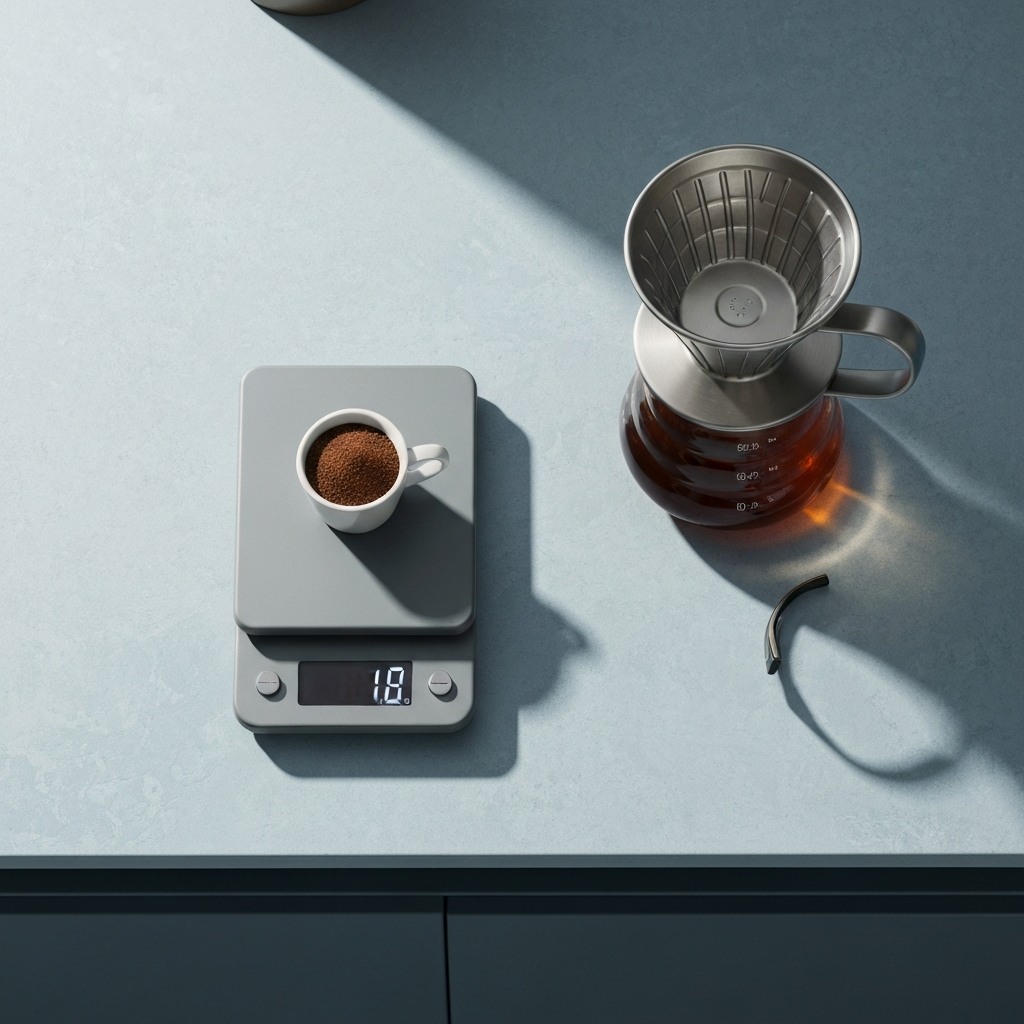
A scale is the most underrated tool in home brewing — it transforms guesswork into a repeatable, adjustable process
What Brew Ratio Actually Means
Brew ratio is the relationship between the mass of dry coffee grounds and the mass of water used to brew them. It is almost always expressed as 1:X, where 1 represents one gram of coffee and X represents the grams of water used. A ratio of 1:15 means 15 grams of water per gram of coffee. A ratio of 1:17 means 17 grams of water per gram of coffee.
Note that we measure water by weight, not volume. One millilitre of water weighs approximately one gram, so for practical home brewing purposes these are equivalent — but using a scale instead of a measuring jug removes a variable (water temperature affects volume slightly) and builds a habit of precision that will serve you as you refine your process.
The ratio determines how concentrated or dilute your brew will be. A lower ratio (more coffee per unit of water, like 1:13) produces a stronger, more intense cup. A higher ratio (less coffee per unit of water, like 1:18) produces a lighter, more delicate one. Neither is objectively better — but both are intentional, and that intentionality is what separates dialled-in brewing from guesswork.
The 1:15 to 1:17 Standard
The Specialty Coffee Association recommends a brew ratio of roughly 55–65 grams of coffee per litre of water for filter brewing — which translates to approximately 1:15.4 to 1:18.2. In practice, most specialty coffee professionals settle on 1:15 to 1:17 as a useful starting range.
Why this range? It was established through decades of calibration against what humans actually find pleasurable to drink — not too concentrated to be fatiguing, not so dilute that flavour and texture disappear. Within this window, a well-brewed cup should have:
- Enough concentration to perceive sweetness, acidity, and body distinctly
- Enough water to allow those flavours to exist in balance, not overwhelming the palate
- A total dissolved solids (TDS) percentage typically between 1.15% and 1.45%
TDS is the scientific measure of how much dissolved material is in your brew. While you do not need a refractometer to brew well at home, understanding that ratio controls TDS explains why the 1:15–1:17 window correlates with pleasurable cups across brew methods.
Ratio by Brew Method
Different brewing methods have evolved their own conventional ratios, and these conventions exist for good reason — they account for each method’s extraction efficiency, brew time, and the sensory expectations of the drinks they produce.
Pour-over (V60, Chemex): 1:15 to 1:17 is standard. The manual pour-over is the method where ratio precision pays off most clearly — because you control every variable, the ratio becomes your anchor.
French press: 1:12 to 1:15. French press produces a heavier, more body-forward cup because the immersion contact is longer and no paper filter strips oils. A slightly higher coffee dose compensates for the fuller saturation of the grounds.
AeroPress: Highly variable — 1:6 to 1:15 depending on whether you brew concentrate or full cup. Many AeroPress recipes use a high-concentration base and dilute to taste, which is itself a ratio-based approach.
Cold brew: 1:4 to 1:8 for concentrate, diluted 1:1 or 1:2 before serving. Cold water extracts much less efficiently than hot, so a dramatically higher dose is needed to produce comparable flavour intensity.
Espresso: 1:1.5 to 1:3 (the “brew ratio” for espresso, often called the output ratio). A double shot at 1:2 means 18g of ground coffee yields approximately 36g of liquid espresso. This extremely high concentration is why espresso is served in small quantities and why it tastes fundamentally different from filter coffee.
How to Dial In Your Ratio
Start at 1:16 — it is the middle of the recommended range and a forgiving place to begin. Weigh your coffee (let’s say 20g) and calculate your water target (20 × 16 = 320g). Brew, taste, and then adjust in one direction:
If the cup tastes too weak, watery, or hollow: Your coffee is under-extracted or too dilute. Try 1:15 (same dose, less water) and see if concentration improves. Alternatively, check your grind — too coarse can cause under-extraction regardless of ratio.
If the cup tastes too strong, heavy, or harsh: Your coffee may be over-concentrated. Move to 1:17 or 1:18 and reassess. If harshness persists at a higher ratio, the problem may be extraction rather than concentration — check grind size and water temperature.
The key discipline is to change one variable at a time. If you change ratio and grind simultaneously, you cannot know which adjustment produced the change in flavour.
Why Weight Beats Volume
Many home brewers start with scoops — a tablespoon of coffee here, a cup of water there. The problem is that coffee density varies dramatically by roast level, grind size, and variety. A tablespoon of finely ground dark roast will weigh significantly more than a tablespoon of coarsely ground light roast. Volume measurements introduce inconsistency that prevents you from building a reliable process.
A kitchen scale costing less than €15 eliminates this inconsistency. Once you can reproduce your ratio with precision, every other adjustment becomes meaningful — because you know the only thing that changed is the variable you intended to change.
The Ratio and Extraction Working Together
Ratio and extraction are related but separate variables. Extraction refers to how much of the coffee’s soluble material is dissolved into the water — controlled primarily by grind size, water temperature, and contact time. Ratio controls the concentration of the resulting liquid.
You can have a well-extracted, perfectly balanced brew at 1:15 that tastes intense, or a perfectly extracted brew at 1:18 that tastes delicate. Both can be excellent. You can also have under-extracted (sour, thin) or over-extracted (bitter, harsh) coffee at any ratio. Ratio governs strength; extraction governs quality within that strength.
This distinction matters when troubleshooting. If your coffee tastes sour and weak, you likely have under-extraction at too high a ratio — you need a finer grind AND more coffee. If it tastes bitter and strong, you have over-extraction at too low a ratio — coarser grind AND less coffee. Reading the combination of sensory signals tells you which direction to move both variables.
Where to Go Next
- What Is Brewing? — understand extraction and the chemistry behind every cup
- Grind Size Guide — the variable that most directly controls extraction alongside ratio
- Your First Cup — how to taste what your ratio is doing to the cup
Related Topics
What is Coffee Brewing?
Coffee brewing extracts soluble flavour from roasted grounds using water — and grind size, temperature, time, and ratio all determine whether the cup sings or disappoints.
getting-startedGrind Size Guide: How Particle Size Shapes Your Cup
From coarse to extra-fine: how grind size controls extraction, which grinder type matters, and how to dial in for every brew method.
brewingWater Temperature in Coffee Brewing: Why 93°C Isn't Always Right
How brew temperature affects extraction rate and flavor, why light and dark roasts need different temps, and practical guidance for every brew method.
getting-startedEspresso
Espresso forces near-boiling water through finely ground coffee at 9 bars of pressure — producing concentrated, crema-topped shots in 25 to 30 seconds.