 English
  Українська
  Čeština
 If washed processing is about clarity and transparency, wet-hulling is about raw, unapologetic earthiness. Known in Bahasa Indonesia as giling basah — literally “wet grinding” — this technique is practised almost exclusively in the Indonesian archipelago, where relentless humidity and tropical downpours make conventional drying methods impractical. The result is a cup that divides opinion like few others in specialty coffee: heavy-bodied, low in acidity, and saturated with flavours of wet earth, cedar, dark chocolate, and wild herbs. For the millions who drink Sumatran, Sulawesi, and Javan coffee every day, these flavours are not defects — they are the entire point.
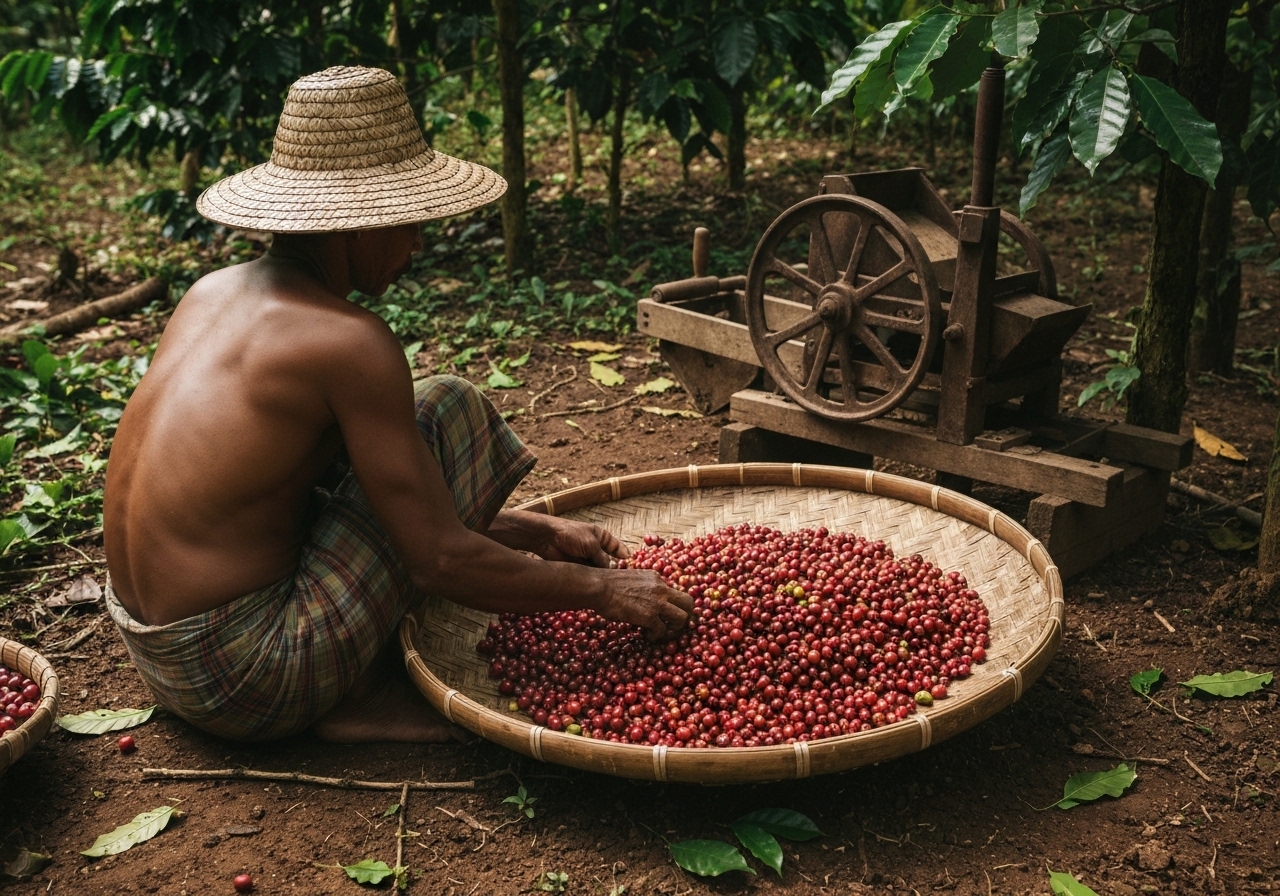
Coffee farming in the Indonesian highlands — where wet-hulling has been standard practice for generations
How Giling Basah Works
The process begins like any other wet method. Freshly picked cherries are depulped — usually by the farmer using a hand-cranked or small motorised pulper — to remove the outer skin and most of the fruit flesh. The depulped beans, still wrapped in their sticky mucilage, are placed in simple plastic sacks or buckets for a brief overnight fermentation, rarely exceeding twelve to eighteen hours.
Here is where wet-hulling diverges dramatically from the washed and honey methods. After fermentation, the beans are washed to remove mucilage and partially dried — but only to around 30 to 35 percent moisture content, roughly double the level at which conventionally processed coffee would be hulled. At this stage, the parchment layer is soft, swollen, and almost rubbery. The farmer then sells this semi-wet parchment coffee to a collector or middleman, who aggregates lots from dozens of smallholders and delivers them to a hulling facility.
At the mill, mechanical hullers strip away the damp parchment in a single aggressive pass. The exposed green beans — pale, bloated, and vulnerable — are spread on patios or tarps for a final drying phase, brought down to the export-ready moisture of 12 to 13 percent. Because the parchment is removed so early, the bean’s protective shell is gone during the most critical stage of drying. This exposure to open air, sunlight, and Indonesia’s humid climate is precisely what drives the characteristic flavour transformation.
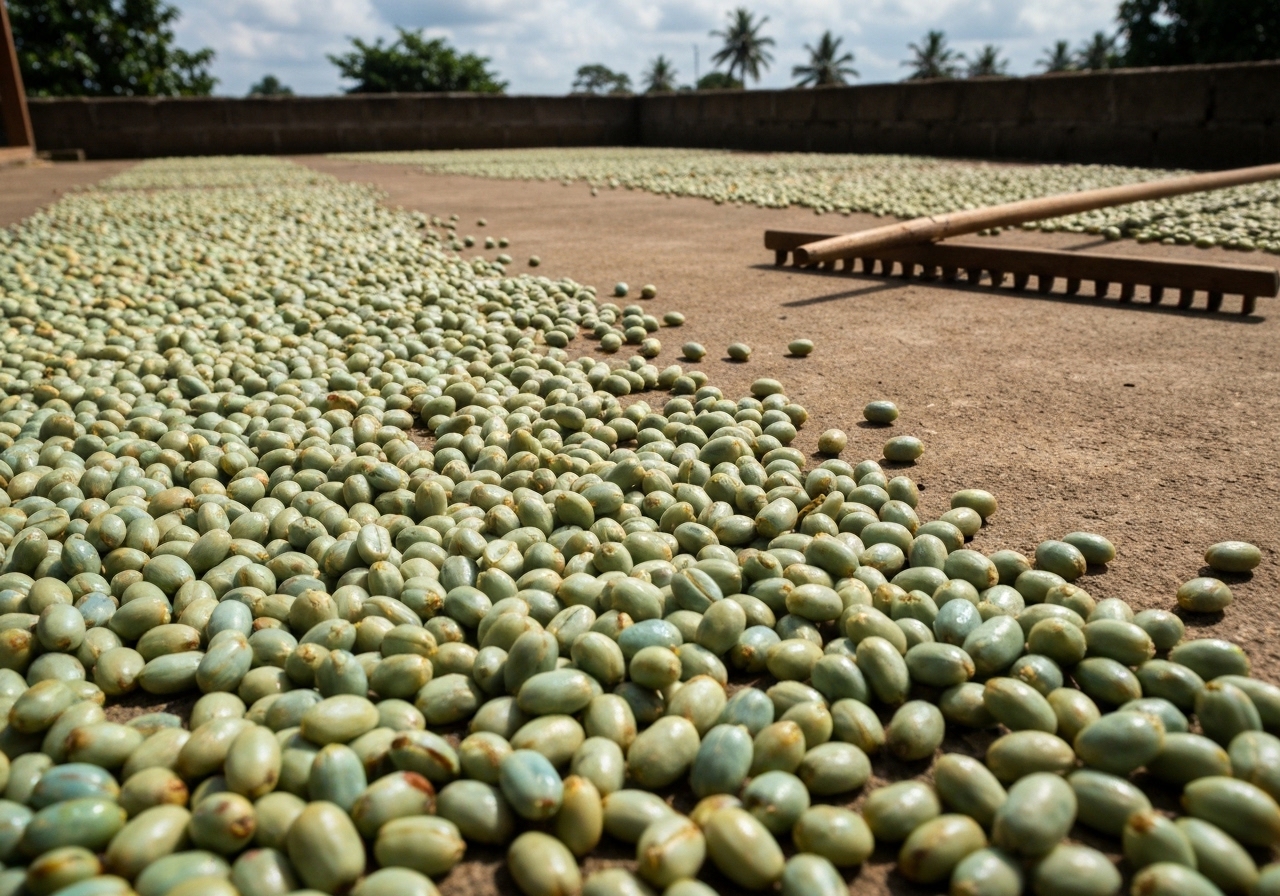
Wet-hulled beans drying without their parchment — exposed to the elements far earlier than in washed or natural methods
In conventional washed processing, parchment protects the bean throughout drying and is only removed at a dry mill weeks or months later. In giling basah, that protection is stripped away when the bean is still at 30–35% moisture — fundamentally altering how the coffee develops flavour.
Why It Exists
Wet-hulling is not a stylistic choice — it is a practical necessity born from geography. Indonesia straddles the equator, and its primary growing regions — the Gayo Highlands of Aceh, the Lintong plateau around Lake Toba in North Sumatra, and the mountains of Sulawesi and Flores — experience humidity levels that routinely exceed 80 percent with afternoon rainfall nearly year-round. Drying coffee in parchment to the standard 11 to 12 percent moisture, as a Kenyan or Colombian producer would, can take weeks under these conditions and risks mould, fermentation defects, and total crop loss.
By hulling at high moisture, farmers accelerate the drying window dramatically. A bean without parchment dries faster because there is no insulating shell trapping moisture inside. What might take three weeks in parchment can be accomplished in two to four days of open-air drying. For a smallholder farmer who needs cash flow and cannot afford extended drying infrastructure, this speed is not merely convenient — it is economically essential.
Specialty Coffee Association research notes that Indonesia’s average annual rainfall exceeds 2,000 mm in most growing regions, making extended outdoor drying unreliable without covered facilities that most smallholders lack.
Flavour Profile
Wet-hulled coffees occupy their own corner of the flavour spectrum. The early removal of parchment and prolonged exposure to humidity impart a set of characteristics that are immediately recognisable:
- Body: Full to syrupy, often the heaviest of any processing method
- Acidity: Muted, sometimes nearly absent — the opposite of a bright washed African coffee
- Primary flavours: Wet earth, cedar, tobacco, dark chocolate, raw cocoa
- Secondary notes: Fresh herbs, green pepper, pine resin, mushroom, sandalwood
- Finish: Long, savoury, occasionally smoky
These flavours have made wet-hulled Sumatran coffee a staple in dark-roast blends and espresso bases worldwide. The heavy body and low acidity provide a foundation that balances higher-toned origins in a blend. For single-origin drinkers, a well-processed Mandheling or Lintong can be revelatory — like tasting the volcanic soil and jungle canopy of Sumatra itself.

The deep, syrupy cup of a wet-hulled Sumatran — earthy, herbal, and unmistakable
Difference from Washed Processing
The distinction is not subtle. In a washed process, the bean stays inside its parchment throughout the entire drying phase, which can last one to three weeks on raised beds. The parchment acts as a buffer, protecting the bean from environmental influence and allowing slow, controlled moisture reduction. Only when the bean reaches 10 to 12 percent moisture does it go to a dry mill for hulling — by which point the bean is hard, dense, and stable.
In giling basah, the parchment is torn away while the bean is still soft and metabolically active. The naked bean absorbs and releases moisture in direct contact with the atmosphere, undergoes enzymatic changes that would not occur inside parchment, and develops the complex earthy aromatics that define the style. The same variety processed washed in Central America and wet-hulled in Sumatra would taste like two entirely different coffees — a powerful illustration of how much processing shapes what ends up in the cup.
The Blue-Green Bean
One of the most recognisable visual signatures of wet-hulled coffee is its colour. Where washed beans are typically jade green or blue-grey, and natural beans tend toward yellow-green, wet-hulled beans display a distinctive dark blue-green, almost teal appearance. This colour results from the enzymatic and oxidative reactions that occur when the unprotected bean is exposed to air at high moisture. Some roasters use this colour as a quick visual cue to identify wet-hulled lots before even reading the label. The beans also tend to be slightly softer and more irregularly shaped than their washed counterparts — a consequence of the aggressive mechanical hulling applied to pliable, wet parchment.
Why It Matters
Wet-hulling matters because it is proof that great coffee does not require a single universal method. In a specialty industry that often defaults to washed processing as the gold standard, giling basah is a reminder that local conditions, practical constraints, and generations of accumulated knowledge produce flavours that no other technique can replicate. The earthy complexity of a Sumatran Mandheling, the herbal intensity of a Sulawesi Toraja, the dark chocolate depth of a Flores Bajawa — none of these would exist without wet-hulling.
As specialty buyers increasingly invest in Indonesian origins — supporting infrastructure improvements, traceability systems, and farmer premiums — the quality ceiling for wet-hulled coffee continues to rise. The best lots from the Gayo Highlands now score above 86 points on the SCA scale, demonstrating that earthiness and quality are not mutually exclusive.
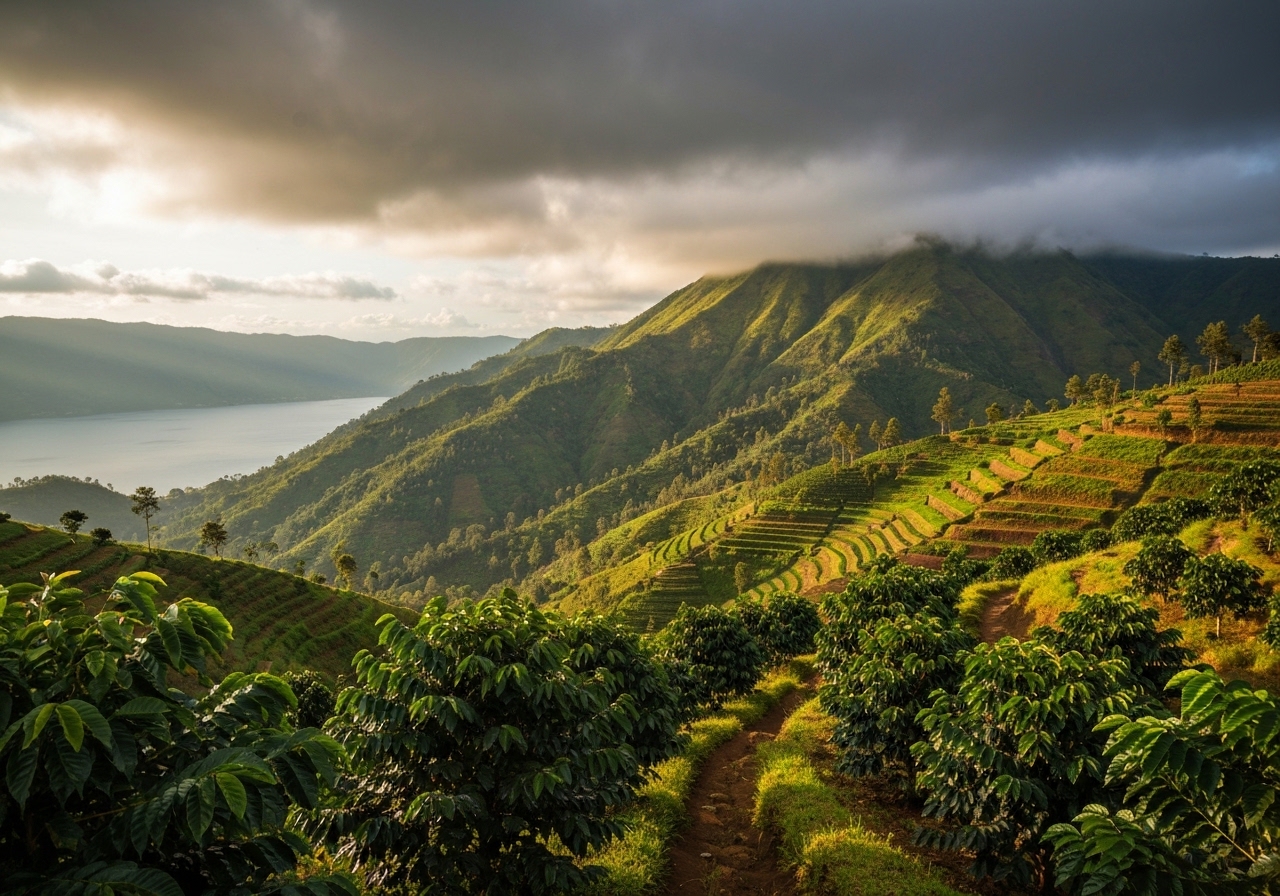
The volcanic highlands of Indonesia — where humidity, altitude, and tradition converge to produce one of coffee’s most distinctive processing methods
Further Reading
- The World Atlas of Coffee by James Hoffmann — detailed coverage of Indonesian processing and regional profiles
- Uncommon Grounds by Mark Pendergrast — the historical context of Indonesian coffee trade
- SCA Processing Research — post-harvest studies including humidity impact on flavour development
- Coffee Quality Institute — Q-grading protocols for evaluating wet-hulled lots
Related Topics
What is Coffee Processing?
Coffee processing — washed, natural, honey — transforms harvested cherries into green beans and shapes the cup more than almost any other variable, including roast level.
originIndonesia
The world's fourth-largest coffee producer, known for earthy Sumatran coffees and the unique wet-hulled processing method.
processWashed (Wet) Processing
Washed coffee processing removes all fruit before drying to reveal clean, bright cups — floral, terroir-transparent, and prized by the specialty world. The benchmark method.
processNatural (Dry) Processing
Natural processing dries whole coffee cherries in the sun before milling — the oldest method, and the one most responsible for fruity, wine-like, and berry-forward cups.