 English
  Українська
  Čeština
 A common assumption about dark roast coffee is that it contains more caffeine — the logic being that darker means stronger. A common assumption about light roast is that it is acidic and weak. Both assumptions are wrong, and correcting them opens up one of the most interesting aspects of specialty coffee: understanding what heat actually does to a coffee bean, and why roasters at the highest level tend to reach for the lighter end of the spectrum.
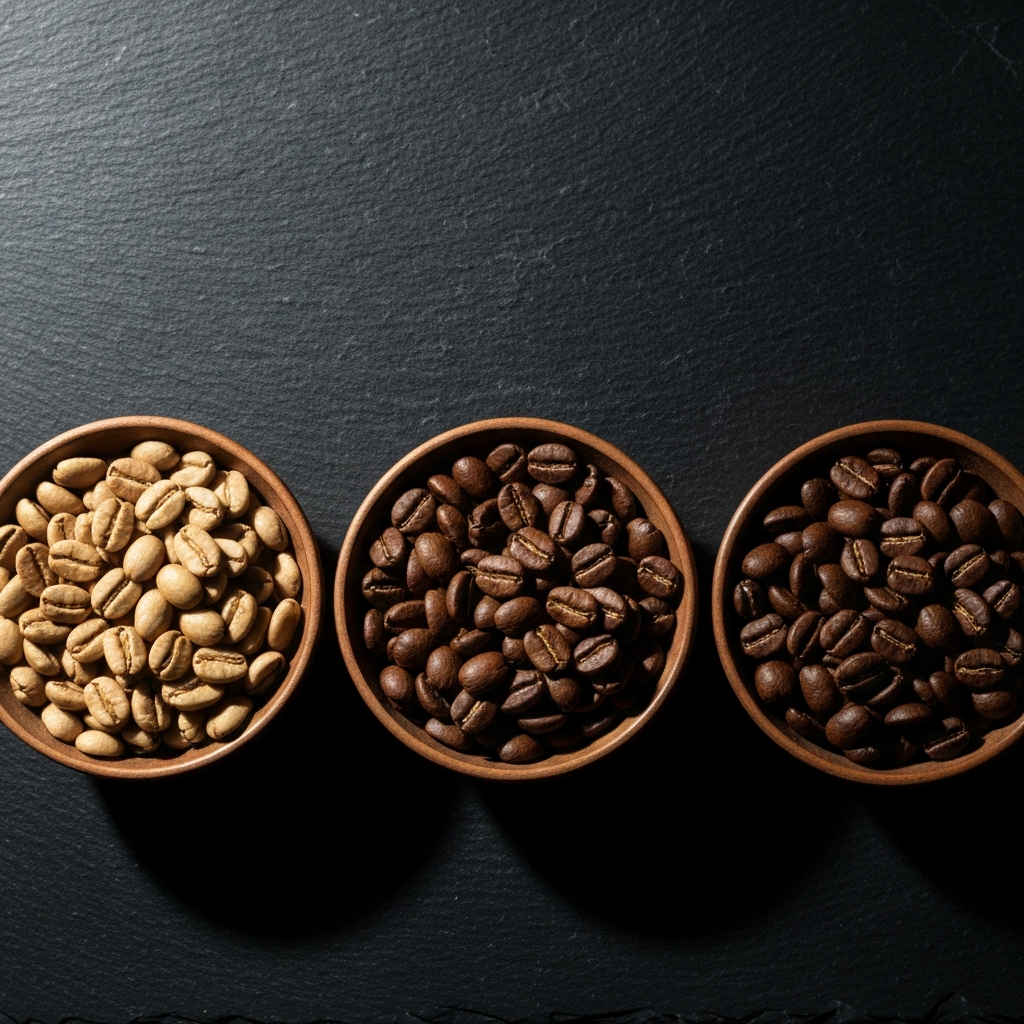
The colour shift from light to dark roast represents profound chemical transformation — not just different shades, but fundamentally different flavour compounds
What Happens Inside the Roaster
Green coffee — the raw, unroasted seed — is dense, grassy, and almost unrecognisable as coffee. It contains hundreds of chemical precursors: sugars, amino acids, chlorogenic acids, lipids, and aromatic compounds that do not yet resemble anything you would want to drink. The roasting process is essentially a controlled series of chemical reactions, driven by heat and time, that transform these precursors into the flavours and aromas we associate with coffee.
The two most important reaction types are the Maillard reaction and caramelisation. The Maillard reaction — the same process that browns bread and seared meat — combines amino acids and reducing sugars under heat to create hundreds of new flavour compounds: nutty, toasty, chocolatey, and caramelised notes. Caramelisation converts sucrose through heat into a spectrum of sweet-to-bitter caramel compounds. Both reactions accelerate dramatically with heat, which is why dark roasting pushes flavour in a specific direction: longer in the roaster means more of these reactions proceeding further, consuming more of the original fruit acids and sugars.
Light Roast: Preserving the Origin
Light roast typically refers to beans taken to an internal temperature of around 195–205°C, dropped before or shortly after “first crack” — the audible snap that occurs when the bean’s steam pressure releases through its structure. At this stage, the bean retains most of its original organic acids, fruit sugars, and the aromatic compounds that reflect its terroir. A light-roasted Ethiopian natural might taste of blueberry, jasmine, and lemon zest. A light-roasted Colombian might offer red apple, brown sugar, and black tea.
The tradeoff is that light roasts are less soluble and require more precise extraction. They are less forgiving of poor grind consistency, off water temperature, or inaccurate ratios. Grind them too coarse and they will taste watery and sour; too fine and they become harsh. This is why light roast has a reputation — partly deserved — for being finicky. In skilled hands, however, it produces the most complex, transparent expression of what a coffee was before the roaster touched it.
Dark Roast: Flavour from the Fire
Dark roast takes the coffee significantly further into the roast — past second crack in many cases, to internal temperatures of 225°C or beyond. At this stage, the Maillard and caramelisation reactions have largely consumed the delicate fruit acids and sugars, replacing them with roast-derived compounds: dark chocolate, smoke, bittersweet caramel, and in extreme cases, carbon. The result is a coffee that tastes more like roasting and less like its origin — a consistent, predictable flavour profile that does not vary much regardless of where the bean came from.
This is the point that specialty roasters make most forcefully: dark roasting masks terroir. A light-roasted Kenyan and a light-roasted Guatemalan taste dramatically different; dark-roasted to the same level, they converge toward a generic bitterness. For commodity blending, this is useful — it creates consistency across varied raw materials. For specialty coffee, it is counterproductive. Why pay for a distinctive farm lot if you are going to roast away everything that made it distinctive?
Dark roast also does not mean stronger in terms of caffeine. Caffeine is relatively heat-stable; it degrades very little across roast levels. Dark-roasted beans are physically less dense (moisture and CO₂ have been driven out), so by weight, dark roast coffee may actually contain slightly more caffeine per gram than light roast. By volume — a scoop versus a scoop — they are essentially the same.
Medium Roast: The Versatile Middle
Medium roast occupies the space between the first and second cracks, typically reaching 210–220°C. It balances the origin character of lighter roasts with enough roast development to mellow harsh acidity and create body and sweetness. Medium roast is the sweet spot for many brewing methods — it extracts consistently, tastes approachable without blandness, and works well for everything from pour-over to French press to espresso. Most specialty roasters offer at least one medium-roast option precisely because it bridges the gap between the complexity of light and the familiarity of dark.
How Roast Level Interacts with Brewing
Roast level should inform how you brew. Light roasts benefit from hotter water (93–96°C) and finer grinds to coax out their higher-solubility compounds. Dark roasts extract easily and often taste better with slightly cooler water (88–92°C) and coarser grinds, reducing the risk of over-extraction and bitterness. Brew ratio matters across all roast levels, but the consequences of error are more pronounced at the extremes.
When you read a coffee bag and it omits the roast level, look at the roast date window recommended, the tasting notes (fruity and floral suggests light; chocolatey and smoky suggests dark), and whether the roaster specialises in single origins (typically lighter) or blends (often darker).
Where to Go Next
- Brewing Ratios Explained — adjust your dose and grind to match your roast level
- Your First Cup: A Tasting Guide — learn to perceive the flavour differences between roast levels
- Coffee Processing Methods — understand how processing interacts with roast to shape final flavour
Related Topics
What Is Specialty Coffee?
The 80-point SCA scale separates extraordinary coffee from commodity. Here is what that number actually means, how it is scored, and why it matters in the cup.
getting-startedArabica vs. Robusta: The Two Faces of Coffee
Arabica and Robusta are the two dominant coffee species — and they differ in genetics, flavour, caffeine, altitude, and price in ways that shape every cup you drink.
getting-startedYour First Cup: Learning to Taste Coffee
Acidity, sweetness, body, finish — the sensory vocabulary of coffee is not intimidating once you know what you are actually looking for. Here is how to start tasting.
getting-startedGrind Size Guide: How Particle Size Shapes Your Cup
From coarse to extra-fine: how grind size controls extraction, which grinder type matters, and how to dial in for every brew method.