 English
  Українська
  Čeština
 Specialty coffee is a perishable. This is the fact that the industry has historically been least eager to advertise — because a perishable product demands a roast date on the bag, a clear sell-by window, and a consumer who knows enough to ask. Understanding how coffee goes stale, and what you can do to slow it, is one of the highest-return improvements any home brewer can make to their cup.
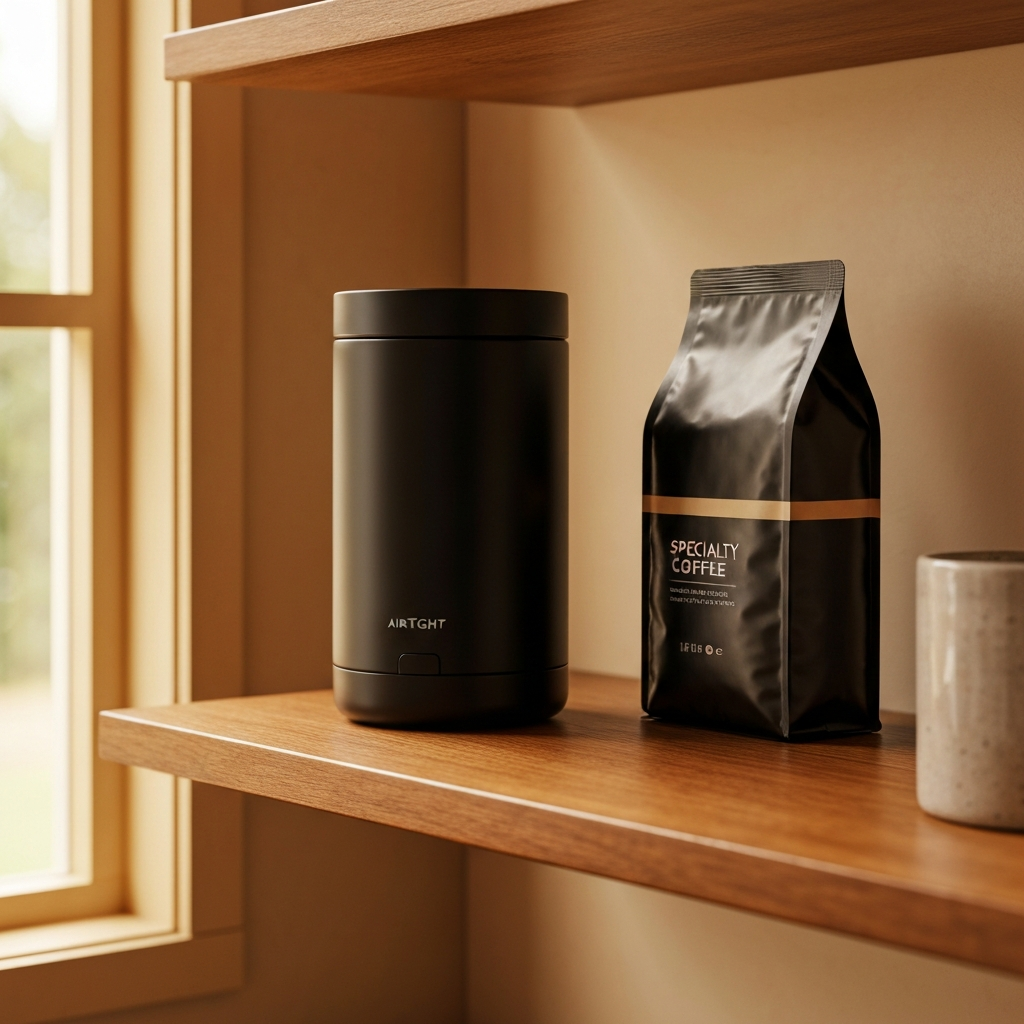
An airtight, opaque container is the simplest and most effective investment in coffee freshness you can make
The Four Enemies of Coffee Freshness
Coffee degrades through four primary mechanisms — and understanding each one explains every best practice in coffee storage.
Oxygen is the primary villain. Roasted coffee beans are porous and contain hundreds of aromatic volatile compounds that oxidise on contact with air. Oxidation breaks down these compounds into less complex, less pleasant molecules — the process that turns a vibrant, fruity Ethiopian into something flat, papery, and vaguely of cardboard. This is why coffee left in an open bag for a week tastes so different from the same coffee on day three.
Light accelerates oxidation, particularly UV light. Clear glass jars on a sunny windowsill are one of the fastest ways to degrade coffee. Even ambient indoor light contributes to photo-oxidation over time.
Heat speeds up virtually every chemical reaction, including the degradation reactions that stale coffee. A bag left near the stove, in a warm car, or on top of a coffee machine (the irony is common) will go stale faster than one stored in a cool cupboard.
Moisture is the most immediately damaging. Coffee is hygroscopic — it readily absorbs water vapour from the air. Moisture triggers premature extraction of the soluble compounds inside the bean, and in high enough quantities, encourages mould. Never store coffee in the refrigerator, where it will absorb moisture and fridge odours simultaneously.
The Optimal Storage Window
Roasted coffee is best consumed between 5 and 30 days after the roast date for most filter brewing methods. For espresso, many roasters and baristas recommend 10–21 days, as the CO₂ still present in very fresh coffee can interfere with extraction and produce sour, gassy results.
After 30 days, most coffees begin to lose the aromatic complexity that makes specialty coffee worth paying for. After 60 days, even well-stored coffee will taste noticeably flatter than it did at its peak. This does not mean coffee becomes undrinkable — it simply becomes ordinary in the same way that week-old bread is still bread, just not exceptional bread.
This is why the roast date on the bag matters so much: it tells you where you are in that window. Coffee without a roast date is asking you to gamble with your cup.
Best Practices for Open Bags
Once a bag of coffee is open, your goal is to minimise its exposure to the four enemies above.
Keep it in the original bag if it has a one-way valve. Most specialty coffee bags feature a small round valve that allows CO₂ produced by the beans to escape without letting oxygen in. This is genuinely useful design — do not pierce or remove it. The foil or kraft paper of a quality bag, with the valve intact and top rolled down tightly, is a reasonable short-term solution for the first week.
Transfer to an airtight container. After the first few days, or if your original bag lacks a valve, transfer the beans to a dedicated coffee canister with an airtight seal. Ceramic or stainless steel canisters with compression lids (which push out residual air as you close them) are the gold standard. Dark, opaque containers protect against light simultaneously.
Do not use glass jars on display. They look beautiful. They are poor storage. Light penetration and the frequent opening required to admire the beans both accelerate staling. Reserve glass for decoration and use an opaque container for actual storage.
Store in a cool, dry cupboard. Room temperature in a dark cupboard — typically 18–22°C in a European home — is ideal. Away from the stove, oven, dishwasher, and any surface that heats up regularly.
Buy small, buy often. The single most effective storage strategy is to buy no more coffee than you will consume in two to three weeks. No container or technique defeats time like simply not having to fight it.
The Freezer Debate
The freezer is coffee’s most contested storage environment. The verdict: used correctly, freezing is excellent. Used carelessly, it causes condensation damage that ruins beans fast.
The case for freezing is real: at -18°C, oxidation and other chemical degradation reactions slow to a near-halt. Coffee frozen within a few days of roasting can retain its freshness for months. This is why specialty roasters sometimes freeze competition lots or limited micro-lots they want to preserve.
The case against is equally real: every time frozen coffee is exposed to warm air, moisture condenses on the cold beans. If you open the bag repeatedly, each cycle deposits more moisture, accelerating staling rather than preventing it.
If you freeze coffee, do it correctly:
- Freeze only if you have more coffee than you can drink within three to four weeks
- Divide into single-use portions before freezing — enough for one or two brewing sessions
- Seal each portion airtight in a zip-lock bag, pushing out all air
- When ready to use, remove a portion and let it return to room temperature before opening the bag — at least 30–45 minutes. This prevents condensation by allowing the beans to warm before they contact air
- Never return thawed coffee to the freezer
Used this way, the freezer is genuinely useful for managing larger quantities of exceptional coffee you want to keep at its best. Used casually — repeatedly opening a bag from the freezer each morning — it is worse than a cupboard.
Ground Coffee vs. Whole Beans
Always store whole beans and grind immediately before brewing. Ground coffee has a surface area many orders of magnitude larger than whole beans, which means it oxidises dramatically faster. Pre-ground coffee begins losing perceptible quality within 15–30 minutes of grinding at room temperature. Even the best storage container cannot meaningfully slow this.
The difference between pre-ground coffee brewed immediately and the same coffee ground 12 hours earlier can be detected by most people with no coffee training. A modest hand grinder paired with whole bean storage will produce a noticeably better cup than even a high-quality flat-burr grinder paired with pre-ground coffee stored overnight.
Practical Summary
| Situation | Recommendation |
|---|---|
| Bag just opened | Roll down tight, use valve bag within a week |
| 1–3 weeks of coffee | Airtight, opaque canister in a cool cupboard |
| More than you can drink in 3 weeks | Freeze in single-use airtight portions |
| Pre-ground | Use within 15 minutes of grinding |
| Refrigerator | Never — moisture and odour absorption |
| Glass jar on window | Never — light and temperature fluctuation |
Where to Go Next
- Coffee Freshness — the science of CO₂ degassing and why freshness windows exist
- How to Read a Coffee Bag — decoding roast dates and what they mean for storage
- What Is Specialty Coffee? — why the coffee worth storing carefully is worth seeking out
Related Topics
Coffee Freshness: Why Roast Date Matters More Than Expiry Date
Why the roast date on your coffee bag tells you far more than any best-before stamp — and how to store, rest, and time your coffee for the best cup.
scienceHow Oxygen Destroys Coffee — and How to Stop It
How oxidation makes coffee go stale, why whole beans stay fresh longer, the right storage containers to use, whether refrigeration works, and how to freeze coffee properly.
getting-startedWhat Is Specialty Coffee?
The 80-point SCA scale separates extraordinary coffee from commodity. Here is what that number actually means, how it is scored, and why it matters in the cup.
getting-startedHow to Read a Coffee Bag
Every detail on a specialty coffee bag is a clue — origin, process, roast date, elevation, variety, tasting notes. Here is how to decode them all.