 English
  Українська
  Čeština
 Cupping is the way the coffee world tastes. From a green buyer evaluating samples in an importing warehouse in Hamburg to a farmer assessing her harvest at a cooperative in Rwanda to a roaster dialling in a new single origin from Ethiopia, the cupping protocol is the universal standard — a shared language that allows coffee to be evaluated consistently, comparatively, and objectively anywhere on Earth. It is the closest thing coffee has to a controlled experiment: same dose, same water, same time, same temperature, same method, every time. The only variable is the coffee itself.
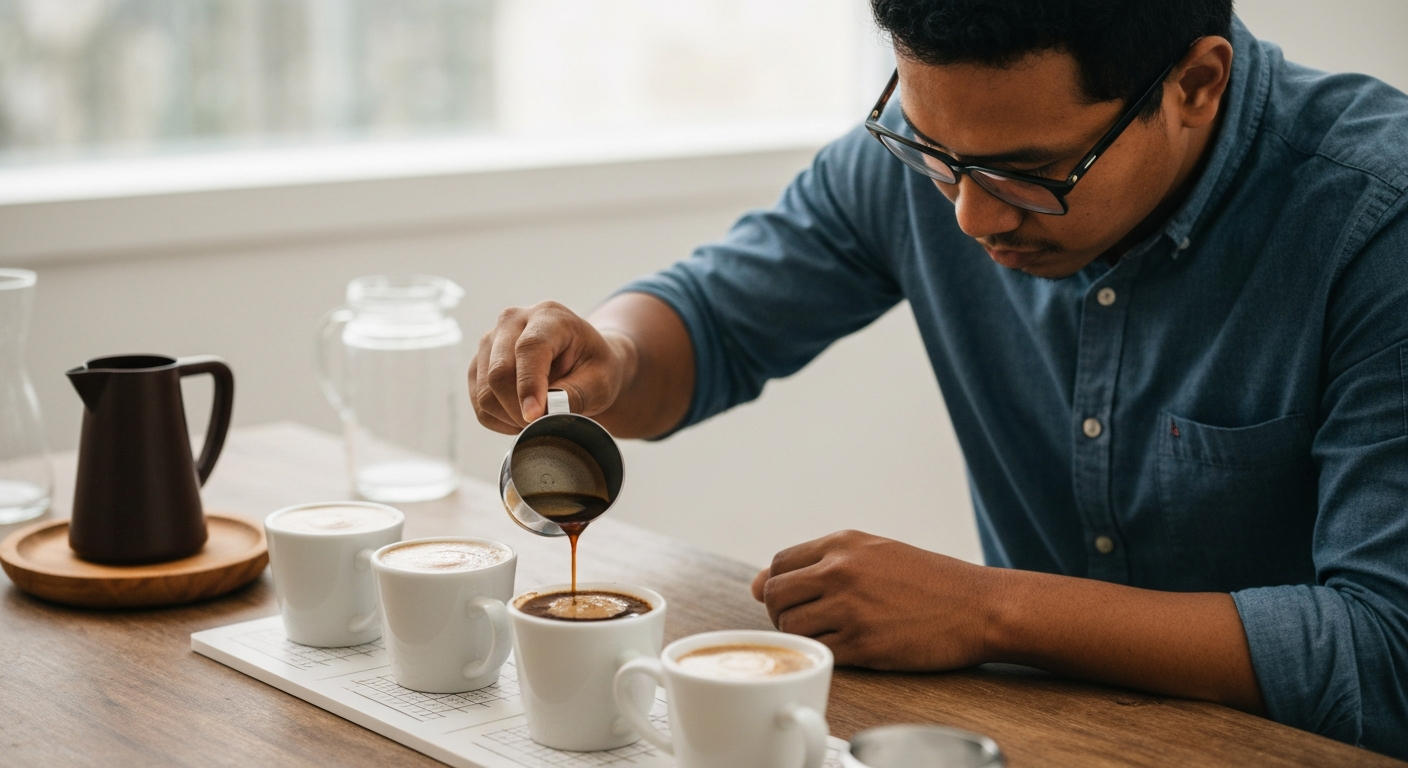
The cupping table — multiple samples arranged for systematic evaluation, each brewed identically to isolate quality differences
Understanding how to cup — and why the protocol is designed the way it is — will make you better at tasting any coffee, brewed any way. It is the single most useful skill a coffee enthusiast can develop.
What Is Cupping?
Cupping is a standardised infusion method where coarsely ground coffee is steeped in hot water directly in a bowl (or wide-mouthed cup), the crust of floating grounds is broken and skimmed, and the liquid is tasted by slurping from a deep spoon. There is no filter, no dripper, no press — just coffee and water in direct contact, evaluated through aroma, flavour, aftertaste, acidity, body, balance, sweetness, cleanliness, uniformity, and overall impression.
The method is deliberately simple and deliberately standardised. By removing all brewing variables — grind size is fixed, ratio is fixed, temperature is fixed, steep time is fixed — cupping isolates the intrinsic quality of the coffee from the skill of the brewer. A pour-over can make a mediocre coffee taste acceptable through careful technique; cupping strips that possibility away. What you taste on the cupping table is what the coffee is.
“Cupping is not a brewing method — it is an evaluation tool,” writes James Hoffmann in The World Atlas of Coffee. “Its purpose is truth. The cupping protocol removes the brewer from the equation so that only the coffee speaks.”
The SCA Cupping Protocol
The Specialty Coffee Association (SCA) cupping protocol is the global standard, used in Q-grading certification, Cup of Excellence competitions, and professional purchasing decisions worldwide. Here is the full procedure:
Equipment per sample:
- 5 cupping bowls (150–180ml, ceramic or tempered glass)
- Cupping spoons (deep, round-bowled, typically silver-plated or stainless steel)
- A grinder (burr, cleaned between samples)
- Filtered water, heated to 93°C (200°F)
- Timer
- Cupping forms
Ratio: 8.25g of coffee per 150ml of water (approximately 1:18.2)
Grind: Slightly coarser than for a pour-over — about 70–75% of the particles should pass through a US Standard #20 (850 micron) sieve

Precision at every step — SCA cupping demands exact ratios, temperatures, and timing to ensure fair, repeatable evaluation
Step by step:
-
Dry fragrance (before water): Grind the coffee into the cupping bowl. Lean in and evaluate the aroma of the dry grounds — this reveals volatile compounds that may dissipate once water is added. Note intensity, complexity, and character. Floral? Fruity? Chocolatey? Spicy?
-
Infusion (0:00): Pour 93°C water directly onto the grounds, filling the bowl. Start the timer. Allow a crust of grounds to form on the surface. Do not stir, agitate, or disturb the crust.
-
Wet aroma (3:00–4:00): At 3 to 4 minutes, lean close to the bowl and “break the crust” — use the back of your cupping spoon to push through the floating grounds in three deliberate strokes, nose directly above the surface. This releases a concentrated burst of aroma. Evaluate the wet aroma for changes from the dry fragrance — new notes often emerge (citrus, stone fruit, fermented character, defects).
-
Skim (4:00–5:00): After breaking the crust, skim the surface with two spoons held together, removing floating grounds and foam. The goal is a clean liquid surface ready for tasting.
-
Tasting (8:00–10:00 and beyond): Once the coffee has cooled to approximately 70°C (around 8–10 minutes), begin tasting. Take a spoonful and slurp it forcefully — the spray of liquid across the palate allows it to hit all taste receptors simultaneously and aerates the coffee, releasing volatile aromatics into the nasal passage. Evaluate flavour, aftertaste, acidity, body, and balance.
-
Cooling evaluation: Return to the cups repeatedly as they cool. Coffee changes dramatically with temperature — flavours that are muted when hot emerge as the liquid drops to 60°C, 50°C, 40°C. The best coffees improve as they cool; flawed coffees often worsen. This multi-temperature evaluation is one of cupping’s most powerful features.
-
Scoring: Using the SCA cupping form, score each attribute on a scale of 6 to 10 (in quarter-point increments). The ten scored attributes are: fragrance/aroma, flavour, aftertaste, acidity, body, balance, sweetness, clean cup, uniformity, and overall. Defects (taints and faults) are subtracted. A total score of 80+ qualifies as “specialty grade.”
The Scoring System
The SCA scoring scale translates sensory impressions into numbers:
- 90–100: Outstanding. Exceptional complexity, balance, and character. Rare.
- 85–89.99: Excellent. Distinctive origin character, high complexity. The sweet spot of premium specialty.
- 80–84.99: Very good. Clean, pleasant, with identifiable positive attributes. The entry point for specialty grade.
- Below 80: Not specialty. May have defects, lack complexity, or present unpleasant characteristics.
These scores drive the entire specialty supply chain. Farmers who produce 85+ coffees command premium prices; 90+ lots sell at auction for extraordinary sums. The Cup of Excellence competition, which uses a modified version of the SCA protocol, has seen winning lots from Colombia, Ethiopia, and Kenya sell for over $100 per pound — compared to commodity prices of $1–3.
Every cupping score tells a story — of altitude, variety, processing, and the care invested at every stage from seed to cup
How to Cup at Home
You do not need a Q-grading certification or a professional cupping lab to benefit from cupping. The protocol scales down beautifully for home use, and the practice will sharpen your palate faster than any other exercise.
Simplified home setup:
- 2–4 wide-mouthed cups or small bowls (ceramic mugs work)
- A soup spoon (the deeper the bowl, the better)
- Your regular burr grinder
- A kitchen scale
- A kettle
- Two or more coffees to compare (cupping is most educational when you taste comparatively)
Home recipe:
- 12g of coffee per cup
- 200ml of water at 93°C
- Grind: medium-coarse
Procedure: Follow the same steps as the SCA protocol — dry fragrance, infusion, break the crust at 4 minutes, skim, taste from 8 minutes onward. The most important habit is tasting as the coffee cools — take notes at multiple temperatures and observe how the cup evolves.
What to pay attention to:
- Acidity: Is it bright, tart, flat, or absent? Does it remind you of citrus, stone fruit, berries, or wine?
- Body: How heavy does the coffee feel in your mouth? Watery, silky, creamy, or syrupy?
- Sweetness: Where is it? Honey, brown sugar, caramel, fruit sweetness?
- Finish: Does the flavour linger pleasantly or disappear abruptly? Is the aftertaste clean or harsh?
- Defects: Does anything taste off — fermented, musty, rubbery, medicinal? These are clear quality markers.
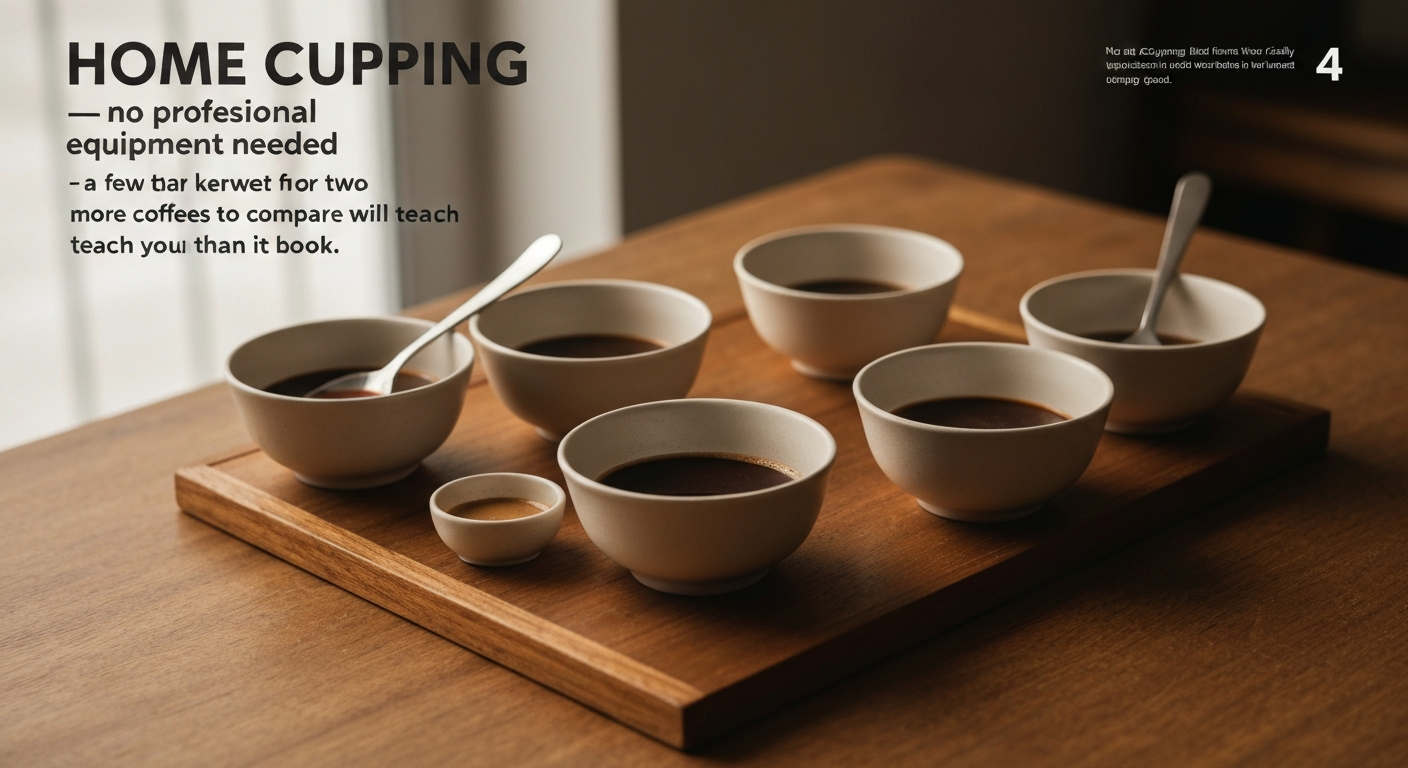
Home cupping — no professional equipment needed. A few bowls, a spoon, and two or more coffees to compare will teach you more than any book
The single most powerful exercise for developing your palate: cup the same coffee from two different processing methods — a washed and a natural from the same origin, or the same variety processed two ways. The differences will be immediately, dramatically apparent, and you will learn more in one session than in weeks of casual drinking.
Why Cupping Matters
Cupping matters because it is where quality is defined, bought, and sold. Every specialty coffee you have ever enjoyed was cupped — probably dozens of times — before it reached your cup. The farmer cupped it to assess the harvest. The cooperative cupped it to grade and lot-separate. The exporter cupped it to assign a price. The importer cupped it to select offerings. The roaster cupped it to develop a profile. The barista may have cupped it to choose a brew method.
For the home enthusiast, cupping is the fastest path to understanding what you like and why. It builds vocabulary, sharpens attention, and reveals the enormous range of flavour that coffee — a single agricultural product from a single genus of plant — can express. Once you start cupping regularly, you will never taste coffee the same way again.
Further Reading
- The World Atlas of Coffee by James Hoffmann — cupping methodology, flavour description, and tasting notes framework
- The Coffee Cuppers Handbook by Ted R. Lingle — the foundational text on cupping methodology and sensory evaluation
- SCA Cupping Protocols — the official standard, including downloadable cupping forms
- Coffee Quality Institute — Q-grading certification and cupping calibration resources
- Cup of Excellence — competition cupping results and winning lot profiles
Related Topics
What is Coffee Brewing?
Coffee brewing extracts soluble flavour from roasted grounds using water — and grind size, temperature, time, and ratio all determine whether the cup sings or disappoints.
processWashed (Wet) Processing
Washed coffee processing removes all fruit before drying to reveal clean, bright cups — floral, terroir-transparent, and prized by the specialty world. The benchmark method.
processNatural (Dry) Processing
Natural processing dries whole coffee cherries in the sun before milling — the oldest method, and the one most responsible for fruity, wine-like, and berry-forward cups.
getting-startedWhat is Coffee Origin?
Coffee origin is the story of place — altitude, soil, and climate shape every flavour note. From Ethiopian florals to Colombian caramel and Kenyan citrus.