 English
  Українська
  Čeština
 When someone calls coffee “a cup of java,” they are invoking over three centuries of history. The island of Java — part of the vast Indonesian archipelago — was the launchpad for one of the most consequential chapters in coffee’s global story, and it remains a producing origin with a character all its own. Java’s coffees are defined by their full body, low acidity, and an earthy depth that reflects both the island’s volcanic geology and its unique processing traditions. For coffee historians and flavour explorers alike, Java is essential territory.
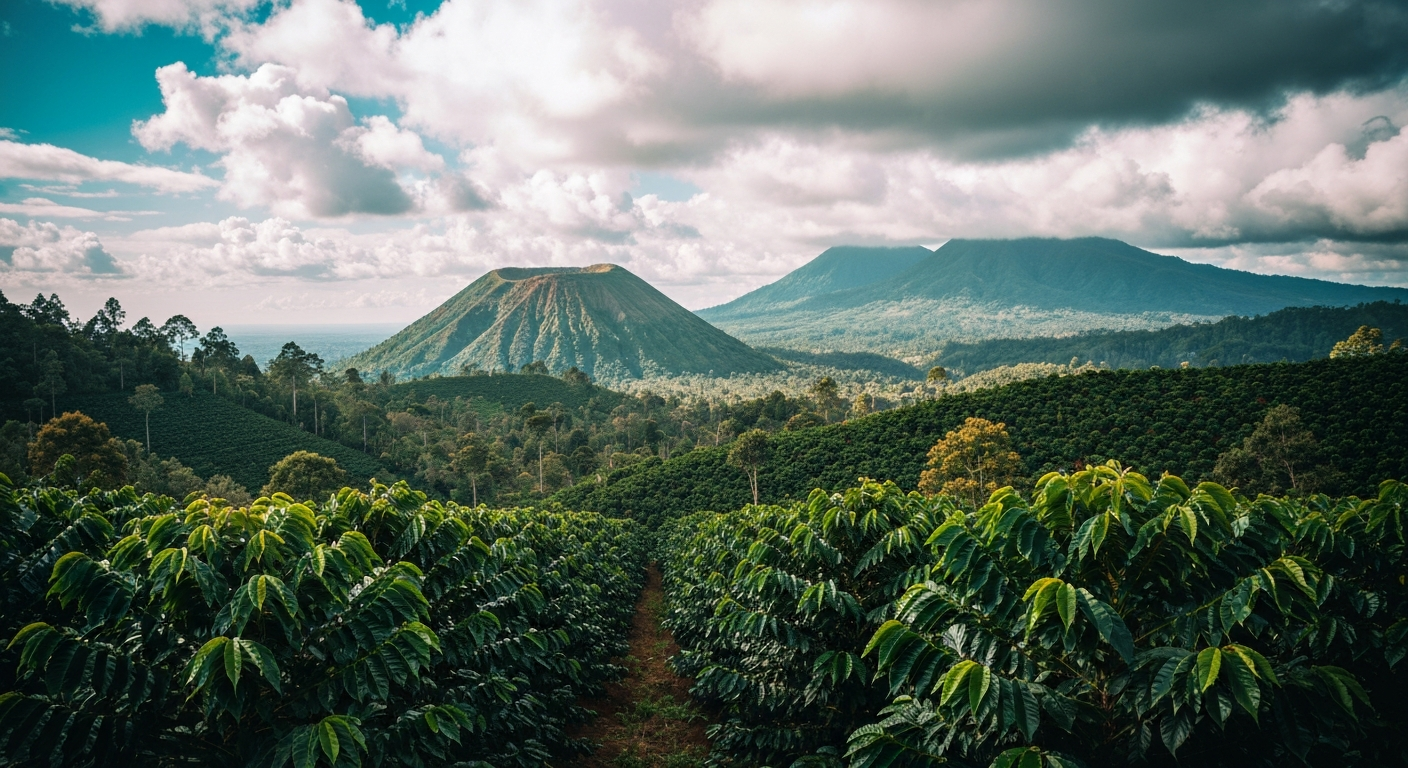
Java’s volcanic landscape — rich soils and tropical humidity have sustained coffee cultivation for over 300 years
Dutch Colonial History
Java’s coffee story begins in 1696, when the Dutch East India Company (VOC) transported Arabica seedlings from Malabar, India, to the island — one of the earliest deliberate transplantations of coffee outside the Arabian Peninsula and Ethiopia. The initial planting failed, destroyed by flooding, but a second shipment in 1699 took hold. Within two decades, Java had become the world’s first large-scale coffee-producing region outside Yemen, and the Dutch monopoly on Javanese coffee made the VOC fabulously wealthy.
The colonial cultuurstelsel (cultivation system) imposed in 1830 forced Javanese farmers to dedicate a portion of their land to export crops — primarily coffee, sugar, and indigo. This coercive system devastated local communities but flooded European markets with cheap Javanese coffee, establishing “Java” as a synonym for the drink itself. As Mark Pendergrast documents in Uncommon Grounds, the Dutch colonial coffee trade was one of the most profitable — and exploitative — enterprises in imperial history.

Java’s coffee heritage stretches back to 1699 — making it one of the oldest commercial coffee origins on Earth
In the late 19th century, the devastating coffee leaf rust epidemic (Hemileia vastatrix) swept through Southeast Asia, destroying the vast majority of Java’s Arabica plantations. The Dutch replanted extensively with disease-resistant Robusta, which now accounts for the majority of Indonesian coffee production. But Arabica survived in the highlands — and today, Java’s remaining Arabica estates produce some of Indonesia’s most distinctive specialty coffees.
The phrase “Mocha-Java” — one of the oldest blends in coffee history — refers to the combination of Yemeni coffee shipped through the port of Mocha with Javanese coffee shipped by the Dutch. This blend, popular since the 17th century, married Yemen’s wine-like complexity with Java’s earthy body.
Regions and Estates
Unlike the smallholder-dominated coffee sectors of Sumatra and Sulawesi, Java’s specialty Arabica production is concentrated on a handful of large government-owned estates (PTP Nusantara) that were established during the Dutch colonial period and nationalised after Indonesian independence.
The Ijen Plateau on Java’s eastern tip, at elevations of 1,200 to 1,500 metres on the slopes of the Ijen volcano, is the primary Arabica zone. The estates of Jampit, Blawan, and Kayumas — all located in this volcanic highland — are the names most associated with premium Javanese Arabica. The Ijen’s sulphur-rich volcanic soils, combined with the moderating influence of the Indian Ocean, produce a terroir that yields dense, heavy beans with distinctive mineral notes.
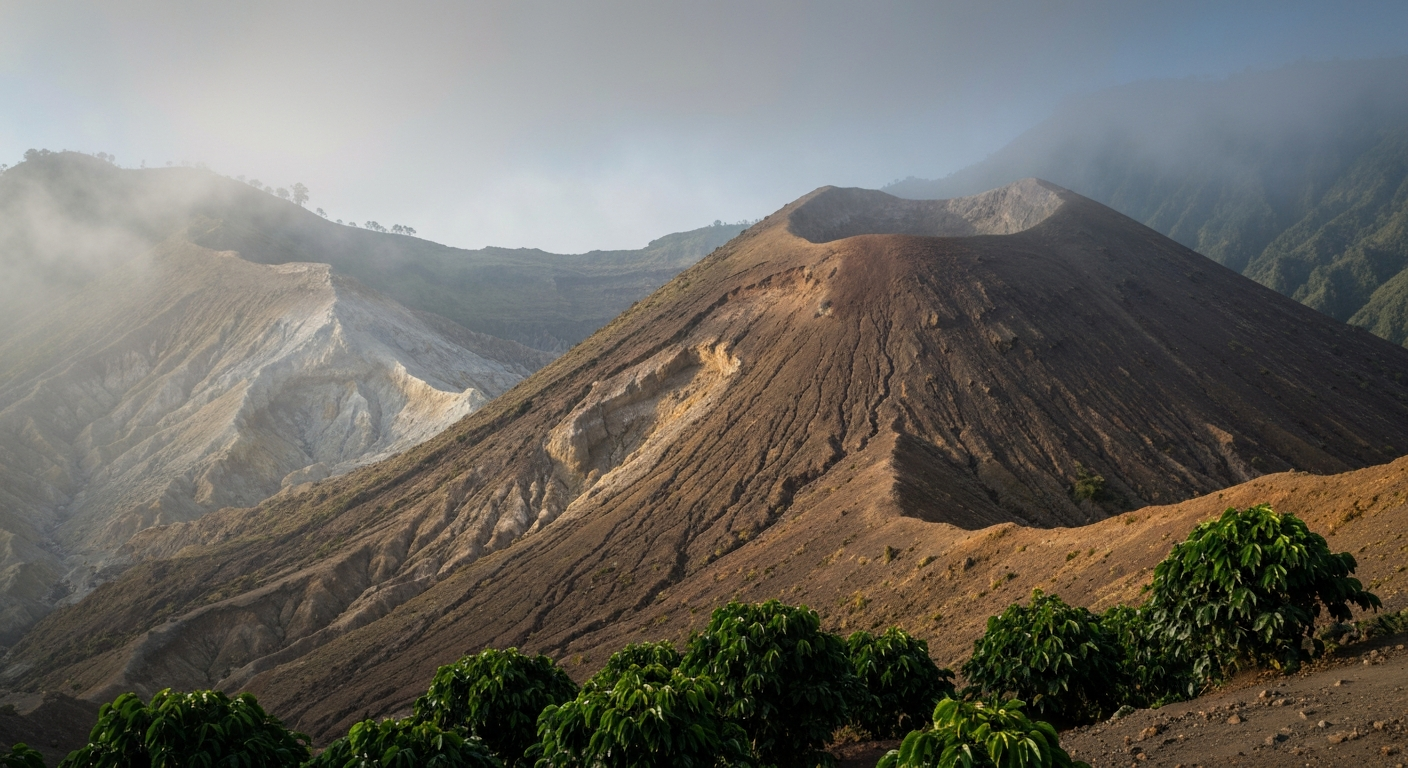
The Ijen Plateau — Java’s premier Arabica zone, where volcanic soils and altitude converge at the island’s eastern edge
Smaller Arabica production also exists in the Arjuno-Welirang highlands of East Java and on the slopes of Mount Merbabu in Central Java, though these lots are less commonly seen on the international specialty market.
Processing — Washed and Monsooned
Java is unusual among Indonesian islands in that its estate-produced Arabica is primarily fully washed — a legacy of the Dutch colonial infrastructure. This sets Javanese coffee apart from the wet-hulled (giling basah) coffees of Sumatra and Sulawesi, producing a cleaner, more refined cup with less of the rustic, wild character associated with those origins.
Washed Javanese Arabica is smooth, balanced, and full-bodied, with subdued acidity and flavours of dark chocolate, molasses, dried herbs, and a persistent earthy undertone. The cup is heavy without being rough — a quality that has made Java a favoured component in espresso blends for centuries.
A small but notable category is Old Java or monsooned Java — green coffee that has been deliberately aged in warehouses for two to three years, during which exposure to the humid monsoon air causes the beans to swell, lose acidity, and develop a profoundly deep, syrupy, almost woody character. This tradition mirrors the accidental “improvement” that occurred during the months-long sailing voyages of the Dutch colonial era, when beans stored in the hulls of ships were transformed by salt air and humidity. Old Java is polarising — its admirers love the musty depth and velvet body; its detractors find it flat and past its prime. Either way, it is a unique artefact of coffee history.
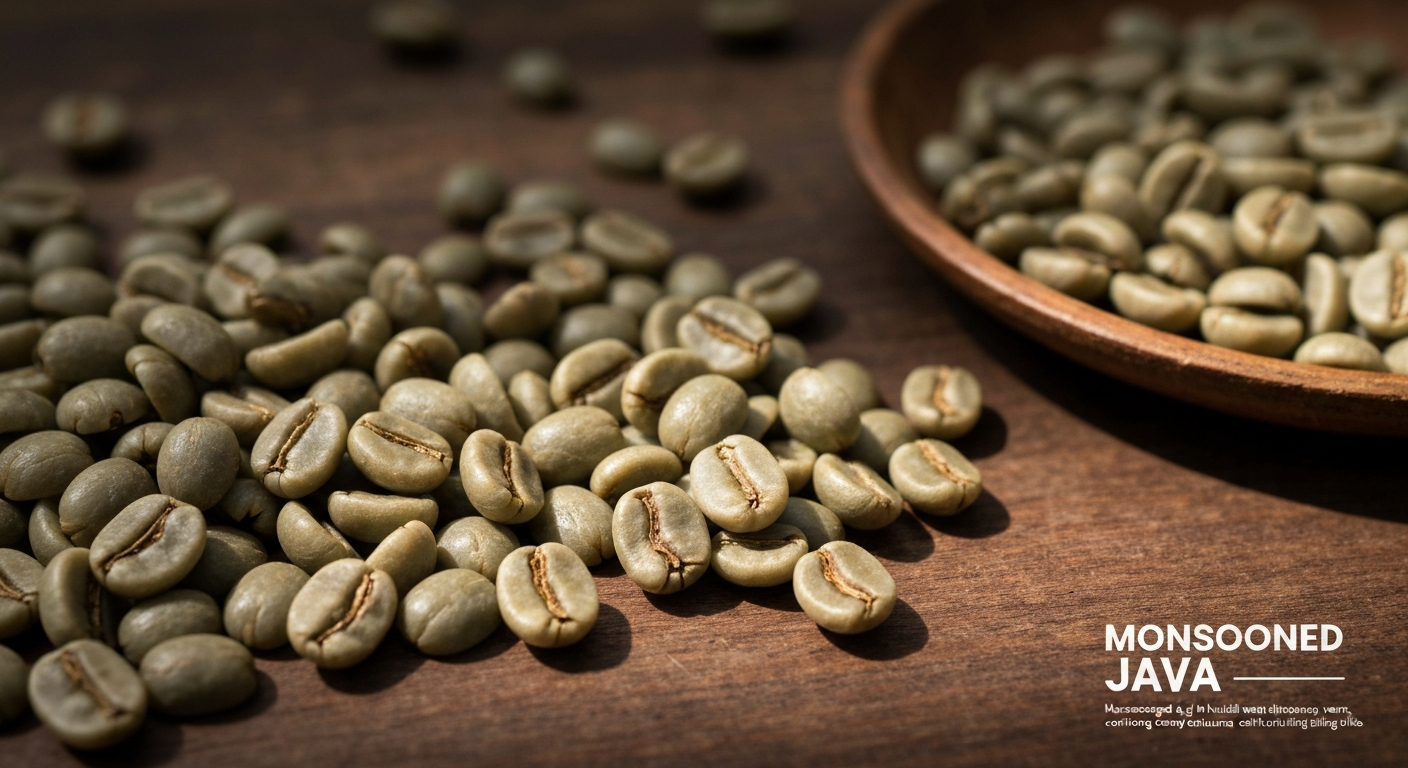
Monsooned Java — beans aged in humid warehouses for years, swelling and developing the deep, earthy character that recalls colonial-era sailing ships
Varieties
Java’s Arabica plantings centre on the Typica variety — specifically selections that trace their lineage directly to those first Dutch transplantations of the late 17th century. These Javanese Typica trees are, in genetic terms, among the most historically significant coffee plants on Earth. The seedlings that the Dutch sent from Java’s botanical gardens to Amsterdam in 1706 eventually became the parent stock for virtually all Typica coffee grown in the Americas — from Colombia to Brazil to Guatemala.
In addition to heritage Typica, some estates have planted the USDA selection (a Typica derivative developed for disease resistance) and various Catimor hybrids. The estate model allows for more controlled varietal management than the smallholder systems found elsewhere in Indonesia, contributing to Java’s relatively consistent cup profile from year to year.
Flavour Profile
Java Arabica delivers a cup that is:
- Body: Full, heavy, syrupy — among the most substantial of any origin
- Acidity: Low and subdued, sometimes barely perceptible
- Flavour: Dark chocolate, baker’s cocoa, molasses, dried herbs, tobacco leaf
- Finish: Long, earthy, with mineral and woody undertones
- Aroma: Spice, cedar, dark caramel
This profile makes Java an exceptional blending component — its weight and depth provide the foundation that brighter, more acidic coffees can sit atop. In espresso blends, Java contributes the body and chocolatey richness that define the traditional Italian style.
Java Today
Java’s coffee industry exists in the shadow of its own colossal history. Production volumes are modest compared to the colonial peak, and the island contributes only a small fraction of Indonesia’s total coffee output — the bulk comes from Sumatra and Sulawesi. But the estates of the Ijen Plateau continue to produce Arabica of genuine distinction, and a growing community of specialty buyers is rediscovering Java not as a historical curiosity but as a living, evolving origin.
For anyone interested in understanding where coffee has been — and what volcanic terroir, heritage varieties, and centuries of tradition can produce in a cup — Java is indispensable.
Further Reading
- The World Atlas of Coffee by James Hoffmann — Indonesian regional profiles including Java’s estate system
- Uncommon Grounds by Mark Pendergrast — the Dutch colonial coffee trade and its global consequences
- Coffee: A Comprehensive Guide by Robert Thurston — the history of coffee cultivation in Java and the spread of Typica worldwide
- ICO — International Coffee Organization — Indonesian production statistics by island and variety
Related Topics
Indonesia
The world's fourth-largest coffee producer, known for earthy Sumatran coffees and the unique wet-hulled processing method.
originSumatra
The iconic Indonesian island known for Mandheling and Lintong coffees — wet-hulled, earthy, herbal, and low in acidity, with a body like no other origin.
varietyTypica
Typica is Arabica's foundational cultivar, known for clean sweetness, silky body, and delicate acidity — the genetic root of most modern coffee varieties worldwide.
processWet-Hulled (Giling Basah)
A processing method unique to Indonesia where parchment is removed at high moisture, creating the signature earthy, herbal, full-bodied character of Sumatran coffee.