 English
  Українська
  Čeština
 Rwanda is a country that defies its geography. Barely larger than the state of Maryland, this landlocked East African nation sits at the intersection of the Congo Basin and the Great Rift Valley, its landscape folded into endless undulating ridges — earning it the name Igihugu cy’Imisozi Igihumbi, the Land of a Thousand Hills. Those hills, rising between 1,500 and 2,500 metres above sea level, blanketed in rich volcanic soil and kissed by equatorial rainfall, happen to be ideal terrain for growing exceptional Arabica coffee. Yet for decades, Rwanda’s coffee was an afterthought on the global stage — low-grade, bulk commodity, barely distinguishable from its neighbours. What has happened since the early 2000s is one of the most extraordinary quality transformations in modern coffee history.
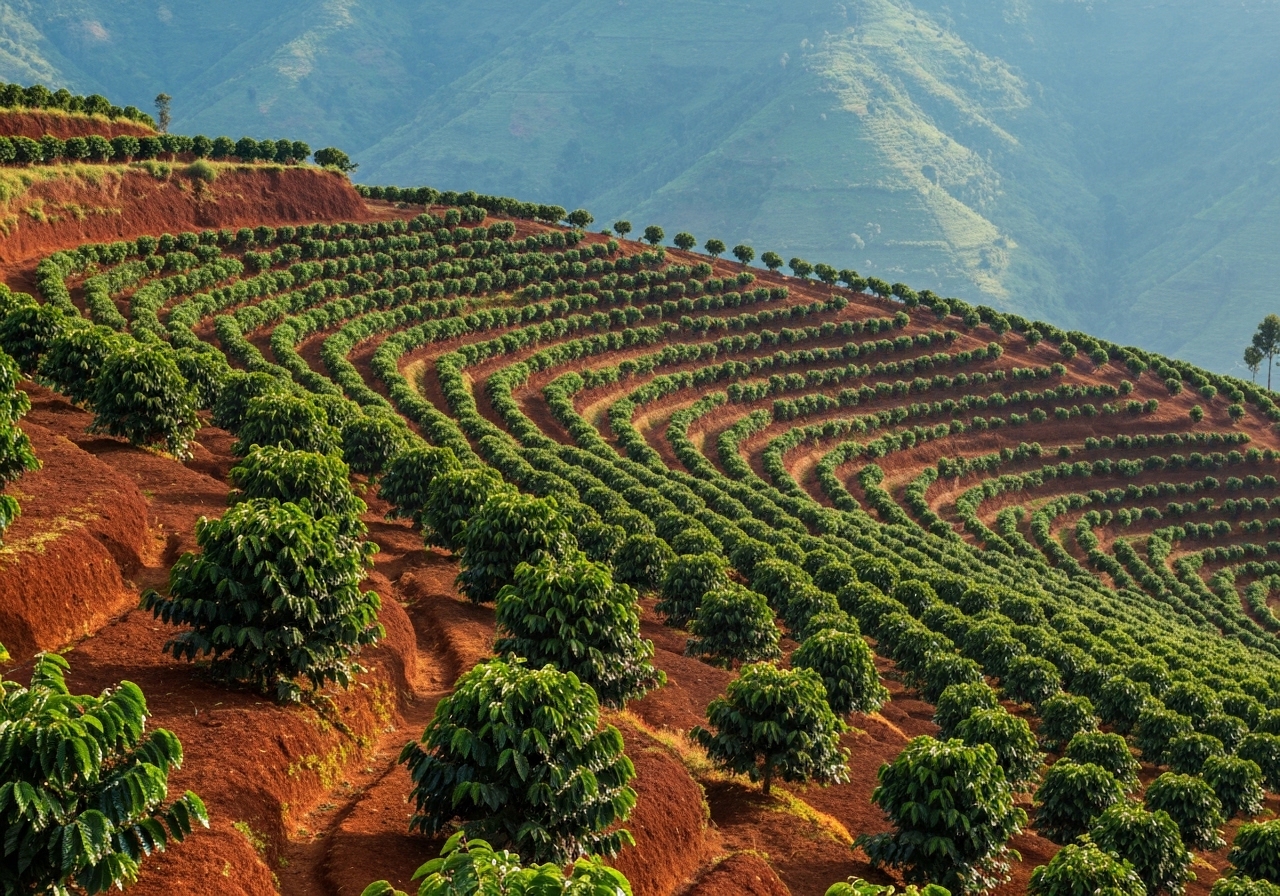
Rwanda’s rolling highlands — volcanic soil and high altitude create ideal conditions for Arabica coffee
Post-Genocide Renaissance
Before 1994, Rwandan coffee was almost exclusively low-quality, semi-washed Robusta and poorly processed Arabica sold at bottom-of-the-barrel prices. The genocide devastated the country’s infrastructure, its people, and its agricultural systems. But in the years that followed, coffee became a vehicle for national rebuilding. With support from USAID’s PEARL and SPREAD projects, the Rwandan government, and organisations like TechnoServe, the country made a deliberate, strategic pivot toward specialty-grade washed coffee.
The logic was compelling: Rwanda’s smallholder farmers — the vast majority cultivating less than a quarter-hectare each — could never compete on volume with Brazil or Colombia. But they could compete on quality. The hills were already planted overwhelmingly with the Bourbon variety, one of the most prized cultivars in specialty coffee, and the altitude and climate were naturally suited to slow cherry maturation. What was missing was infrastructure, training, and market access. The transformation that followed would reshape an entire national economy.
Washing Stations — The Engine of Quality
The single most important innovation in Rwanda’s coffee revolution was the construction of centralised washing stations, known locally as stations de lavage. Before their introduction, farmers processed cherries at home using rudimentary methods, resulting in inconsistent, defect-ridden lots. The first modern washing station opened in 2001; today, over 300 operate across the country.
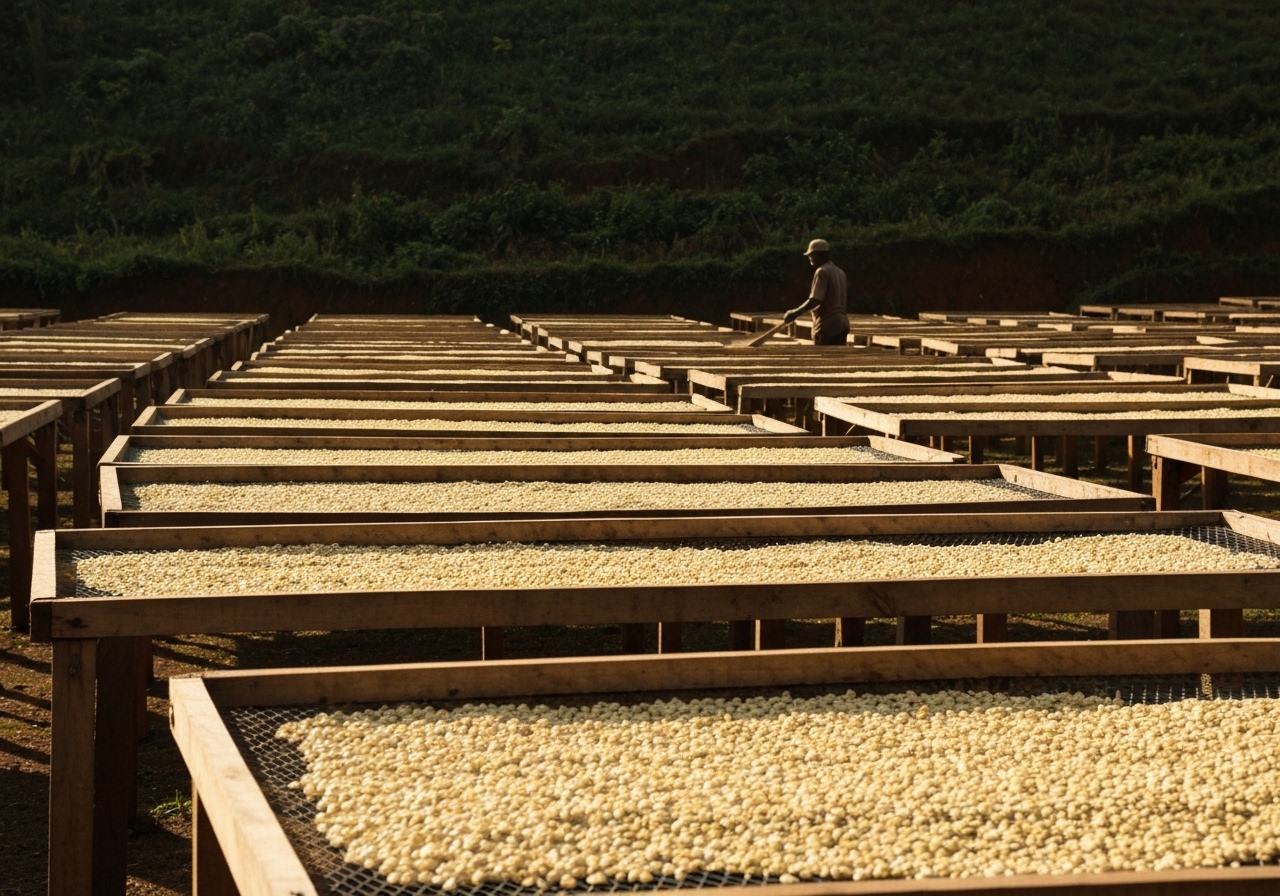
Raised drying beds at a Rwandan washing station — careful post-harvest handling is central to the country’s quality leap
At a washing station, ripe cherries are depulped, fermented in concrete tanks for 12 to 24 hours, thoroughly washed in grading channels, and then slow-dried on raised African beds for up to three weeks. The result is a clean, bright cup that allows terroir and variety to speak clearly. Each station aggregates cherries from hundreds — sometimes thousands — of surrounding smallholders, making it the de facto unit of traceability in Rwandan coffee. When you see a bag labelled “Dukunde Kawa” or “Buf Café,” you are reading the name of a washing station or cooperative, not a single farm.
Rwanda’s roughly 400,000 smallholder coffee farmers cultivate an average of just 200 trees each — making washing stations essential for achieving the consistency and volume that specialty buyers demand.
Growing Regions
Rwanda’s principal coffee-growing zones span the western, southern, and northern provinces. The shores of Lake Kivu in the west — particularly the Nyamasheke and Rusizi districts — produce some of the country’s most celebrated lots, with altitudes reaching 2,000 metres and lake-effect microclimates moderating temperature swings. The southern province around Huye (formerly Butare) is historically significant and consistently produces balanced, caramel-sweet cups. In the north, the volcanic soils near the Virunga mountains lend a distinctive mineral complexity.
Unlike Ethiopia or Kenya, where regional flavour profiles are starkly differentiated, Rwanda’s terroir variations are subtler. The dominant influence on cup quality is often the washing station itself — its fermentation protocols, drying discipline, and cherry selection — rather than the specific hillside where the trees grow. This makes the washing station manager one of the most consequential figures in Rwandan specialty coffee.
Flavour Profile
Rwandan coffees at their best are luminous. The hallmark is a bright, juicy acidity — often described as cranberry, red currant, or blood orange — supported by a silky, medium body and a floral aromatic lift that recalls hibiscus or chamomile. The Bourbon variety that dominates Rwandan farms naturally tends toward sweetness, and well-processed lots deliver caramel, brown sugar, and honey undertones that balance the acidity beautifully.

Rwandan Bourbon brewed as a pour-over — expect vibrant cranberry acidity, floral aromatics, and a silky caramel finish
As James Hoffmann notes in The World Atlas of Coffee, the best Rwandan lots “have a wonderful, almost creamy mouthfeel combined with very pleasing fruitiness.” When a Rwandan coffee is dialled in — a light-to-medium roast, brewed as a pour-over — it can rival the clean fruit-forward intensity of a top Kenyan while offering a gentler, more approachable acidity.
The so-called “potato defect” is worth mentioning: an off-flavour caused by the bacterium Lelliottia amnigena (previously attributed to the antestia bug) that makes an occasional bean taste startlingly like a raw potato. It occurs randomly and is undetectable before grinding. While frustrating, its incidence has been significantly reduced through improved cherry sorting and processing hygiene.
Cup of Excellence Success
Rwanda was the first African country to participate in the Cup of Excellence competition, hosting its inaugural event in 2008. The results stunned the specialty world. Rwandan lots scored consistently above 87 points, and winning coffees fetched prices many times the commodity market rate — transformative sums for smallholder cooperatives. The programme provided international validation and created direct commercial relationships between Rwandan producers and specialty roasters worldwide.
Since then, Rwanda has become a regular fixture in international quality competitions, and the price premiums generated by Cup of Excellence and direct-trade relationships have provided a powerful incentive for continued investment in quality. Several cooperatives — Buf Café, Dukunde Kawa, and the women-led Kopakaki among them — have built international reputations that transcend the competition circuit.
Why It Matters
Rwanda’s coffee story matters because it is proof that quality can be built, not just inherited. Unlike Ethiopia, with its millennia of coffee culture and unmatched genetic diversity, or Kenya, with its century-old research infrastructure, Rwanda essentially started from scratch in the early 2000s. Through deliberate policy, foreign investment, farmer training, and an unwavering focus on washed processing excellence, a country smaller than Belgium became one of Africa’s most exciting specialty origins within a single generation.
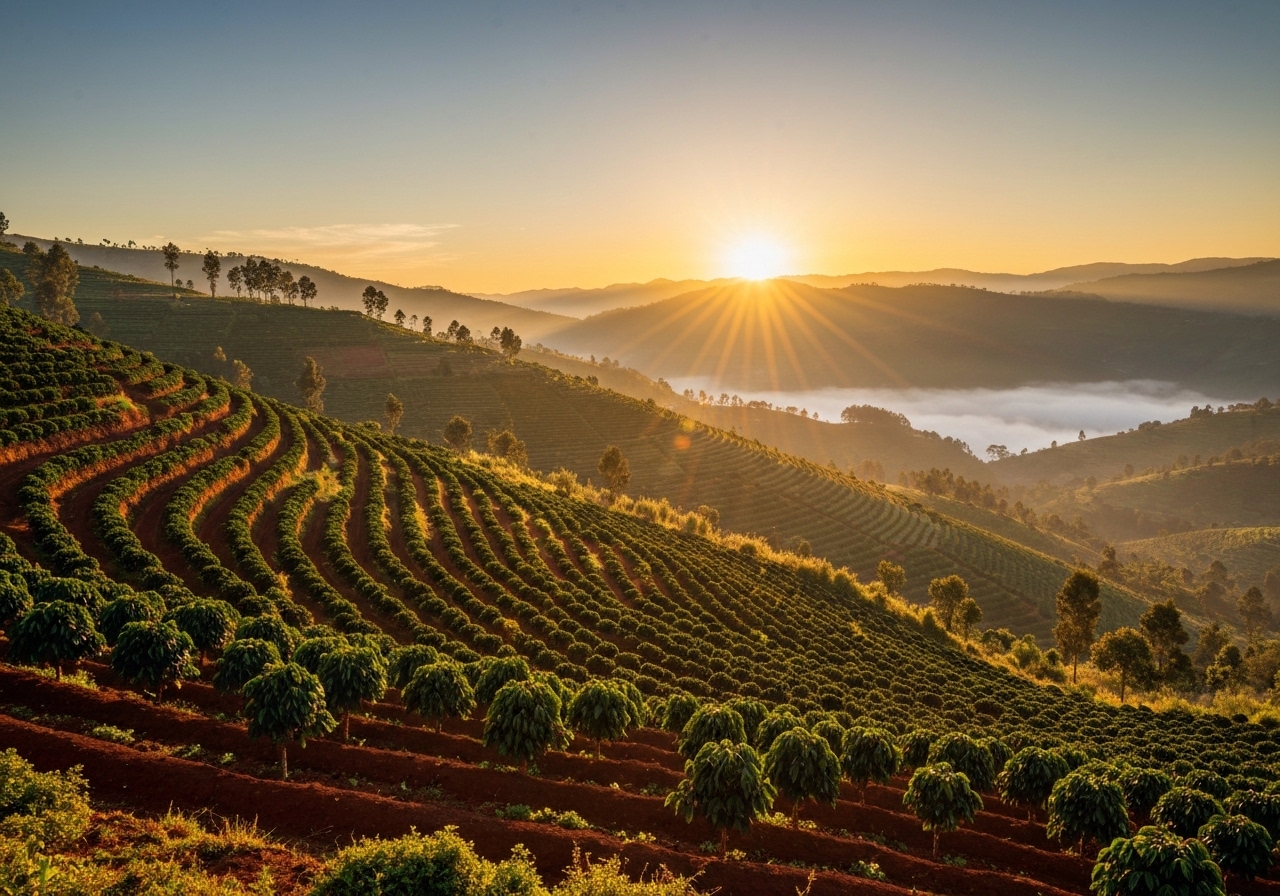
Dawn over Rwanda’s coffee-growing highlands — a country that turned tragedy into one of specialty coffee’s great success stories
For the hundreds of thousands of smallholder families who depend on coffee, the quality premium is not abstract — it translates directly into school fees, healthcare, and food security. And for coffee drinkers seeking bright, clean, complex cups from an origin with a compelling human story, Rwanda delivers something no other country quite replicates.
Further Reading
- The World Atlas of Coffee by James Hoffmann — regional profiles and tasting notes for Rwandan growing zones
- Uncommon Grounds by Mark Pendergrast — the broader history of coffee as an economic force in developing nations
- Cup of Excellence — Rwanda — competition results and winning lot profiles
- TechnoServe — reports on coffee quality improvement programmes in Rwanda and East Africa
Related Topics
Kenya
Kenyan coffee delivers intense blackcurrant, grapefruit, and tomato-like acidity from SL28 and SL34 cultivars grown at high altitude near Mount Kenya.
originEthiopia
The birthplace of Arabica and still its most genetically diverse origin — Ethiopia produces florals, berries, and citrus from thousands of heirloom varieties across its highlands.
varietyBourbon
Bourbon is Arabica's second foundational cultivar — named after Réunion island, prized for rich sweetness, chocolate notes, full body, and complex fruit.
processWashed (Wet) Processing
Washed coffee processing removes all fruit before drying to reveal clean, bright cups — floral, terroir-transparent, and prized by the specialty world. The benchmark method.