 English
  Українська
  Čeština
 The Other Coffee
For most of specialty coffee’s history, Robusta has been the species you were supposed to ignore. While Arabica earned the accolades, the cupping scores, and the auction records, Coffea canephora — universally known as Robusta — was dismissed as harsh, bitter, and fit only for commodity blends. But that narrative is incomplete, and increasingly outdated. Robusta accounts for roughly 40 percent of global coffee production, underpins the entire instant coffee industry, gives Italian espresso its signature crema, and is now producing specialty-grade lots that challenge long-held assumptions. As Rob Hoos writes in Modulating the Flavor Profile of Coffee, “To ignore Robusta is to ignore nearly half the world’s coffee — and some of its most interesting recent developments.”
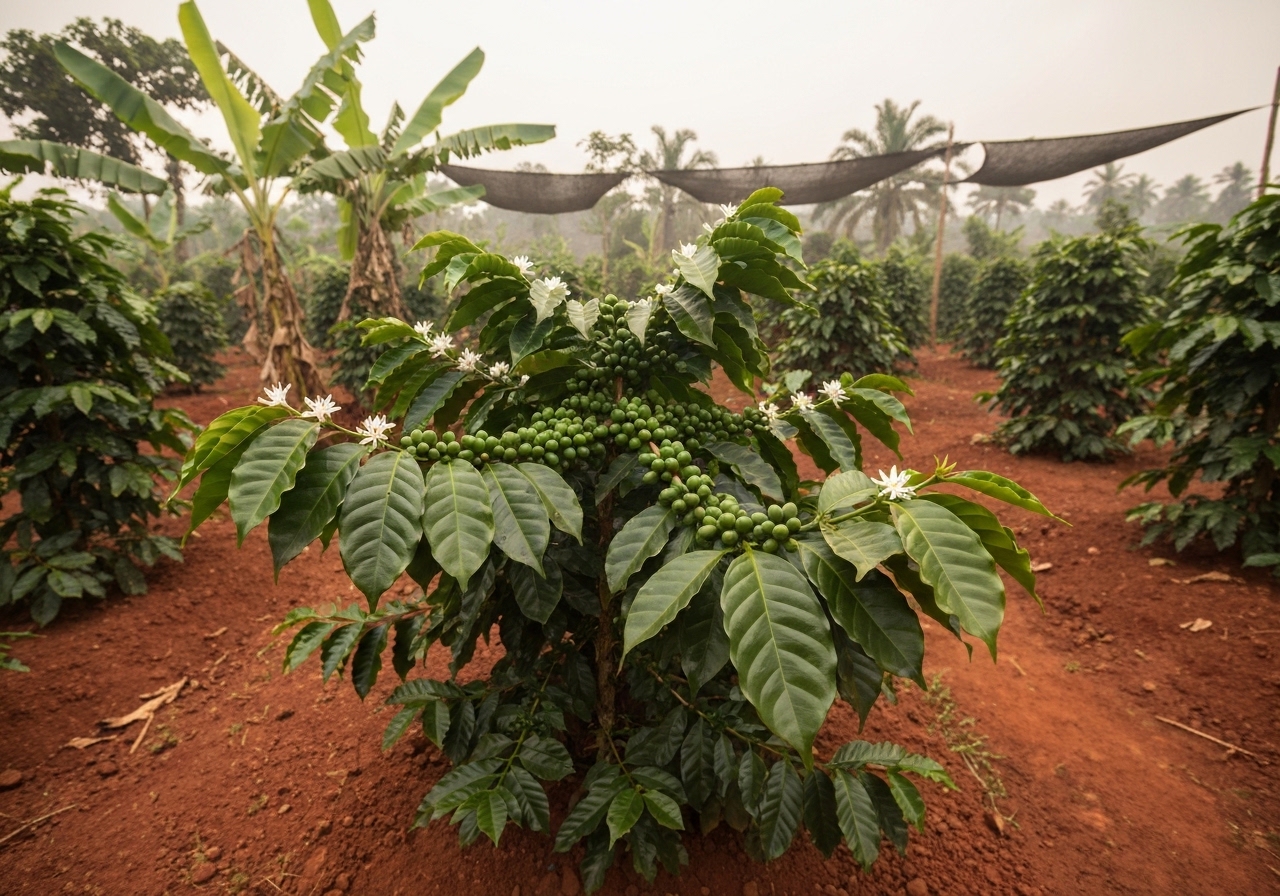
Robusta thrives at low altitudes in hot, humid climates — conditions that would stress or kill most Arabica plants
Robusta vs Arabica
The differences between coffee’s two dominant species are rooted in genetics. Arabica is a tetraploid (44 chromosomes), the offspring of an ancient cross between Robusta and Coffea eugenioides. Robusta is a diploid with 22 chromosomes — a simpler genome, but one that codes for resilience rather than delicacy. Robusta contains roughly twice the caffeine of Arabica (2.2 to 2.7 percent versus 1.0 to 1.5 percent by dry weight), which acts as a natural insecticide. It has lower sugar content (3 to 7 percent versus 6 to 9 percent), fewer lipids, and higher chlorogenic acid levels — compounds that contribute to its more assertive, bitter flavour profile. But these are generalisations. At the top end of quality, the gap narrows considerably.
Caffeine is bitter. Robusta has twice as much of it. This single fact explains most of the flavour prejudice — but not all of it. Processing, terroir, and roasting matter just as much as species.
Growing Conditions
Where Arabica is fussy, Robusta is forgiving. It grows at altitudes from sea level to 800 metres, tolerates temperatures of 24°C to 30°C, and handles annual rainfall of 2,000 to 3,000 millimetres with ease. Its root system is deeper and more robust (the name is earned), making it more drought-tolerant once established. Most critically, it resists coffee leaf rust (Hemileia vastatrix) — the fungal disease that has devastated Arabica crops from Sri Lanka to Central America. Robusta also shrugs off the coffee berry borer beetle, thanks to its high caffeine content. These traits make it economically vital for smallholder farmers across the coffee belt who cannot afford the inputs and altitude that Arabica demands. A Robusta tree yields 20 to 30 percent more fruit than an Arabica tree of the same age, and it begins producing earlier — typically within two years of planting versus three to four for Arabica.
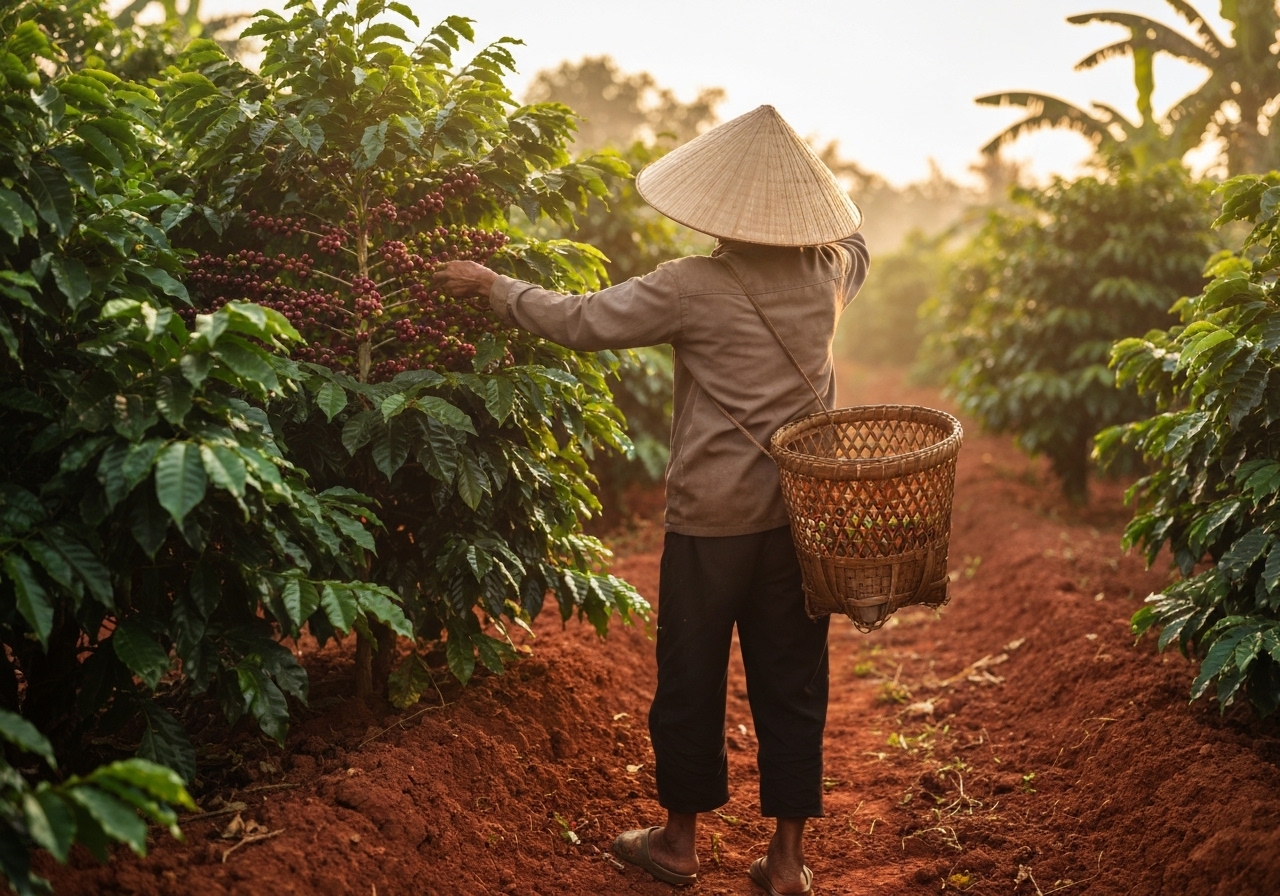
Robusta cherries ripen unevenly, often requiring multiple picking passes — selective harvesting is key to quality, just as with Arabica
Flavour Profile
Robusta’s reputation for harshness comes largely from commodity-grade lots that are mass-harvested, carelessly processed, and dark-roasted to mask defects. When treated with the same attention given to specialty Arabica — selective picking, careful processing, and appropriate roasting — Robusta reveals its own character. Expect a heavier body, lower acidity, and flavour notes of dark chocolate, roasted nuts, earthy tobacco, and brown sugar. The higher caffeine delivers a punchy, lingering finish. Some well-processed Vietnamese and Indian Robustas show surprising sweetness, with hints of dried fruit and spice. The mouthfeel is thick and syrupy — qualities that make it indispensable in espresso blending, where it adds body, crema, and backbone that Arabica alone cannot provide.
Vietnam — The World’s Robusta Giant
Vietnam is the world’s largest Robusta producer and the second-largest coffee producer overall, trailing only Brazil. The country’s coffee story is remarkably recent: large-scale cultivation began only in the 1990s, driven by government policy and the economic reforms of Đổi Mới. Today, the Central Highlands — particularly Đắk Lắk, Lâm Đồng, and Gia Lai provinces — produce over 1.5 million tonnes of Robusta annually. Vietnamese coffee culture itself revolves around Robusta: cà phê sữa đá (iced coffee with condensed milk) and cà phê trứng (egg coffee) are national institutions built on the species’ bold, heavy-bodied character. Brazil, Indonesia, and Uganda are also major producers, with Uganda growing indigenous Robusta in the forests around Lake Victoria — some of the oldest known wild populations.
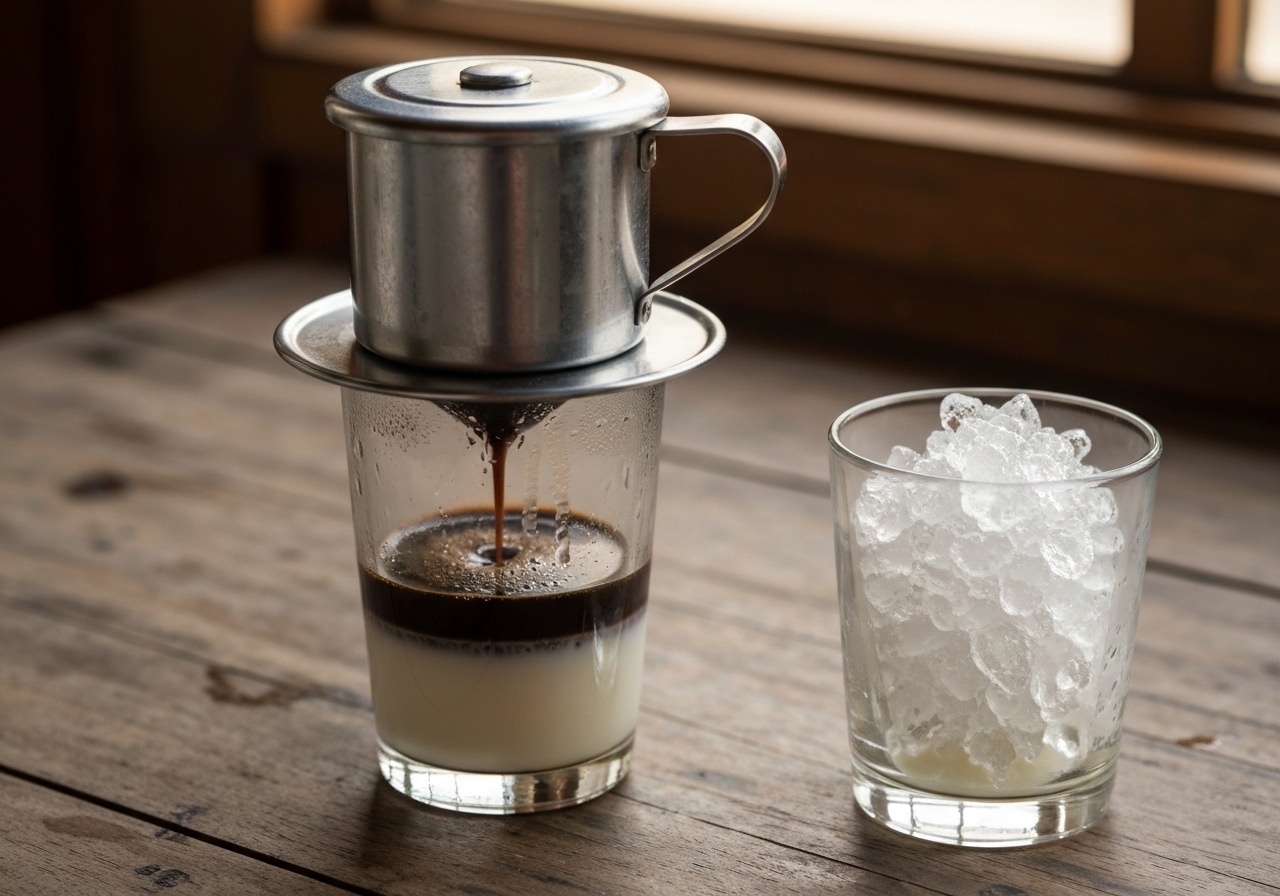
Vietnamese cà phê sữa đá — brewed through a phin filter with condensed milk, this iconic drink showcases Robusta’s bold body and chocolate-forward intensity
Role in Espresso Blends and Instant Coffee
Robusta is the invisible engine of two of coffee’s largest commercial sectors. In traditional Italian espresso blending — think Lavazza, Illy’s competitors, and countless local roasters across southern Europe — Robusta is added at 10 to 40 percent to boost crema production, increase body, and add the bittersweet punch that Italians expect from their morning caffè. The higher caffeine is a feature, not a bug: it delivers the jolt that a single 25-millilitre shot needs to provide. Meanwhile, the instant coffee industry is built almost entirely on Robusta. Its lower cost, higher yield, and bold flavour that survives the spray-drying or freeze-drying process make it the obvious choice. Brands like Nescafé, which controls roughly 20 percent of the global coffee market, depend on consistent Robusta supply chains stretching from Vietnam to Brazil.
The Fine Robusta Movement
The most significant shift in Robusta’s status has been the emergence of “Fine Robusta” — a term formalised by the Coffee Quality Institute (CQI) in 2010 with the creation of a dedicated Q Robusta grading system. Fine Robusta is assessed on its own merits, not against Arabica benchmarks: evaluators score for body, bitterness balance, mouthfeel, and flavour intensity. Lots scoring 80 points or above on the Fine Robusta scale are emerging from India (particularly the Chikmagalur and Kodagu regions), Uganda, Ecuador, and increasingly from Vietnamese specialty producers who are applying washed and honey processes to their Canephora cherries. These coffees command premiums that were unthinkable a decade ago, and they are appearing on specialty menus in London, Melbourne, and New York.
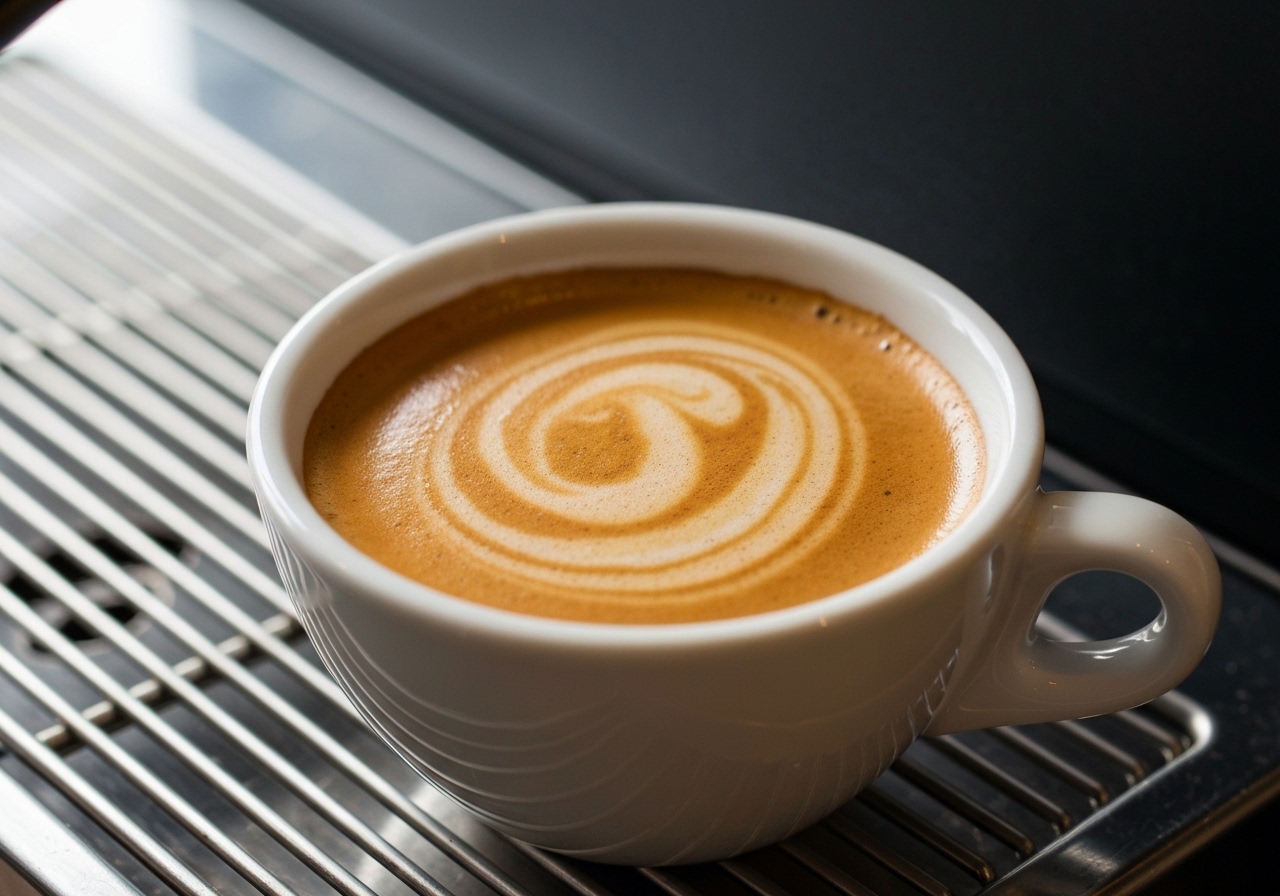
The thick, persistent crema that espresso lovers prize is often thanks to Robusta’s higher concentration of CO₂-trapping compounds — a quality Arabica alone struggles to match
Why Robusta Matters
Climate change is redrawing the map of coffee cultivation. As temperatures rise and suitable Arabica-growing altitude bands shrink, Robusta’s heat tolerance and disease resistance become not luxuries but necessities. Breeders at World Coffee Research and national institutions are developing Arabica-Robusta hybrids — introgression lines that carry Robusta’s resilience genes within an Arabica flavour framework. Varieties like Catimor and Sarchimor already contain Robusta DNA from the Timor Hybrid, a natural cross discovered on the island of Timor in the 1920s. The future of coffee may well depend on the species that specialty culture spent decades dismissing. As Andrea Illy notes in Espresso Coffee: The Science of Quality, “Canephora is not Arabica’s inferior cousin — it is its complement, and increasingly, its genetic insurance policy.”
Robusta deserves to be understood on its own terms: not as a lesser Arabica, but as a different coffee with its own strengths, its own terroir, and its own emerging quality culture. The next time you pull an espresso with a thick, tawny crema or sip a Vietnamese cà phê sữa đá through crushed ice, you are tasting what Robusta does best.
Further Reading
- Espresso Coffee: The Science of Quality by Andrea Illy and Rinantonio Viani — the authoritative text on espresso science, including Robusta’s role in blending
- Modulating the Flavor Profile of Coffee by Rob Hoos — practical insights into how roasting brings out Robusta’s potential
- Coffee Quality Institute — Q Robusta — the organisation behind Fine Robusta grading and certification
- ICO Coffee Development Report — global production statistics, including Robusta market data and Vietnam’s dominance
Related Topics
Arabica (Coffea arabica)
Arabica accounts for 60% of global coffee production and virtually all specialty coffee. Here is what separates it from Robusta — genetics, altitude, and cup character.
varietyWhat are Coffee Varieties?
Coffee varieties — Typica, Bourbon, Gesha, SL28 — are the genetic blueprints behind every cup. A guide to what they are, how they differ, and why variety matters for flavour.
getting-startedEspresso
Espresso forces near-boiling water through finely ground coffee at 9 bars of pressure — producing concentrated, crema-topped shots in 25 to 30 seconds.
getting-startedThe Coffee Belt
The Coffee Belt spans the tropics between Cancer and Capricorn, home to all 70 coffee-growing nations and every Arabica and Robusta variety on Earth.