 English
  Українська
  Čeština
 For decades, “decaf” was a punchline in specialty coffee — a thin, cardboard-flavoured afterthought brewed reluctantly for those who could not handle caffeine. That era is over. Modern decaffeination processes have advanced to the point where the best decaf coffees are genuinely delicious, retaining the complexity, sweetness, and origin character of their caffeinated counterparts with only subtle differences detectable even by trained cuppers. Understanding how caffeine is removed — and why the method matters — is essential for anyone serious about coffee quality, whether they drink decaf or not.

Modern decaf — when done right, the cup quality is indistinguishable from its caffeinated equivalent for all but the most trained palates
The Challenge
Caffeine is a small, water-soluble molecule that is deeply embedded in the cellular structure of the green coffee bean, alongside hundreds of other flavour-forming compounds — sugars, amino acids, organic acids, and volatile aromatics. The fundamental challenge of decaffeination is selectivity: how do you extract caffeine without dragging all those desirable flavour compounds out with it? Every decaf process is, at its core, a solution to this selectivity problem — and the quality of the resulting cup depends almost entirely on how well the process solves it.
All commercial decaffeination methods share a basic sequence: green (unroasted) coffee beans are moistened to make them permeable, a solvent or extraction medium is applied to draw out the caffeine, and the beans are then dried back to their original moisture content. The differences lie in what is used as the extraction medium and how the process protects the non-caffeine compounds.
By international standards, “decaffeinated” coffee must have at least 97% of its original caffeine removed. Most modern processes achieve 99.9% removal — a typical cup of decaf contains 2–5 mg of caffeine compared to 80–120 mg in a regular cup.
Swiss Water Process
The Swiss Water Process (SWP) is the most widely known chemical-free decaffeination method and has become synonymous with premium decaf in the specialty market. Developed commercially in the 1980s in Vancouver, Canada, and operated exclusively by Swiss Water Decaffeinated Coffee Inc., the process uses only water, temperature, and time.
The science is elegant. Green coffee beans are soaked in hot water, which dissolves both the caffeine and the flavour compounds. This first batch of beans is discarded — they have lost everything. But the resulting solution, now saturated with flavour compounds but also containing caffeine, is passed through activated charcoal filters that are sized to capture caffeine molecules (which are relatively large) while allowing smaller flavour molecules to pass through. The result is Green Coffee Extract (GCE) — water that is loaded with coffee flavour but free of caffeine.
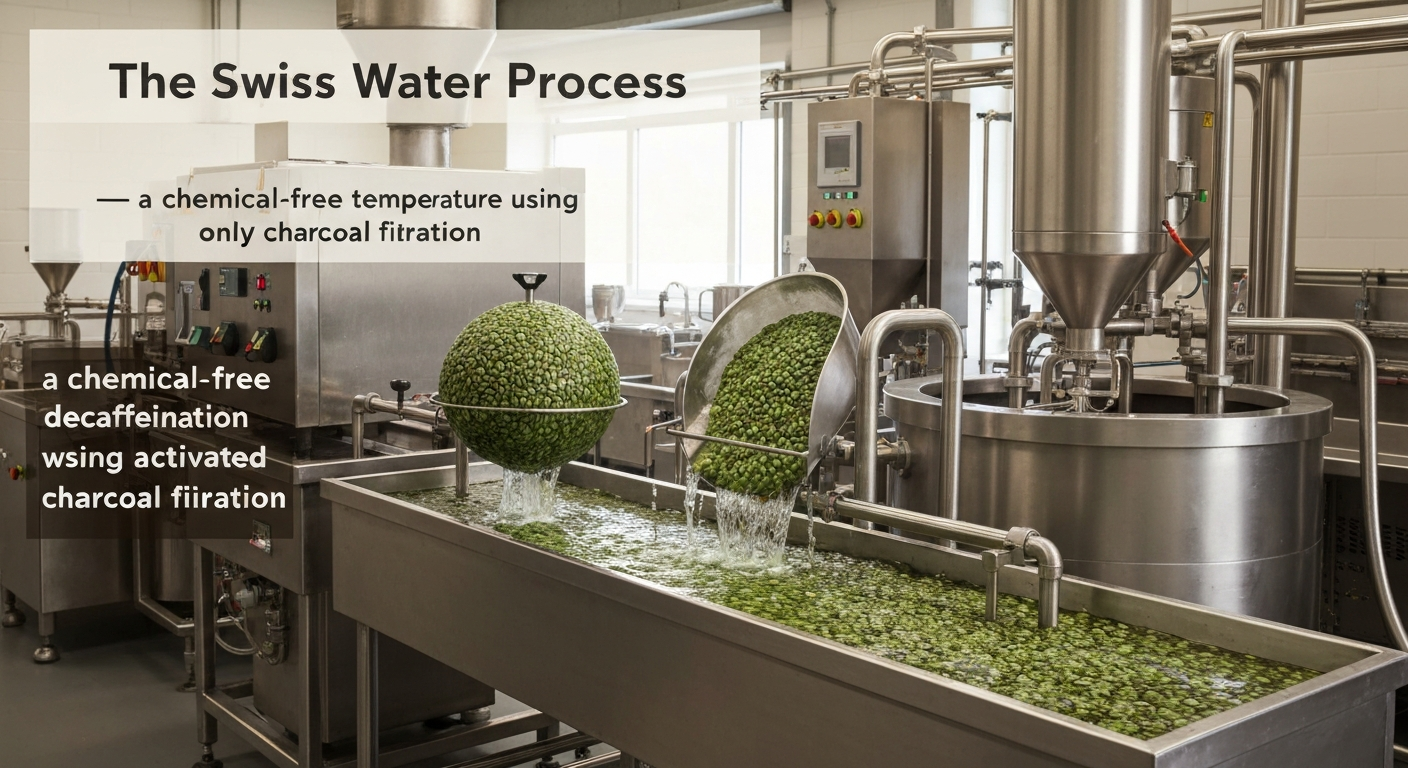
The Swiss Water Process — chemical-free decaffeination using only water, temperature, and activated charcoal filtration
When new green coffee beans are immersed in this GCE, osmotic pressure drives only the caffeine out of the beans into the solution — because the GCE is already saturated with every other compound, there is no concentration gradient to pull flavour out. The caffeine-laden GCE is re-filtered through charcoal to remove the caffeine, and the cycle repeats until the beans reach 99.9% caffeine-free.
Swiss Water coffees are clean, well-balanced, and retain origin character admirably. The process is certified organic and appeals to consumers who prefer no chemical solvents. Its main limitation is a slight dulling of the brightest, most volatile aromatics — the floral top notes that distinguish the very finest lots. For the vast majority of coffees, the quality loss is negligible.
CO2 (Supercritical Carbon Dioxide) Process
The supercritical CO2 process is the most technologically advanced decaffeination method and is increasingly favoured by specialty roasters for high-end single-origin decaf. Developed in the 1980s and refined continuously since, it uses carbon dioxide in a “supercritical” state — a phase between liquid and gas achieved at high pressure (around 300 atmospheres) and moderate temperature (65–70°C) — as the extraction solvent.
In this state, CO2 has the penetrating ability of a gas but the solvent density of a liquid. It is remarkably selective for caffeine, dissolving it efficiently while leaving most other compounds — sugars, proteins, and the delicate volatile aromatics — largely intact. The caffeine-laden CO2 is then depressurised, the caffeine precipitates out (and is typically sold to pharmaceutical or soft-drink companies), and the CO2 is recycled for the next batch.
The result is a decaf that preserves origin character and aromatic complexity better than almost any other method. CO2-processed decafs can be strikingly faithful to their caffeinated counterparts — a CO2-processed Ethiopian can still present jasmine and bergamot; a CO2-processed Colombian retains its caramel sweetness and balanced acidity.
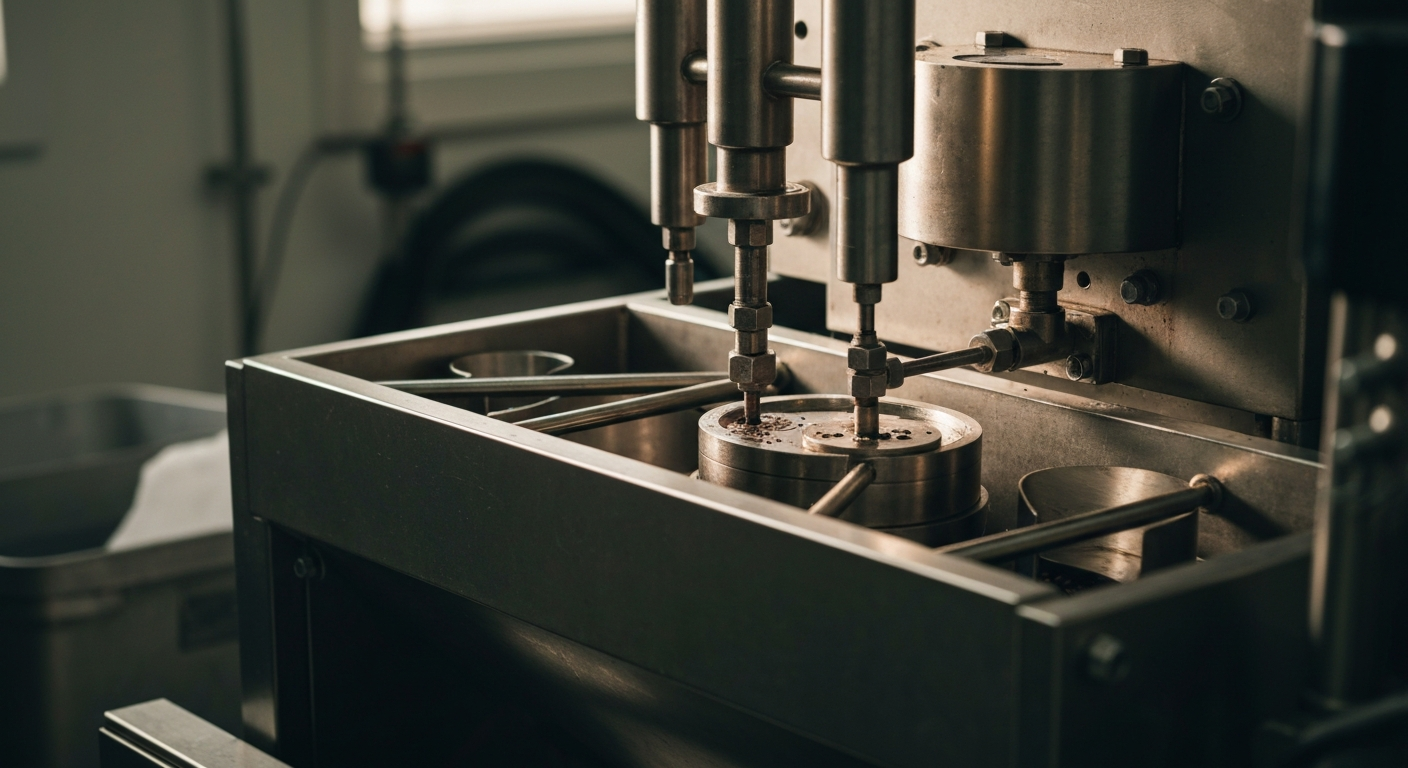
CO2 decaffeination — high-pressure supercritical extraction preserves the most volatile aromatics that other methods can diminish
The downside is cost. The high-pressure equipment required is enormously expensive, and only a handful of facilities worldwide — primarily in Germany — operate CO2 decaffeination at commercial scale. This makes CO2 decaf the most expensive option, but for roasters committed to the best possible decaf quality, it is increasingly seen as worth the premium.
Ethyl Acetate (EA) — Sugarcane Process
The ethyl acetate (EA) process — often marketed as “sugarcane decaf” — has surged in popularity in the specialty market, particularly for Colombian coffees. EA is a naturally occurring compound found in ripe fruit, and when derived from sugarcane (as it typically is in Colombia), producers can market the process as “naturally decaffeinated” — a claim that, while technically accurate, is somewhat generous given the industrial chemistry involved.
In the EA process, green coffee beans are steamed to open their pores, then repeatedly washed in a solution of water and ethyl acetate. The EA bonds selectively with caffeine molecules and carries them out of the bean. The beans are then steamed again to remove any residual EA (which evaporates completely at 77°C, well below roasting temperatures), and dried.
EA-processed coffees have a distinctive profile. The method tends to enhance perceived sweetness and body while softening acidity — producing a cup that is round, chocolatey, and syrupy with a gentle sweetness that many drinkers find immediately appealing. Some cuppers detect a subtle fruity or fermented quality in EA decafs that adds character. The process works particularly well with full-bodied, lower-acidity coffees that suit the sweetness amplification.
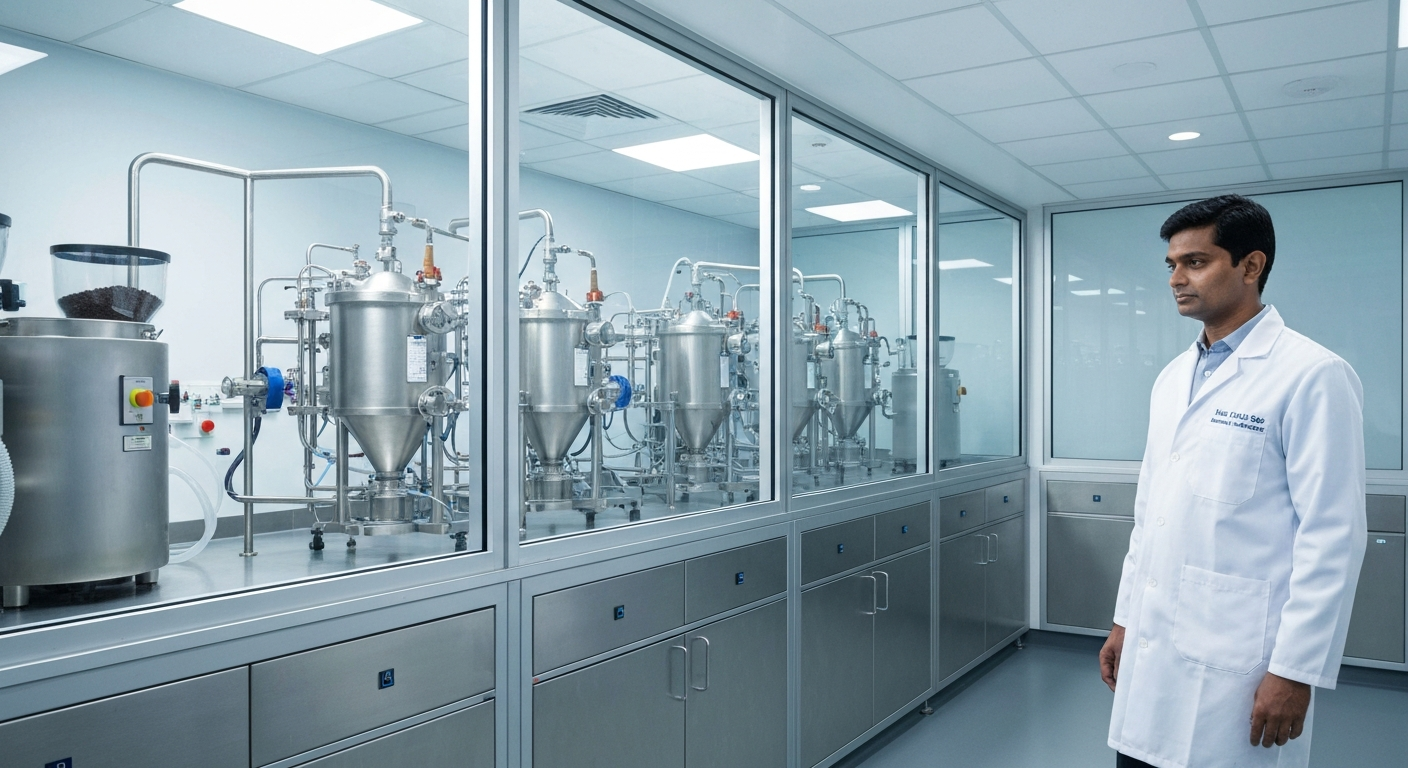
Sugarcane-derived EA — Colombia’s proximity to sugarcane production makes the EA process locally accessible and cost-effective
Colombia’s Descafecol facility in Manizales is the world’s largest EA decaffeination plant, processing coffee at origin rather than in the consuming country — a significant advantage, as the beans travel only a short distance before and after decaffeination, reducing handling and degradation. Several other EA facilities have opened across Latin America in recent years, reflecting growing demand.
The Quality Revolution
The transformation in decaf quality over the past decade has been driven by three converging forces.
First, better green coffee going in. Specialty roasters now send their highest-quality lots for decaffeination, recognising that the process can only preserve what is already there. A mediocre commodity coffee will produce mediocre decaf regardless of the method; a carefully sourced 86-point single origin can emerge from decaffeination at 83–85 points — a quality level that would have been unthinkable for decaf a generation ago.
Second, process refinement. Swiss Water has continuously improved its GCE formulations, CO2 operators have optimised their pressure and temperature curves, and EA processors like Descafecol have invested in quality-control infrastructure that treats every batch as a specialty product.
Third, market demand. The explosion of specialty coffee culture has created a large population of knowledgeable drinkers who love coffee but want or need to limit caffeine — whether for health, pregnancy, sleep, or simply evening enjoyment. These consumers expect quality and are willing to pay for it, creating a commercial incentive for quality decaf that did not previously exist.
The new decaf — indistinguishable from regular coffee in the best cafes, where quality decaffeination meets expert roasting
Choosing a Process
There is no single “best” decaffeination process — each has trade-offs:
- Swiss Water: Chemical-free, consistent, good origin preservation. Slightly dulls the brightest aromatics. Certified organic available.
- CO2: Best overall flavour preservation, especially of volatile aromatics. Expensive. Limited availability.
- EA (Sugarcane): Enhances sweetness and body, cost-effective at origin. Subtle process character. “Natural” marketing can be misleading.
For roasters, the choice often comes down to the specific coffee being decaffeinated. Bright, floral Africans benefit from CO2’s aromatic preservation. Full-bodied Colombians and Brazilians shine with EA’s sweetness enhancement. Swiss Water works well across the board as a reliable, chemical-free default.
For consumers, the most important thing is simply to know that excellent decaf exists — and to seek it from roasters who treat decaffeination as a quality commitment rather than an obligation.
Further Reading
- Craft Coffee: A Manual by Jessica Easto — accessible explanation of decaffeination methods and their impact on flavour
- The World Atlas of Coffee by James Hoffmann — context on decaf’s evolving role in specialty coffee
- Swiss Water Decaffeinated Coffee — the SWP facility, process details, and partner roaster directory
- Descafecol — Colombia’s EA decaffeination facility and the sugarcane process
- SCA Research — studies on caffeine extraction and its impact on sensory quality
Related Topics
What is Coffee Processing?
Coffee processing — washed, natural, honey — transforms harvested cherries into green beans and shapes the cup more than almost any other variable, including roast level.
processWashed (Wet) Processing
Washed coffee processing removes all fruit before drying to reveal clean, bright cups — floral, terroir-transparent, and prized by the specialty world. The benchmark method.
getting-startedArabica (Coffea arabica)
Arabica accounts for 60% of global coffee production and virtually all specialty coffee. Here is what separates it from Robusta — genetics, altitude, and cup character.
getting-startedEspresso
Espresso forces near-boiling water through finely ground coffee at 9 bars of pressure — producing concentrated, crema-topped shots in 25 to 30 seconds.