 English
  Українська
  Čeština
 Extraction Is Mass Transfer
Every cup of coffee is a physics experiment. When hot water meets ground coffee, dissolved solids — sugars, acids, lipids, melanoidins, chlorogenic acids — migrate from the interior of each cell outward into the surrounding liquid. This process is called mass transfer: the movement of soluble compounds down a concentration gradient, from regions of high concentration (inside the coffee particle) to regions of low concentration (the brew water).
The driving force is simple. When freshly ground coffee meets water, the water immediately begins dissolving compounds at the particle surface. As surface-layer compounds are depleted, a concentration gradient forms between the saturated surface and the still-concentrated interior. Molecules diffuse outward to equalise the gradient. Stir the water, and fresh low-concentration liquid arrives at the surface, steepening the gradient and accelerating diffusion. This is why agitation matters in pour-over — it is not ritual, it is physics.
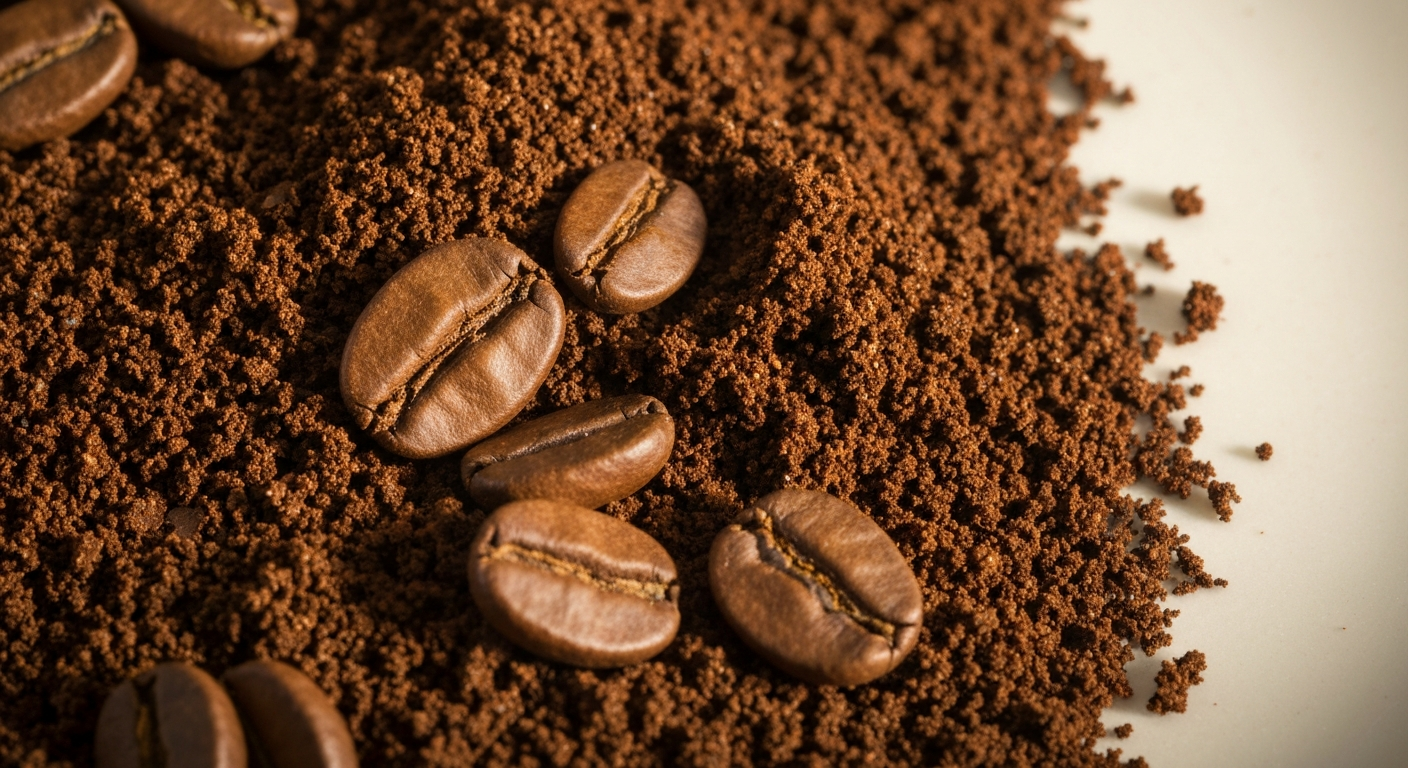
Each coffee particle is a porous matrix of cellulose cells packed with soluble compounds. Extraction begins at the surface and works inward.
Surface Area and Grind Size
The single most powerful variable in extraction is grind size — because grind size determines surface area, and surface area determines how much of the coffee is directly exposed to water.
Halving the average particle diameter roughly quadruples the total surface area. This is why grinding finer extracts faster: more surface area means more simultaneous extraction sites, more dissolved solids per second, and faster saturation of the brew water. The mathematics follow an inverse-cube relationship — small changes in grind have outsized effects on extraction speed.
This is also why fine grinding carries a bitterness risk. Extraction is not uniform across all soluble compounds. Acidic, fruity compounds dissolve first — they are the smallest, most mobile molecules. Bitter, astringent compounds (oxidised chlorogenic acids, high-molecular-weight melanoidins) dissolve later. A very fine grind extracts everything so quickly that there is no time window to stop before the bitter compounds arrive. The same physics that make espresso possible also make over-extraction easy.
A useful mental model: extraction follows a sequence. Acids first, then sugars and sweetness, then bitterness and astringency. Good brewing is about stopping in the middle of that sequence — in the sweet spot between under and over.
Pressure in Espresso: 9 Bar and Why It Matters
Espresso operates at approximately 9 bars of pressure — roughly 130 PSI, or nine times atmospheric pressure. This is not arbitrary. Pressure serves two distinct functions in espresso physics.
First, pressure accelerates water penetration through the compacted coffee puck. At 9 bar, water is forced through channels and micropores in the coffee bed far faster than gravity could achieve. Contact time is compressed to 25–30 seconds. The physics of extraction still apply, but the timeline is dramatically shortened — which is why espresso demands a fine grind to ensure sufficient extraction yield within that brief window.
Second, and more interestingly, pressure is responsible for crema. At 9 bar, CO₂ gas — naturally present in freshly roasted coffee — is forced into solution in the hot water. When that pressurised liquid exits the portafilter into atmospheric pressure, the CO₂ rapidly comes out of solution and forms fine bubbles, trapping coffee oils in an emulsion. The result is crema: the golden-brown foam that signals pressure extraction. No other brewing method can produce it — French press and pour-over operate at or near atmospheric pressure.
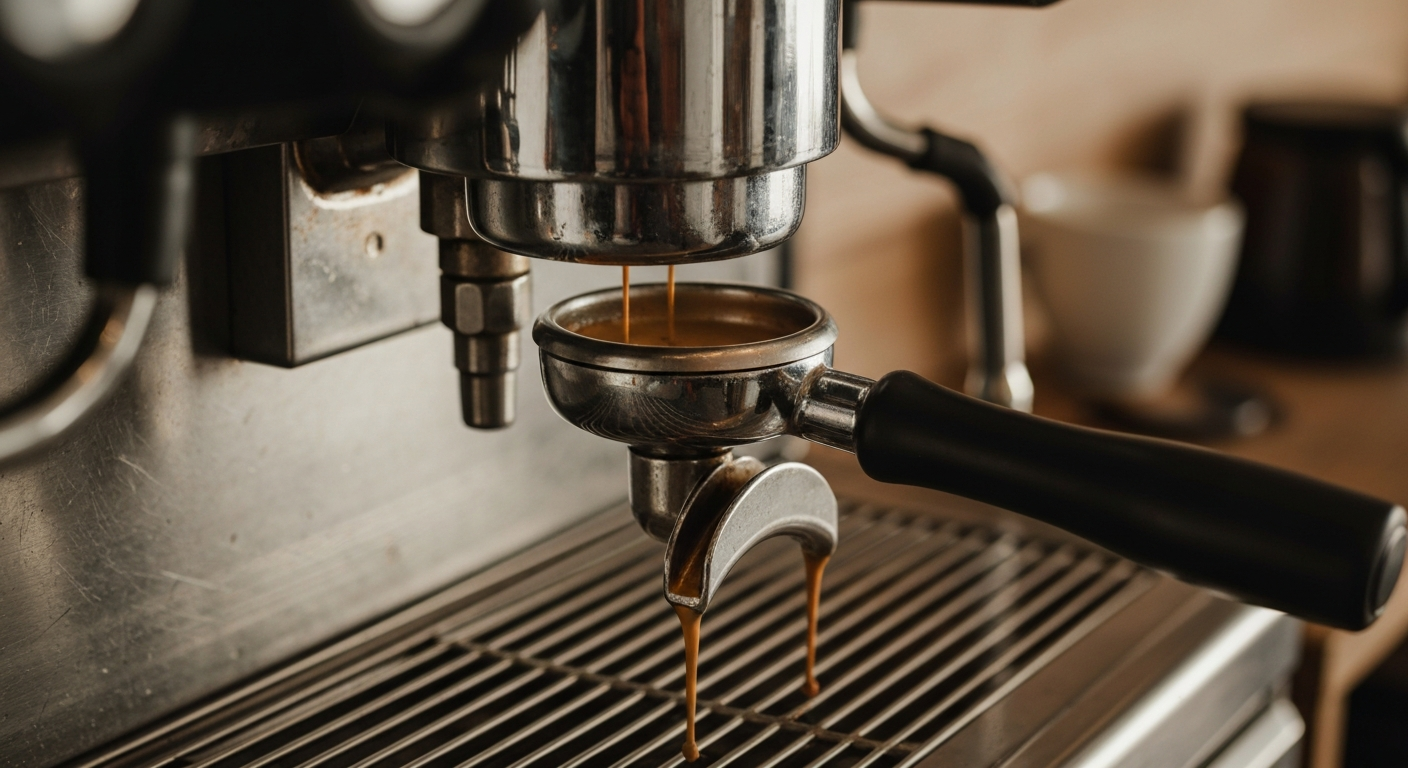
The crema on an espresso shot is a CO₂ emulsion forced into existence by 9 bars of pressure. It is a direct physical consequence of the brewing method.
Diffusion and Turbulence: Moving Fresh Water to the Surface
Extraction is self-limiting by nature. As dissolved solids accumulate in the water surrounding a coffee particle, the concentration gradient flattens. Diffusion slows. Eventually, if the water sits perfectly still, a saturated boundary layer forms around each particle and extraction stalls entirely — long before full extraction is achieved.
Turbulence breaks this stall. Water movement — whether from pouring, agitation, pressure, or convection from temperature — continuously sweeps the boundary layer away, delivering fresh low-concentration water to the particle surface. This is why:
- Espresso machines create turbulence via pressurised flow
- Pour-over brewers use circular pouring patterns to agitate the bed
- AeroPress and French press users are sometimes instructed to stir
- Immersion brews (French press, cold brew) benefit from occasional agitation
The physics is identical in each case: you are managing the concentration gradient at the particle surface, keeping it steep enough to drive continued extraction.
Temperature Physics: Why 92–96°C?
Temperature affects extraction through two distinct mechanisms: solubility and reaction kinetics.
Most soluble coffee compounds are more soluble at higher temperatures — the classic solubility-temperature curve. More importantly, the rate of diffusion scales with temperature according to the Stokes-Einstein equation. At 96°C versus 85°C, the diffusion coefficient of dissolved organics increases noticeably, meaning compounds migrate faster from particle to water.
But temperature also drives chemical reactions inside the brewing process itself. Many aromatic compounds are volatile — they evaporate more rapidly at higher temperatures. Some desirable acids break down or transform at excessive heat. The 92–96°C window represents a sweet spot: hot enough to achieve good diffusion rates and solubility, cool enough to preserve volatile aromatic compounds and avoid degrading delicate acids.
Below about 85°C, extraction slows dramatically — which is why cold brew requires 12–24 hours of contact time to compensate for the low temperature. The physics does not change; only the timescale shifts.
The Golden Ratio: 18–22% Extraction Yield
Extraction yield — the percentage of the coffee’s dry mass that ends up dissolved in the brew — is the fundamental measure of how much of the coffee you actually extracted. The Specialty Coffee Association defines the ideal window as 18–22% extraction yield for filter coffee, typically at a brew strength (TDS) of 1.15–1.45%.
Why does under-extraction (below ~18%) taste sour and thin? Because you stopped in the first phase of mass transfer — primarily acidic compounds with low molecular weight. The sweetness compounds, which dissolve later, never made it into the cup.
Why does over-extraction (above ~22%) taste bitter and dry? Because you continued into the third phase of mass transfer — bitter phenols, astringent tannin-like compounds, and degraded lipids that were slow to dissolve but eventually did.
The 18–22% window is not arbitrary taste preference. It is the region of the extraction sequence where acids, sugars, and bitter compounds are present in a balanced ratio.

A refractometer measures the TDS (Total Dissolved Solids) of a brew. Combined with brew weight and dose, TDS allows you to calculate extraction yield directly.
Bloom Physics: CO₂ as an Extraction Barrier
Freshly roasted coffee contains significant CO₂, produced during roasting and trapped within the cellular structure of the bean. When hot water first contacts ground coffee, this CO₂ degasses rapidly — you can see it as the characteristic dome-shaped foam of the bloom phase.
The physics matters because CO₂ bubbles forming inside and around coffee particles physically block water penetration. Water cannot easily enter a CO₂-saturated pore. If you skip the bloom and pour all your water immediately, a significant portion of the coffee bed is surrounded by CO₂ bubbles acting as a barrier, producing uneven, channelled extraction — some particles over-extract while shielded ones under-extract.
The 30–45 second bloom phase lets the CO₂ purge first. Once the degassing slows, water can penetrate the coffee bed evenly and extraction proceeds uniformly. This is also why very fresh coffee (roasted within the last 3–5 days) can be challenging to brew well — the CO₂ content is so high that bloom management becomes critical.
Further Reading
- Rao, S. (2008). The Professional Barista’s Handbook. Espresso extraction theory, pressure profiling, and yield measurement.
- Specialty Coffee Association. Water Quality Handbook — extraction yield targets and TDS standards.
- Barista Hustle — The Percolation Concept — mathematical models of extraction and particle dynamics
- Moroney, K.M. et al. (2019). “Analysing extraction uniformity from porous coffee beds using mathematical modelling and computational fluid dynamics approaches.” PLOS ONE.
Related Topics
What is Coffee Processing?
Coffee processing — washed, natural, honey — transforms harvested cherries into green beans and shapes the cup more than almost any other variable, including roast level.
getting-startedEspresso
Espresso forces near-boiling water through finely ground coffee at 9 bars of pressure — producing concentrated, crema-topped shots in 25 to 30 seconds.
brewingPour Over
Pour-over is a manual coffee brewing method using paper filters and controlled water flow, producing clean, nuanced cups that reveal single-origin character.
getting-startedWhat is Coffee Brewing?
Coffee brewing extracts soluble flavour from roasted grounds using water — and grind size, temperature, time, and ratio all determine whether the cup sings or disappoints.