 English
  Українська
  Čeština
 Extraction Yield: The Science Behind a Perfect Cup
There is a number that describes every cup of coffee you have ever brewed. It tells you what percentage of the dry coffee mass dissolved into the water during brewing — and whether that number was too low, too high, or in the narrow range that corresponds to a balanced, complex, enjoyable cup. That number is extraction yield, and understanding it transforms guesswork into a system.
This is not academic theory reserved for competition baristas. Extraction yield explains why your coffee tastes sour on Monday and bitter on Thursday when you did nothing intentionally different. It gives you a framework for diagnosing what went wrong and a vocabulary for fixing it.
What Extraction Yield Is
Dry, roasted coffee is approximately 30% soluble — meaning up to 30% of its mass can theoretically be dissolved into water. In practice, not all of those compounds are desirable. The specialty coffee industry has converged on 18–22% extraction yield as the target range for a balanced cup. Below 18%, the coffee is under-extracted. Above 22%, it is over-extracted.
The extraction yield formula is straightforward:
Extraction Yield (%) = (Brewed Beverage Weight × TDS) ÷ Dry Coffee Dose × 100
Where TDS (Total Dissolved Solids) is expressed as a decimal (e.g., 1.35% TDS = 0.0135).
You do not need to calculate this by hand. A refractometer — an optical instrument that measures how much light bends as it passes through the brewed coffee — gives you the TDS reading directly, and most specialty coffee apps (Barista Hustle’s Brew Calculator, VST’s Coffee Tools) convert TDS and brew weight into extraction yield automatically.
But you can also diagnose extraction yield without any equipment at all: simply taste the cup and know what to listen for.
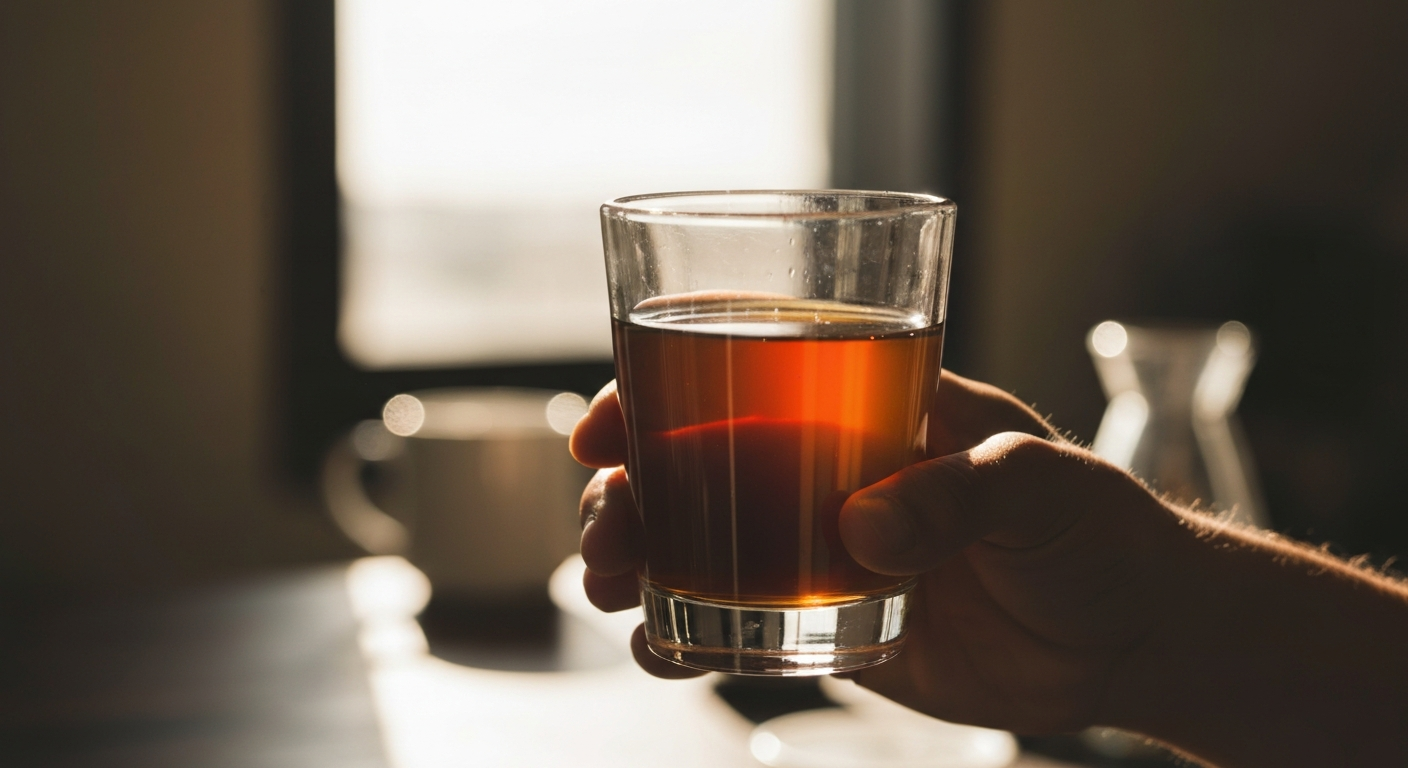
Colour, clarity, and aroma give you early clues — but flavour tells the clearest story about where extraction landed
TDS: What It Measures and What It Doesn’t
TDS stands for Total Dissolved Solids — the aggregate concentration of all dissolved coffee compounds in the brewed beverage, expressed as a percentage (or in grams per litre). For filter coffee, the Specialty Coffee Association (SCA) targets a TDS of 1.15–1.45%. For espresso, TDS runs much higher: 8–12%.
TDS measures strength — how concentrated the beverage is. It does not measure extraction yield directly, though the two are related. A coffee with 1.5% TDS brewed from a small dose is likely over-extracted. The same 1.5% TDS brewed from a larger dose may be perfectly extracted. TDS and extraction yield are different axes of quality.
The relationship between them is captured in the Coffee Brewing Control Chart, first developed by MIT professor E.E. Lockhart in the 1950s and refined by the SCA. The chart plots TDS on the vertical axis against extraction yield on the horizontal axis, with a target zone in the centre where both strength and extraction are in range. Brewing inside that zone consistently is the goal.
Brew Ratio: The Lever You Control Most Easily
Brew ratio is the weight of dry coffee relative to the weight of water used to brew it. Specialty filter coffee typically uses ratios in the range of 1:15 to 1:17 (1g of coffee per 15–17g of water). Espresso uses dramatically different ratios — commonly 1:2 to 1:2.5 (a double espresso of 18g coffee yielding 36–45g of liquid).
Brew ratio is the most direct lever for controlling TDS: more coffee relative to water produces a stronger, more concentrated brew. But it also affects extraction yield, because changing the amount of water changes how much of the coffee’s solubles actually dissolve.
Higher ratio (more water per gram of coffee): More dilute, lower TDS. Extraction yield can increase because more solvent is available to dissolve compounds from each gram of coffee.
Lower ratio (less water per gram of coffee): More concentrated, higher TDS. Extraction yield may decrease because the solvent becomes saturated with dissolved compounds and extraction slows.
This interaction is why you cannot fix over- or under-extraction by simply changing the ratio — you also need to adjust grind size, contact time, or water temperature to keep extraction yield in range while hitting your target TDS.
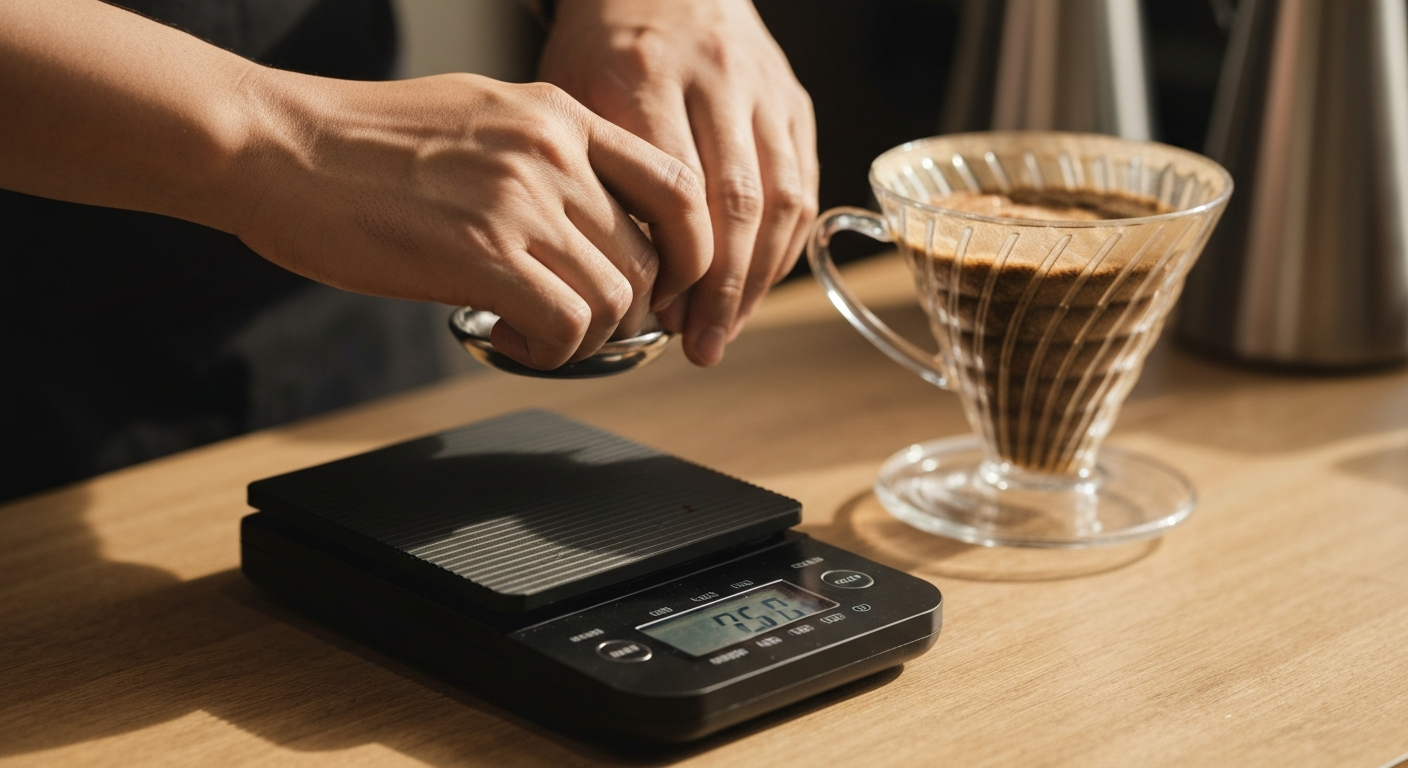
A precision scale is the most important tool for repeatable brewing — without consistent dose and yield weight, extraction yield cannot be tracked or controlled
The Extraction Timeline: What Dissolves When
Extraction does not happen uniformly. Coffee’s soluble compounds dissolve in a rough sequence based on molecular size and solubility. Understanding this order explains why under- and over-extracted coffees taste the way they do.
First to extract (low extraction yield, 0–10%): Fruit acids — citric, malic, tartaric — are highly soluble and come out quickly. So do some aromatic compounds responsible for floral and bright notes. A severely under-extracted coffee is dominated by raw acidity: sharp, sour, and one-dimensional.
Middle of extraction (10–18%): Sugars and the compounds that register as sweetness dissolve next. This is also where much of the pleasant complexity and fruit character develops — the stone fruit, citrus, and berry notes associated with high-quality specialty coffee. As extraction moves through this range, sourness gives way to brightness, and sweetness begins to emerge.
Target zone (18–22%): By the time 18–22% of the coffee’s dry mass has dissolved, the cup typically contains a good balance of acidity, sweetness, and body. The compounds dissolved at this stage include longer-chain sugars, more complex aromatic esters, and melanoidins (the Maillard reaction products responsible for roasty, chocolatey depth).
Over-extraction (above 22%): Beyond 22%, the compounds that dissolve are increasingly bitter and astringent — caffeine’s bitter relatives, tannin-like polyphenols, and degraded aromatic compounds. At this stage, pleasantness deteriorates. The cup becomes harsh, drying, and hollow despite tasting strong.
Symptoms: How to Diagnose by Taste
Under-Extracted Coffee
Tastes like: Sour, sharp, acidic, hollow, watery, thin, lacking sweetness, sometimes grassy or cereal-like. The acidity is raw and unpleasant rather than bright and juicy.
Feels like: Light-bodied, thin mouthfeel. The flavour disappears quickly after swallowing with little aftertaste.
Common causes:
- Grind too coarse (water passes through without extracting fully)
- Water too cool (extraction rate slows dramatically below 88°C)
- Contact time too short (brew finished before extraction was complete)
- Dose too low relative to water volume
- Uneven extraction — channelling in espresso, or uneven saturation of grounds
Over-Extracted Coffee
Tastes like: Bitter, harsh, dry, astringent, heavy, sometimes medicinal or woody. The aftertaste is long and unpleasant.
Feels like: Drying mouthfeel — like strong tea that has steeped too long. Coating on the tongue that does not resolve.
Common causes:
- Grind too fine (too much surface area exposed to water for too long)
- Water too hot (extraction proceeds too aggressively)
- Contact time too long
- Dose too high, concentrating extraction into a smaller volume
- Old, stale beans (their remaining solubles extract rapidly and bitterly)

A pale, watery cup and a dark, opaque cup tell opposite stories — extraction yield is visible before you even taste
How to Measure Extraction Yield
With a Refractometer
A coffee refractometer (the VST LAB Coffee III or similar) measures TDS optically. The procedure:
- Brew your coffee as normal.
- Let a small sample cool to room temperature (25°C or below). Warm samples give inaccurate readings.
- Place two drops on the refractometer prism.
- Read the Brix or TDS value.
- Enter TDS, brew weight, and dry coffee dose into a brewing calculator to get extraction yield.
Refractometers designed for other uses (wine, salinity) do not give accurate coffee TDS readings — the refractive index calibration is different. Use a coffee-specific instrument.
Without a Refractometer: Taste-Based Diagnosis
You can estimate extraction zone from flavour alone with practice. Brew a cup, sip it, and ask:
- Is it sour and thin? Under-extracted. Grind finer, extend contact time, or raise water temperature.
- Is it bitter and harsh? Over-extracted. Grind coarser, shorten contact time, or reduce water temperature.
- Is it simultaneously sour and bitter? Uneven extraction — likely a distribution or grind consistency problem. Check your grind size consistency and brewing technique.
- Does it taste balanced — acidic but sweet, complex but clear? You are in range.
Fixing Extraction Problems: A Decision Tree
Sour and thin (under-extracted):
- Grind finer (fastest fix, most direct impact)
- Increase water temperature by 2–3°C
- Extend brew time (pour slower, use a coarser grind with longer steep)
- Check water — very soft or distilled water under-extracts; add minerals
Bitter and harsh (over-extracted):
- Grind coarser
- Reduce water temperature by 2–3°C
- Shorten contact time (pour faster, reduce steep time)
- Reduce dose slightly if the ratio is very low
Both sour and bitter (uneven extraction):
- Check grind uniformity — consider a better burr grinder
- Improve grounds distribution — shake or stir the bed before brewing
- For espresso: diagnose and fix channelling with a distribution tool or WDT
Too weak but balanced (good extraction, low TDS):
- Increase dose (use more coffee)
- Reduce brew water volume for same dose
Too strong but balanced (good extraction, high TDS):
- Reduce dose
- Increase brew water volume
- Dilute after brewing (acceptable for espresso-based drinks; less common for filter)
The Interaction of All Variables
Extraction yield is not a single-knob dial. It is the output of a system where grind size, water chemistry, brew ratio, water temperature, contact time, and turbulence all interact. The experienced brewer holds most variables constant and adjusts one at a time — typically starting with grind, since it has the most direct and immediate effect on extraction rate.
The goal is not to optimise for a number. The goal is to optimise for the cup — extraction yield and TDS are diagnostic tools that help you understand what happened and predict what to adjust. Use them in service of taste, not as targets unto themselves. A coffee at 21.5% extraction yield that tastes harsh may still be over-extracted relative to what that particular coffee’s character calls for. Trust your palate; use the numbers to understand why.
Further Reading
- Lockhart, E.E. (1957). The Soluble Solids in Beverage Coffee as an Index to Cup Quality — the foundational research behind the coffee brewing control chart
- Perger, M. Barista Hustle Brew Calculator — free extraction yield and TDS calculator
- Specialty Coffee Association. Brew Control Chart — the visual framework for extraction yield vs strength
- Grind Size Guide — how particle size is the fastest lever for extraction control
- Water Chemistry and Coffee — how mineral content affects what extraction yield actually tastes like
Related Topics
What is Coffee Brewing?
Coffee brewing extracts soluble flavour from roasted grounds using water — and grind size, temperature, time, and ratio all determine whether the cup sings or disappoints.
getting-startedGrind Size Guide: How Particle Size Shapes Your Cup
From coarse to extra-fine: how grind size controls extraction, which grinder type matters, and how to dial in for every brew method.
scienceWater Chemistry and Coffee
Why TDS, magnesium, calcium, and alkalinity determine whether your coffee tastes brilliant or flat — and how to fix your tap water.
scienceThe Physics of Coffee Extraction
How mass transfer, pressure, diffusion, and temperature work together to pull flavour from ground coffee into your cup.