 English
  Українська
  Čeština
 Cupping: How Coffee Professionals Taste and Score
The cup of coffee you drink this morning passed through many hands before it reached you. And at almost every stage of its journey — from the farm to the cooperative, the exporter, the importer, the roaster, and the green buyer — someone cupped it. They ground it, steeped it in a bowl, broke a crust, slurped from a spoon, and then, crucially, they scored it.
Cupping is the universal evaluation method of the coffee industry. But the physical procedure is only half of it. The other half — the harder, more rewarding half — is the sensory vocabulary and the scoring system that turns a subjective tasting impression into a number that can be compared, communicated, and acted upon. This guide explains that vocabulary, the SCA cupping form, and how to develop the calibration skills to use it well.
For a step-by-step walkthrough of the cupping procedure itself, see Cupping: The Universal Language of Coffee Evaluation.
Why Cupping Uses a Standardised Protocol
Before the SCA cupping protocol existed, coffee was evaluated inconsistently — different buyers, different methods, different criteria. A cup that one exporter called “excellent” might mean something entirely different to the importing roaster who received the shipment. The SCA protocol solved this by fixing every variable of the brewing method (dose, ratio, grind size, water temperature, steep time) and standardising the attributes evaluated and the scale used to score them.
The result is a system where a Q-grader in Ethiopia and a roaster in Copenhagen can evaluate the same coffee and, if well-calibrated, arrive at scores within one or two points of each other. This shared language is what makes the global specialty coffee supply chain function.
The SCA Cupping Setup
Ratio: 8.25g of coffee per 150ml of water (approximately 1:18.2)
Grind: Medium-coarse — slightly coarser than a pour-over, so that approximately 70–75% of particles pass through a US Standard #20 (850-micron) sieve
Water temperature: 93°C (200°F)
Number of cups per sample: 5 (to check for uniformity and catch defects in individual cups)
Procedure in brief: Evaluate dry fragrance, pour water, evaluate wet aroma at 3–4 minutes by breaking the crust, skim, begin tasting at 8–10 minutes, and continue evaluating as the cup cools through multiple temperature windows.
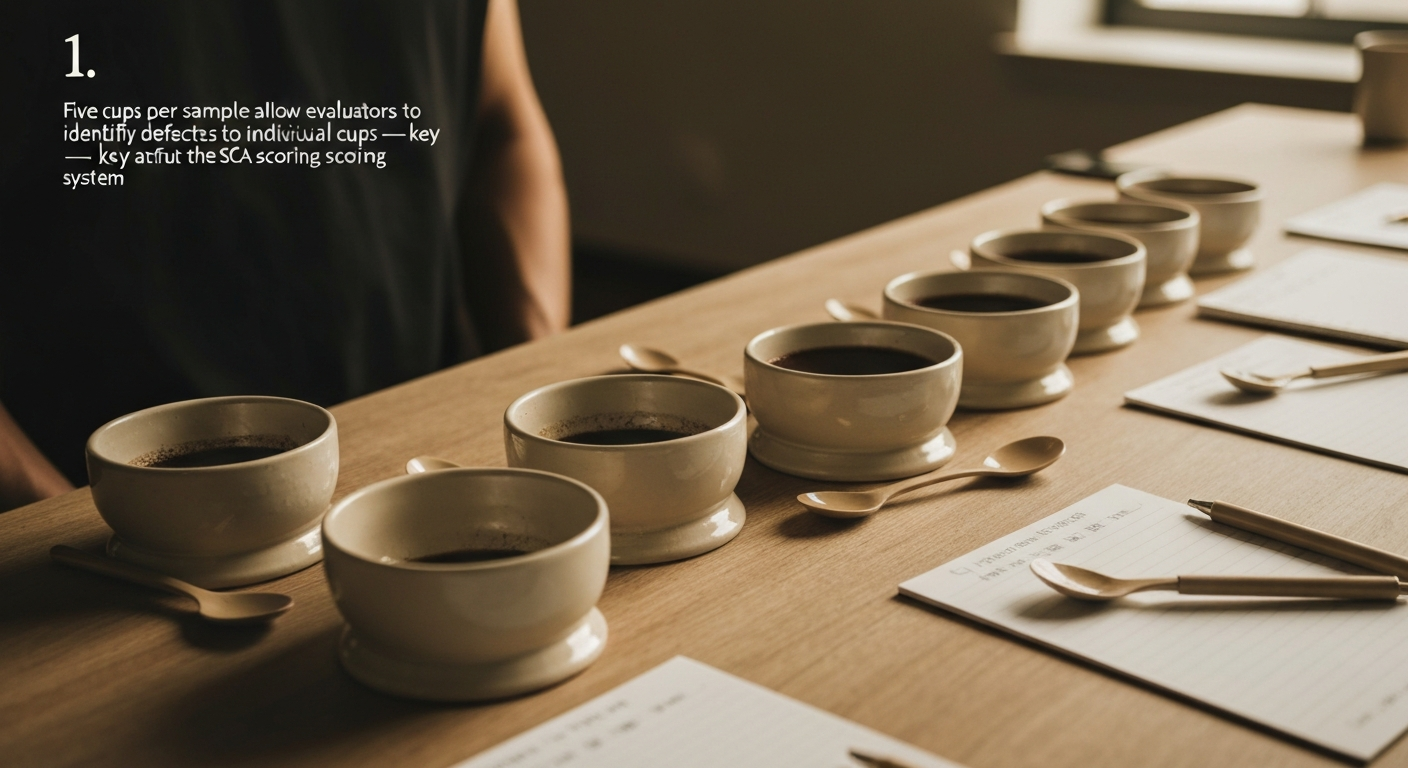
Five cups per sample allow evaluators to identify defects in individual cups and assess uniformity — a key attribute in the SCA scoring system
The Ten Scored Attributes
The SCA cupping form scores ten attributes, each on a scale of 6–10 in 0.25-point increments. The total possible score is 100 (before defect deductions). Coffees scoring 80 or above are classified as specialty grade.
1. Fragrance / Aroma
These two attributes are scored together but evaluated at different moments.
Fragrance is the smell of the dry, freshly ground coffee before water is added. Grind the coffee into the bowl and immediately lean close — volatile aromatic compounds begin escaping the moment the bean structure is broken. You have approximately 15 minutes before the most volatile compounds dissipate significantly.
Aroma is the smell after hot water is added, evaluated in two moments: the overall steam rising from the bowl during steeping, and then the intense burst released when you break the crust at 3–4 minutes.
What to look for: intensity, complexity (how many distinct notes can you detect?), and quality (are the aromas clean and pleasant, or do any off-notes intrude?). Common descriptors span floral (jasmine, rose, lavender), fruit (berry, citrus, stone fruit), sweet (caramel, chocolate, honey), and herbal or spice notes. A dry or fermented character at this stage is a warning sign.
Score range guidance:
- 6: Low intensity, simple, possibly off-notes
- 7: Moderate intensity, one or two distinct positive notes
- 8: Good intensity, clearly identifiable complexity, clean
- 9: High intensity, multiple distinct harmonious notes, exceptional clarity
- 10: Extraordinary complexity and intensity; exceedingly rare
2. Flavour
Flavour is the combined sensory impression of taste and aroma as experienced during tasting — the dominant note of the cup’s character. It is scored at the first sip and updated across multiple temperature windows.
Flavour is the most holistic attribute and often where the cup’s identity is most clearly expressed. A Yirgacheffe should present bright citrus and floral notes; a Sumatra should present earth, cedar, and dark fruit. When those expected characters arrive cleanly and in balance, flavour scores high. When the cup tastes generic, muddy, or off, flavour is penalised first.
3. Aftertaste
Aftertaste is the length and quality of the flavour impression remaining after the coffee is swallowed (or spit, in professional settings). A long, pleasant, evolving aftertaste — where the cup continues to reveal complexity — scores well. An abrupt finish, or one that turns bitter or astringent, scores lower.
Ask: does the aftertaste resolve cleanly? Does it linger in a pleasant way? Does it add new information (a new flavour note, a shift in character) or simply persist as a bitter residue?
4. Acidity
Acidity in coffee does not mean vinegar-sharp sourness — it refers to the perception of bright, lively organic acids (citric, malic, phosphoric, tartaric) that contribute liveliness and structure to the cup. High-quality acidity is described as vibrant, juicy, or crisp; it makes the cup feel alive and refreshing. Low-quality acidity is described as harsh, sharp, or fermented.
Acidity is evaluated on two dimensions: intensity (how much) and quality (how pleasant). A coffee can have high-intensity acidity that scores well if the quality is high, or high-intensity acidity that scores poorly if it is harsh and unpleasant.
Geographic patterns: Ethiopian and Kenyan coffees tend to score high on acidity intensity with bright fruit character. Brazilian and Sumatran coffees tend to have lower acidity intensity. Neither is inherently better — the score reflects quality relative to what the coffee is expressing, not a universal preference for high acidity.
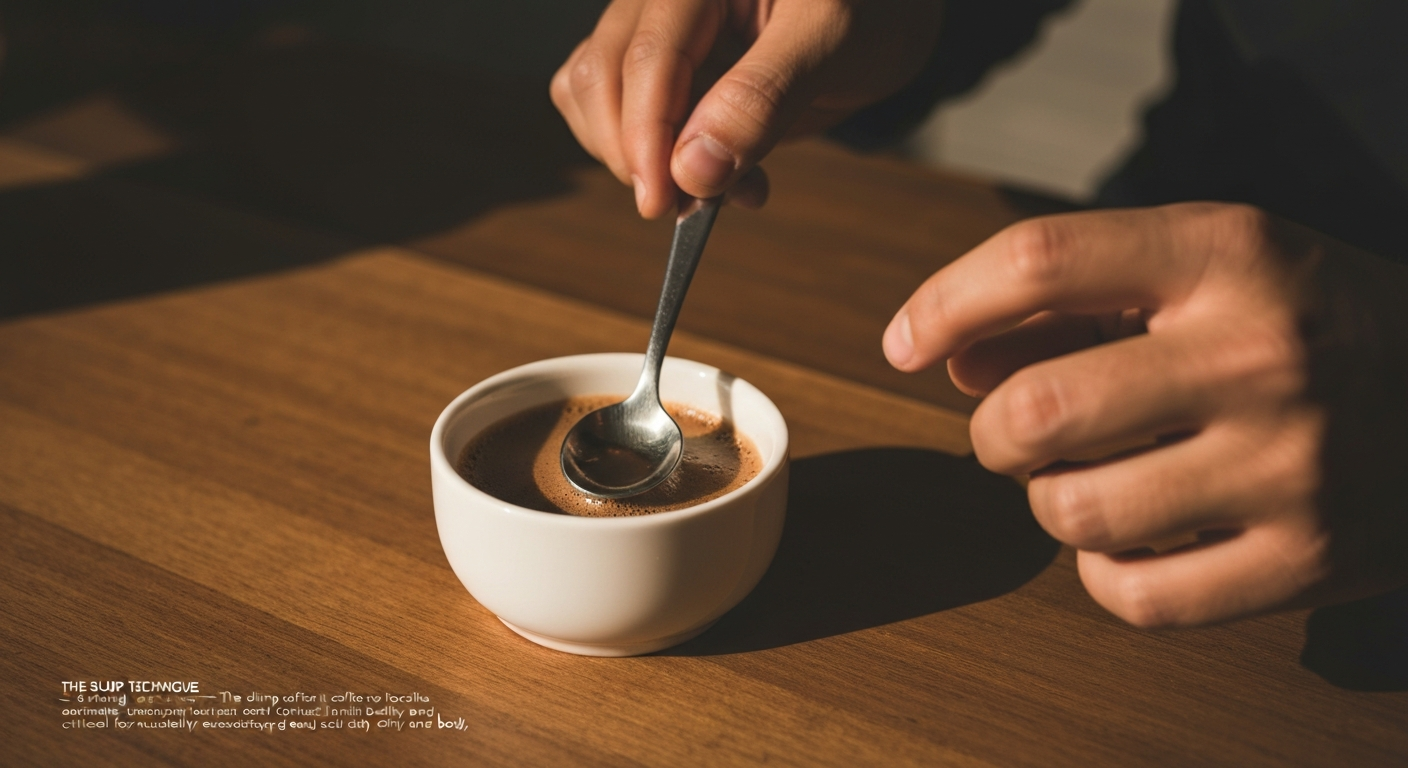
The slurp technique — drawing coffee forcefully across the palate — aerates the liquid and maximises contact with all taste receptors, critical for accurately evaluating acidity and body
5. Body
Body is the tactile sensation of weight, density, and texture of the coffee in the mouth — often described using terms like thin, silky, round, creamy, full, or syrupy. It is primarily determined by the concentration of dissolved lipids, proteins, and long-chain polysaccharides in the brew.
Body is evaluated by how the coffee feels as it moves across the tongue and palate, not by how it tastes. A light-bodied coffee (like many washed Ethiopians or Kenyans) is not necessarily lower scoring than a full-bodied one (like an Indonesian wet-hulled or a natural Brazilian) — the score reflects quality and appropriateness of body for the coffee’s character.
Body and mouthfeel are closely related: mouthfeel includes not just weight but texture (does the coffee feel clean and smooth, or rough and astringent?).
6. Balance
Balance is the most holistic and arguably most difficult attribute to score: it evaluates how well the individual components — flavour, aftertaste, acidity, and body — work together in an integrated whole. A cup can have excellent individual attributes that feel disjointed; a cup with moderate attributes that are harmoniously integrated may score higher on balance.
Balance is penalised when:
- Acidity is so dominant that it overwhelms other notes
- Body is so heavy that it mutes clarity
- Bitterness overrides sweetness and fruit character
- The cup shifts dramatically between sips rather than presenting consistently
Balance rewards coffees that feel complete and satisfying across the entire evaluation, not just at peak temperature.
7. Sweetness
Sweetness in coffee is not the added-sugar sweetness of a latte — it is the perceived natural sweetness of the coffee’s own dissolved sugars and the impression of sweetness from aromatic compounds. Coffees with good sweetness have a pleasant, gentle sweetness that harmonises with acidity and reduces the perception of bitterness.
Sweetness is scored per cup: each of the five cups in a cupping is evaluated and scores 2 points if sweetness is present, zero if it is absent. Maximum score is 10 (2 points × 5 cups). This makes sweetness the most binary of the scored attributes — it is present or it is not, measured across the full sample set.
Coffees with processing defects, poor fermentation control, or that are old and stale often lack sweetness — the sugars have degraded or been dominated by fermented or woody notes.
8. Clean Cup
Clean cup measures the absence of negative impressions — off-flavours, defects, taints, or faults — from the first sip through to the swallow and finish. Cleanliness is scored per cup (2 points each, 10 points maximum, same as sweetness) and reflects whether each individual cup in the sample set tastes free of contamination.
A “clean” coffee is not bland — it simply means that what is present in the cup is the coffee’s authentic character, without interference from defects. Specialty coffee prioritises cleanliness because defects indicate problems at farming (over-fermentation, pest damage), processing (contamination), or storage (mould, moisture damage).
Common defects that reduce clean cup score: fermented/rotting fruit character (Sour), potato taste (Rioy), musty notes (mould), phenolic or medicinal character, and rubber or petroleum notes.
9. Uniformity
Uniformity evaluates whether all five cups in the sample taste the same. In ideal conditions, five cups brewed from the same lot should be indistinguishable. A lack of uniformity — where one or two cups taste noticeably different from the others — suggests inconsistency in the lot, whether from mixed varieties, uneven processing, or bean defects.
Uniformity is also scored per cup: 2 points per uniform cup, zero per non-uniform cup. A single anomalous cup in an otherwise excellent sample costs 2 points and is a significant signal to a buyer.
10. Overall
Overall is the evaluator’s holistic impression — a space to score what could not be fully captured in the individual attributes. If a coffee has a particular combination of complexity, terroir expression, or emotional resonance that exceeds the sum of its parts, overall is where that is captured. If a coffee underperforms relative to its individual scores, overall can reflect that too.
Think of overall as the evaluator’s personal statement about the coffee’s worth: “Here is my final judgement, beyond the checklist.”
Defect Scoring
Defects are scored separately and subtracted from the total. The SCA protocol distinguishes:
- Taints: Off-flavours that are present but not overwhelming. A slight phenolic note, a hint of ferment. Each tainted cup subtracts 2 points from the final score.
- Faults: Severe off-flavours that overwhelm the cup. Each faulty cup subtracts 4 points.
A single faulty cup in a sample set can drop a coffee below the 80-point specialty threshold — which is intentional. Severe defects indicate systemic problems and the coffee should not be sold as specialty regardless of other attributes.
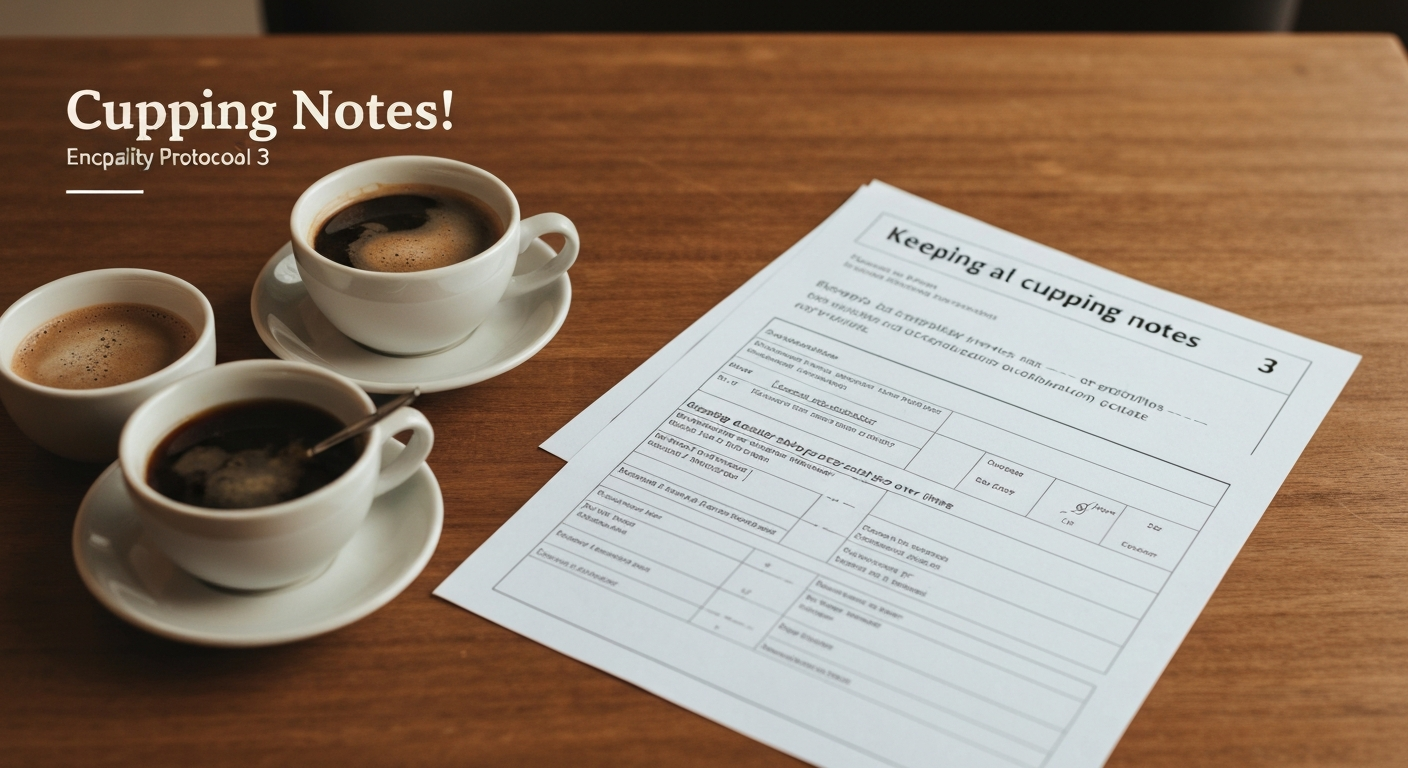
Keeping detailed cupping notes — including specific descriptors and scores per attribute — is how evaluators develop calibration over time and track quality across lots
The Scoring Scale: What the Numbers Mean
| Score | Classification | What It Means |
|---|---|---|
| 90–100 | Outstanding | Exceptional complexity, balance, and origin character. Top 1% of specialty lots. |
| 85–89.99 | Excellent | Distinctive character, high complexity. Premium single-origin territory. |
| 80–84.99 | Very Good | Clean, pleasant, identifiable positive attributes. Specialty grade threshold. |
| 75–79.99 | Good | Above commodity quality but not specialty. Commercial premium range. |
| Below 75 | Below specialty | May have defects or insufficient quality for specialty classification. |
The practical stakes are significant. Coffees scoring 85+ command premium prices — often 2–4× the commodity price — from specialty importers and roasters. Cup of Excellence auction lots, which use a modified version of the protocol, regularly sell 90+ coffees for extraordinary sums. The score is not an academic exercise; it is the price mechanism of the specialty supply chain.
Cupping at Home: A Calibration Practice
You do not need Q-grader certification to cup at home. The practice scales beautifully to a kitchen counter and a few mugs, and the sensory training you build is the most direct path to understanding what you taste and why.
What you need:
- 2–4 wide mugs or cereal bowls (ceramic preferred)
- A soup spoon or large dessert spoon
- A kitchen scale
- A kettle
- Two or more different coffees (cupping comparatively is far more educational than cupping solo)
- A notepad
Home recipe: 12g of coffee per 200ml of water at 93°C. Grind to medium-coarse. Follow the SCA procedure: evaluate dry fragrance immediately after grinding, pour water, evaluate aroma and break the crust at 4 minutes, skim, begin tasting at 8–10 minutes.
The calibration exercise: The fastest way to develop your palate is to cup the same coffee processed two different ways — a washed and a natural from the same origin or producer if possible. The processing difference creates dramatic, immediately perceptible contrasts in sweetness, body, and fruit character that teach you what those attributes actually feel like, not just what the words mean.
A second valuable exercise: cup the same coffee at different temperatures. Evaluate each cup at roughly 70°C, 60°C, 50°C, and 40°C. Note how the profile changes. Coffees that are excellent at 70°C and continue to develop as they cool are scoring high on balance and sweetness. Coffees that taste acceptable hot but turn bitter or astringent as they cool reveal extraction or quality problems.
Further Reading
- Cupping: The Universal Language of Coffee Evaluation — the full step-by-step SCA cupping procedure
- Lingle, T.R. The Coffee Cuppers Handbook (SCAA, 1986) — the foundational methodology text, still the definitive reference
- SCA Cupping Protocols and Forms — the official downloadable cupping form and procedures
- Coffee Quality Institute — Q-grader certification, including sensory calibration training
- Cup of Excellence — winning lot profiles and scoring reports showing the system in action
- Extraction Yield — the brewing science underlying what makes a cup cup well
Related Topics
Coffee Cupping
The universal language of coffee evaluation — how professionals cup coffee using SCA standards, and how you can apply the same protocol at home to sharpen your palate.
getting-startedWhat is Coffee Brewing?
Coffee brewing extracts soluble flavour from roasted grounds using water — and grind size, temperature, time, and ratio all determine whether the cup sings or disappoints.
processWashed (Wet) Processing
Washed coffee processing removes all fruit before drying to reveal clean, bright cups — floral, terroir-transparent, and prized by the specialty world. The benchmark method.
processNatural (Dry) Processing
Natural processing dries whole coffee cherries in the sun before milling — the oldest method, and the one most responsible for fruity, wine-like, and berry-forward cups.