 English
  Українська
  Čeština
 Spread across more than seventeen thousand islands along the equator, Indonesia is a country whose geography seems purpose-built for growing coffee. Volcanic soil, tropical humidity, altitudes ranging from sea level to well above 1,500 metres — the archipelago offers a staggering range of microclimates within a single nation. Indonesia ranks as the world’s fourth-largest coffee producer, behind Brazil, Vietnam, and Colombia, and yet its reputation rests less on sheer volume than on a flavour profile that divides opinion like no other origin: deep, earthy, full-bodied, and sometimes startlingly savoury. As James Hoffmann writes in The World Atlas of Coffee, Indonesian coffees “challenge expectations of what coffee can and should taste like.”
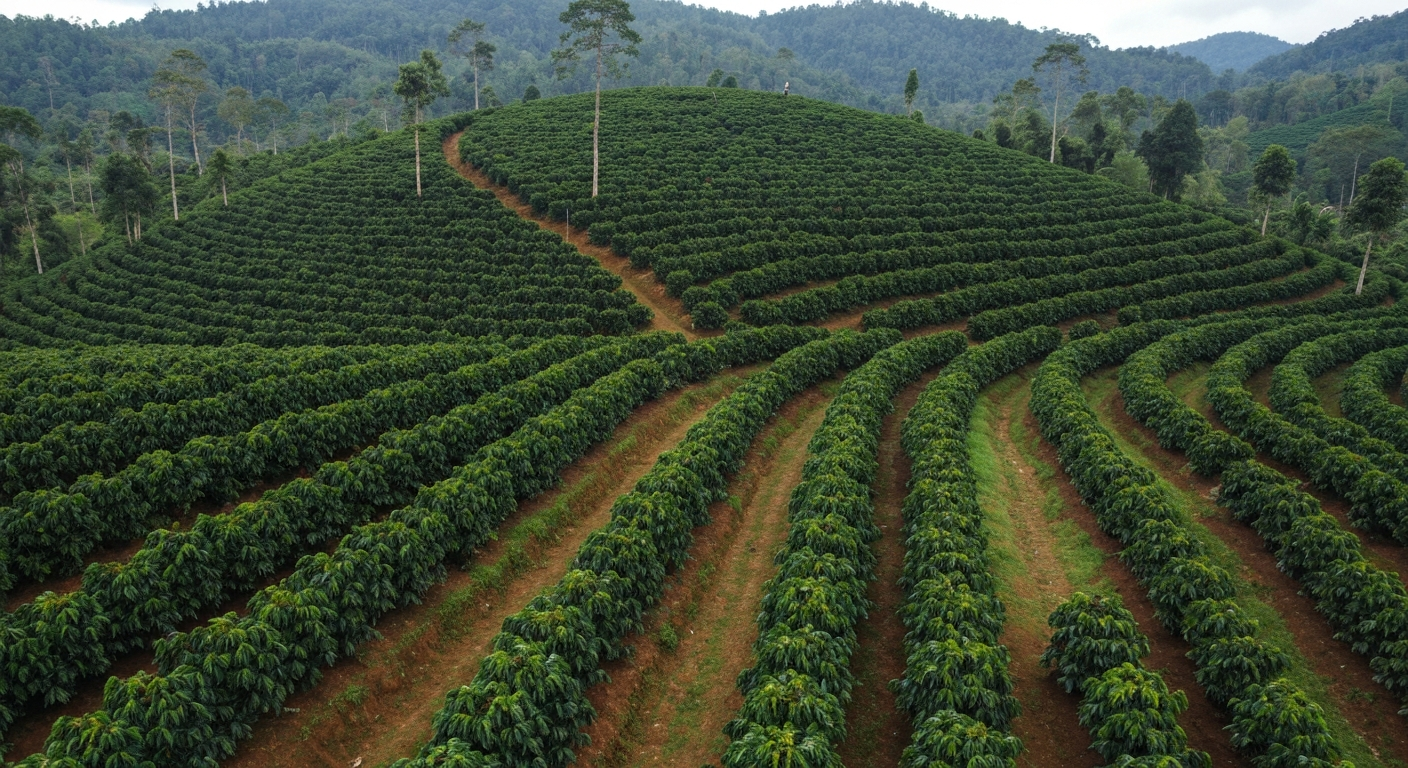
Indonesia’s volcanic highlands — equatorial heat, rich soil, and abundant rainfall create ideal conditions for coffee cultivation
The Dutch colonial administration introduced coffee to Java in the late seventeenth century, making Indonesia one of the oldest producing nations outside of Africa and the Arabian Peninsula. The word “java” itself became English-language slang for coffee — a linguistic fossil from the era when the island dominated global supply. Today, production extends far beyond Java to Sumatra, Sulawesi, Bali, Flores, and Papua, each island contributing its own character to the country’s remarkably diverse portfolio.
Island Origins
Sumatra
Sumatra is the island most closely associated with Indonesian coffee in the minds of specialty buyers. The Mandheling and Lintong regions, situated around Lake Toba in the north, produce Arabica coffees famous for their heavy body, low acidity, and flavour notes that range from cedar and tobacco to dark chocolate and tropical fruit. Gayo, in the Aceh highlands, has gained particular renown in recent years for cleaner, more complex lots that retain the characteristic earthiness while adding herbal sweetness and spice. Much of Sumatran coffee is grown by smallholders on plots of one to two hectares, harvested selectively, and processed at the farm level — a decentralised model that makes traceability both challenging and rewarding.
Java
Java’s coffee history is the longest of any Indonesian island, dating to 1696 when the Dutch East India Company planted its first seedlings. The government-run estates of the colonial era — Jampit, Blawan, Kayumas, Pancoer, and Tugosari — still operate today and produce some of the island’s finest washed Arabicas. Estate-processed Java coffees tend to be cleaner and brighter than their Sumatran counterparts, with herbal, nutty, and mildly spicy characteristics. “Old Java” or “aged Java,” stored in warehouses for several years to deepen body and reduce acidity, was historically blended with Yemen Mocha to create the legendary “Mocha-Java” — arguably the world’s oldest known coffee blend.
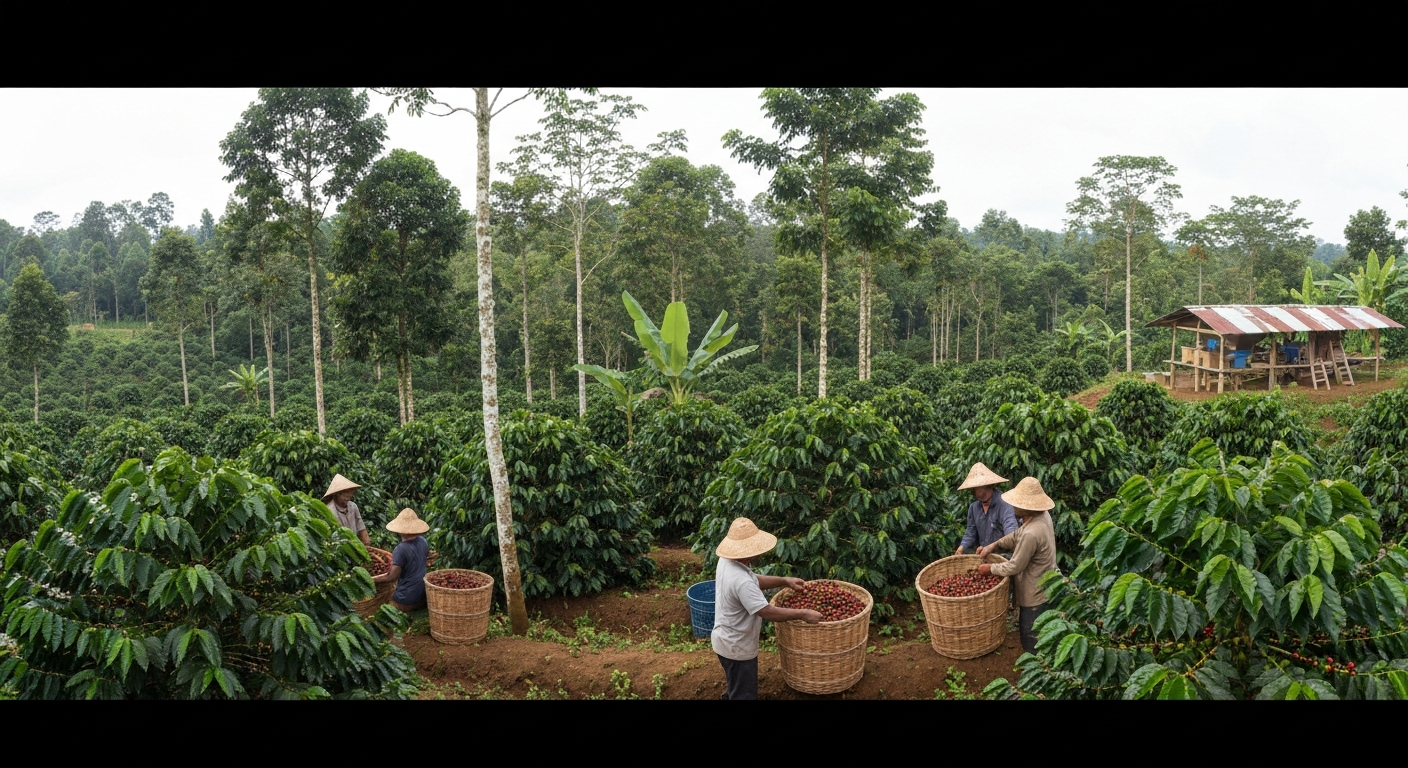
Terraced hillside farming in the Indonesian highlands, where smallholders cultivate coffee among food crops
Sulawesi
The Toraja highlands of Sulawesi, rising above 1,400 metres in the island’s central spine, produce coffees that many consider the most balanced in the archipelago. Sulawesi Toraja is less aggressively earthy than Sumatran coffee, offering instead a clean sweetness, warm spice notes, and a buttery, almost creamy body. The cultural traditions of the Toraja people — elaborate funeral ceremonies, ornate carved houses — infuse the region with a sense of heritage that extends to its coffee farming.
Bali and Flores
Smaller in output but increasingly visible in the specialty market, Bali’s Kintamani region grows Arabica under citrus shade trees on the slopes of Mount Agung, producing cups with bright lemon acidity and caramel sweetness that surprise anyone expecting the typical Indonesian earthiness. Flores, an island in the Lesser Sundas, yields coffees with a chocolate-forward, syrupy profile — a hidden gem that is slowly gaining recognition among roasters looking beyond the established names.
Giling Basah: The Wet-Hulled Difference
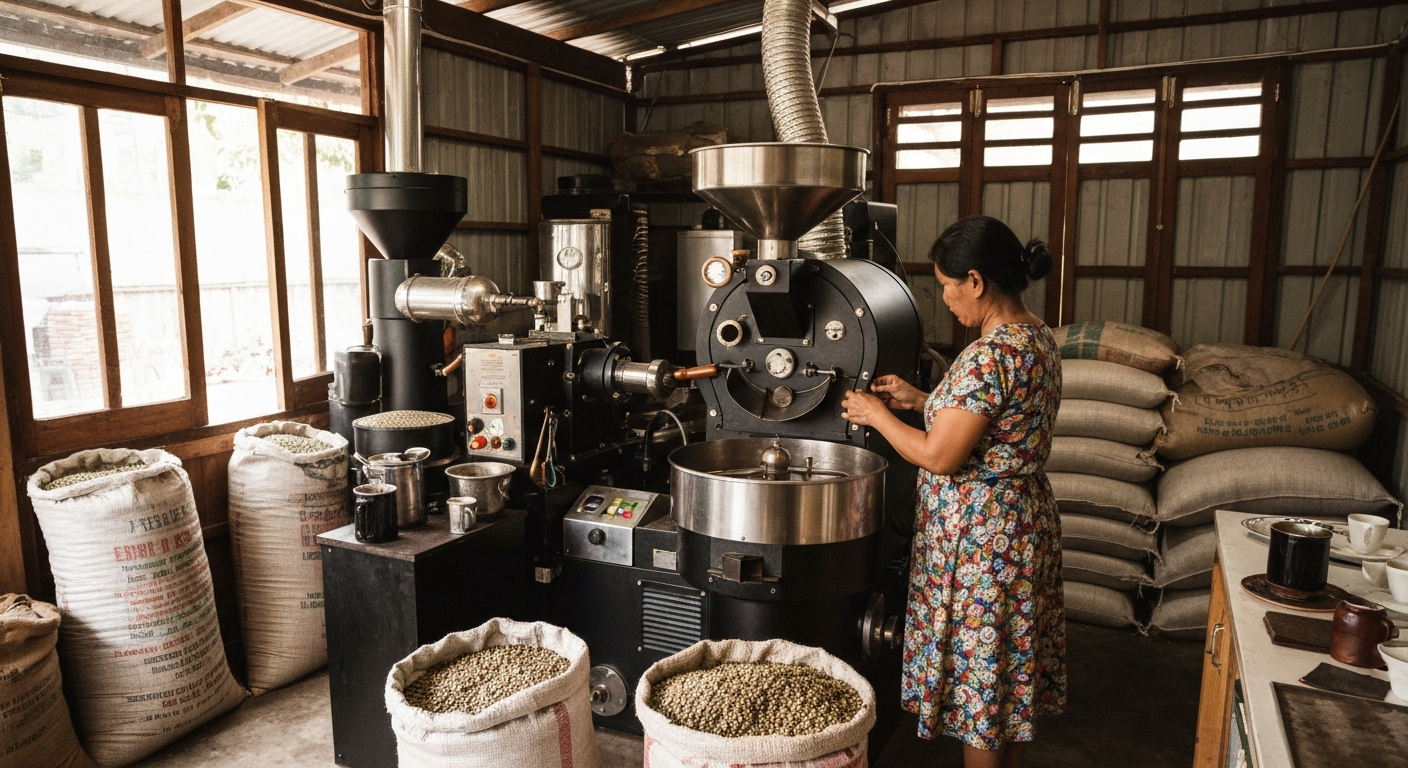
No discussion of Indonesian coffee is complete without giling basah, the wet-hulling process that is arguably the single greatest influence on the country’s distinctive flavour. In conventional washed processing, parchment coffee is dried to approximately 11 per cent moisture before the parchment layer is removed. In giling basah, farmers depulp and briefly ferment their cherries, then sell the wet parchment — still at 30 to 50 per cent moisture — to collectors, who mechanically strip the parchment and spread the exposed green beans to dry in the open air.
Green coffee drying after wet-hulling — exposed beans lose moisture rapidly in Indonesia’s tropical heat
This method emerged as a practical response to Indonesia’s relentless humidity: farmers cannot afford to wait weeks for parchment to dry when daily rainstorms threaten mould. The trade-off is significant. Removing the protective parchment early exposes the bean to ambient conditions, encouraging enzymatic and microbial changes that produce the heavy body, muted acidity, and earthy, herbal, sometimes mushroom-like flavours that define classic Indonesian coffee. As Hoffmann notes, giling basah “is both the origin of the flavours people love and the source of many of the defects they don’t.”
Specialty producers in Gayo and Toraja are increasingly experimenting with fully washed and natural processing to showcase cleaner, fruit-forward profiles, but wet-hulling remains overwhelmingly dominant and is, for many drinkers, the very essence of what makes Indonesian coffee Indonesian.
Flavour Profile
Indonesian Arabicas processed through giling basah present a flavour spectrum unlike any other origin in the coffee belt. Expect low to moderate acidity, a full, almost syrupy body, and tasting notes that lean towards earthy, herbaceous, and woody — cedar, tobacco leaf, dark chocolate, dried herbs, and pipe smoke are common descriptors. The best lots balance these savoury qualities with underlying sweetness: brown sugar, baking spice, or tropical fruit. Washed Javas and naturally processed Gayo lots offer a lighter, cleaner counterpoint, proving that Indonesia’s palate is broader than its reputation suggests.
Robusta Production
While the specialty world focuses on Arabica, Indonesia is in fact one of the world’s largest Robusta producers. Roughly 75 per cent of the country’s total output is Robusta, grown primarily in southern Sumatra (Lampung province), Java, and Kalimantan at lower elevations. Indonesian Robusta is a staple of instant coffee blends and commercial espresso worldwide, valued for its high caffeine content and strong, bitter flavour. A growing “fine Robusta” movement, championed by producers in Java and Lampung, is beginning to challenge assumptions about the species, yielding cups with chocolate, nutty, and grain-like sweetness that score competitively in Robusta-specific cupping protocols.
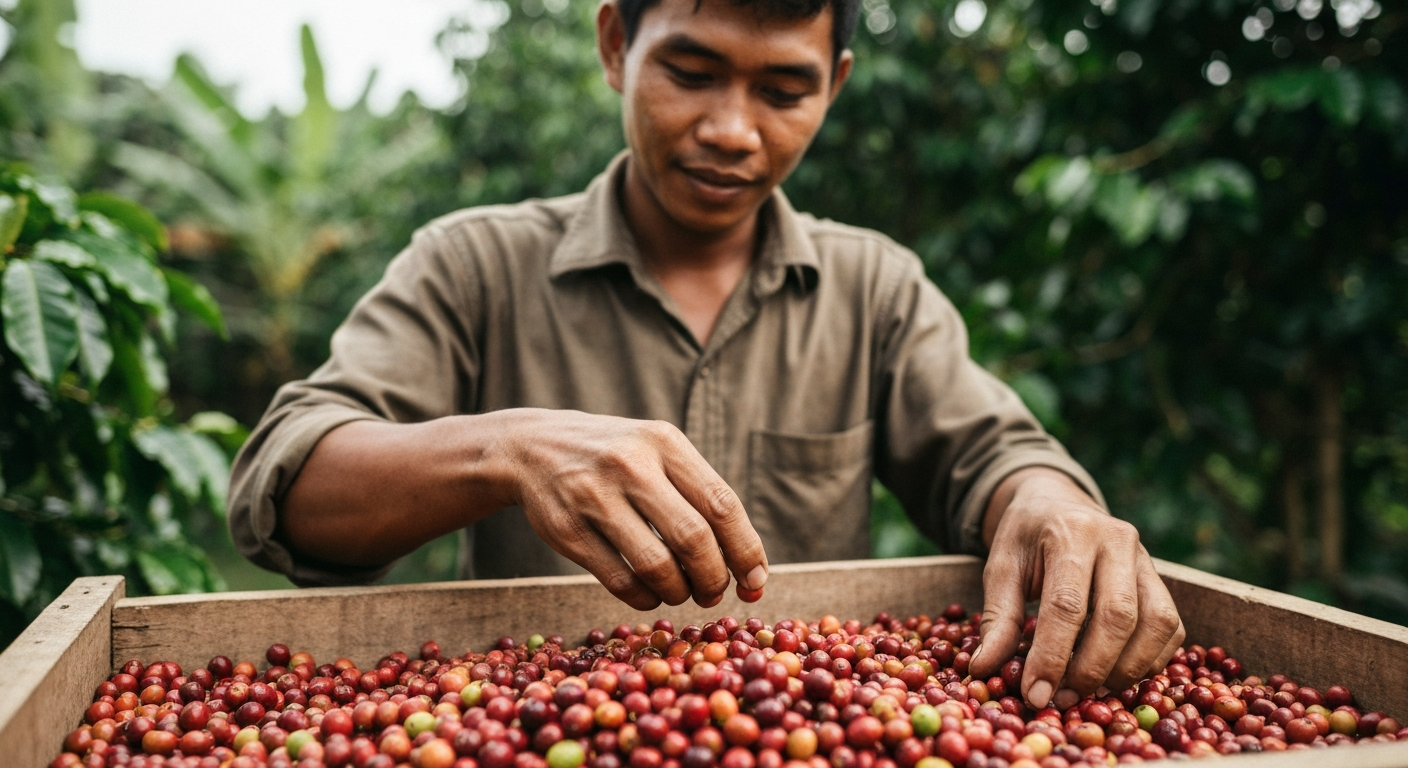
Freshly harvested coffee cherries — Indonesian smallholders pick selectively across multiple passes during the harvest season
Kopi Luwak: A Cautionary Note
Indonesia is the birthplace of kopi luwak — coffee made from beans that have passed through the digestive tract of the Asian palm civet. Once a curiosity of wild-sourced production, kopi luwak has become an industrialised, often exploitative trade. Civets are frequently caged in poor conditions and force-fed cherries to meet tourist demand. Multiple investigations, including by the BBC and National Geographic, have documented widespread animal cruelty. The Specialty Coffee Association does not recognise kopi luwak as a quality category, and most reputable roasters refuse to stock it. The coffee itself, stripped of much of its acidity by enzymatic digestion, is generally considered unremarkable by professional cuppers. For ethical and quality reasons alike, the specialty industry has largely moved on — and so should consumers.
Why Indonesia Matters
Indonesia matters to coffee for reasons that extend beyond its production volume. It is the origin of wet-hulling, a processing method found nowhere else in the world, and its flavour profile occupies a unique corner of the taste spectrum — savoury, heavy-bodied, and unapologetically different from the bright, fruity coffees of East Africa or Latin America. Its smallholder farming model, with an estimated 2 million coffee-growing households, makes it a critical case study in livelihood economics and sustainability. And its vast Robusta output quietly underpins the global commercial coffee supply chain.
For the adventurous drinker willing to embrace coffee’s wilder, earthier side, Indonesia is essential territory. From the cedar-and-tobacco depth of a classic Mandheling to the spice-sweet balance of a Toraja lot, these are coffees that reward an open mind — and remind us that the world of coffee is far more diverse than any single flavour profile can contain.
Further Reading
- The World Atlas of Coffee by James Hoffmann — detailed profiles of Indonesian islands and processing methods
- Uncommon Grounds by Mark Pendergrast — the colonial history of Java’s coffee industry
- Specialty Coffee Association — processing standards and cupping protocols
- International Coffee Organization — Indonesian production statistics and market data
Related Topics
What is Coffee Origin?
Coffee origin is the story of place — altitude, soil, and climate shape every flavour note. From Ethiopian florals to Colombian caramel and Kenyan citrus.
getting-startedThe Coffee Belt
The Coffee Belt spans the tropics between Cancer and Capricorn, home to all 70 coffee-growing nations and every Arabica and Robusta variety on Earth.
processNatural (Dry) Processing
Natural processing dries whole coffee cherries in the sun before milling — the oldest method, and the one most responsible for fruity, wine-like, and berry-forward cups.
varietyRobusta (Coffea canephora)
Often dismissed but increasingly respected, Robusta is coffee's resilient workhorse — powering espresso blends, instant coffee, and a growing fine Robusta movement.