 English
  Українська
  Čeština
 After a coffee cherry is picked, the clock is already ticking. Tropical heat begins working on the fruit immediately, and within hours, the microbial activity that will either enhance or destroy the flavour of the seed inside has begun. How a producer responds to this urgency — how quickly and in what manner they remove the fruit from the seed and dry it to a stable moisture content — is what we mean by “processing,” and it is one of the most powerful flavour variables in specialty coffee.
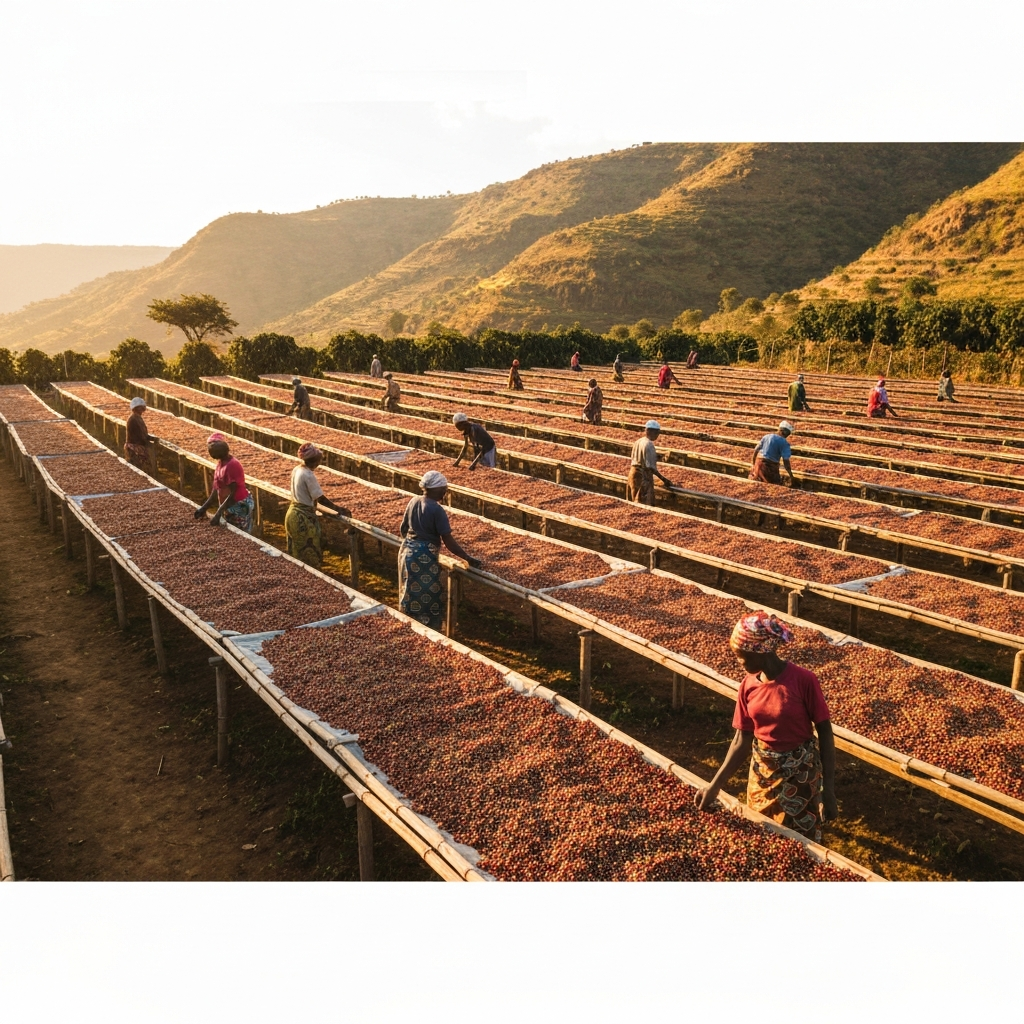
Raised drying beds allow airflow beneath and above the coffee, ensuring even, controlled drying — a critical investment in cup quality at the processing stage
Why Processing Matters So Much
The coffee cherry consists of layers of fruit surrounding the seed: skin, pulp, sticky mucilage, parchment. These layers contain sugars and organic acids. When the seed is dried while still in contact with these layers, those compounds migrate into the seed and influence its flavour. Remove the fruit quickly and you minimise this transfer; leave it on longer and you maximise it. Three main approaches — washed, natural, and honey — define most of the spectrum.
Washed Processing
Washed coffee, also called wet-processed or fully washed, removes as much of the fruit as possible before drying. The typical sequence: cherries are pulped within hours of harvest to remove the skin and most of the pulp. The pulped beans — still coated in a layer of sticky mucilage — are then submerged in water tanks and fermented for 12 to 72 hours, during which naturally occurring microbes and enzymes break down the remaining mucilage. After fermentation, the beans are thoroughly washed with clean water to remove all residue and then dried on raised beds or patios to a moisture content of approximately 11%.
The result is a “clean” coffee that minimises the influence of the fruit and maximises the transparency of the seed’s inherent flavour — its genetics, altitude, and terroir. Washed Ethiopians from Yirgacheffe are famous for their delicate florals and citrus brightness; washed Kenyans for their electric, blackcurrant acidity. Both express their origin with unusual clarity precisely because the processing method removes distracting fruit flavour and lets the bean speak.
Washed processing requires abundant clean water, making it less viable in water-stressed regions. It also demands precise fermentation control: over-fermented washed coffees develop unpleasant “winey” or vinegar-like notes that dramatically reduce cup quality.
Natural Processing
Natural processing, also called dry processing, is the oldest method — it predates machinery entirely. Whole cherries, unprocessed, are spread directly onto drying beds or patios and left to dry in the sun with the fruit intact. Over three to six weeks, the cherry desiccates: the skin shrivels, the pulp dries, the sugars caramelise, and the seed inside absorbs the transformed fruit compounds throughout the long drying period. The dried cherry is then hulled mechanically to reveal the green bean within.
Natural processing produces a dramatically different cup profile: heavier body, lower perceived acidity, and an abundance of fruity sweetness — often described as blueberry, strawberry, red wine, or tropical fruit. Ethiopian naturals from Sidama or Harrar have become iconic for this character. The method requires less water than washed processing and can be practised in regions without reliable water access — which is historically why it dominated Ethiopian and Yemeni production.
The downside is inconsistency and risk. Whole cherries drying in tropical heat create ideal conditions for unwanted fermentation if not turned regularly and carefully monitored. A poorly managed natural can taste funky, overfermented, or mouldy — a high risk for a high potential reward that makes naturals both the most exciting and the most variable coffees on the market.
Honey Processing
Honey processing sits between washed and natural — removing the skin and some or all of the pulp, but leaving varying amounts of mucilage on the parchment during drying. The name comes not from the ingredient but from the sticky, honey-like texture of the mucilage-coated beans as they dry in the sun. Colour designations — yellow honey, red honey, black honey — indicate how much mucilage remains: yellow has the least (closest to washed), black has the most (closest to natural).
The result is a balanced profile: more sweetness and body than a washed coffee, more clarity and acidity than a natural. Honey processing originated in Costa Rica, where producers were looking for a method that used less water than traditional washed processing while still producing clean, consistent results. It has since spread across Central America and is increasingly common in Ethiopia, Colombia, and beyond.
Newer Methods: Anaerobic and Beyond
Beyond the classic three, a generation of experimental processing techniques has emerged in specialty coffee over the last decade. Anaerobic fermentation seals coffee in oxygen-free tanks where specific microbial populations produce distinctive flavour compounds — often intensely fruity, wine-like, or tropical. Carbonic maceration, borrowed from wine, uses CO₂ to drive specific fermentation pathways. Extended maceration, submerged natural, and various hybrid methods continue to push the boundaries of what processing can achieve.
These methods are controversial in the specialty world — some argue they mask or replace terroir with process-driven flavour, while others see them as legitimate tools for expanding coffee’s flavour potential. What is beyond dispute is that they are now firmly part of the specialty market, commanding premium prices and attracting devoted followers.
Where to Go Next
- What Is a Coffee Cherry? — understand the fruit anatomy that makes processing so consequential
- Anaerobic Fermentation — go deeper on the experimental methods reshaping specialty coffee
- Altitude and Terroir — understand how processing interacts with origin to create a cup’s identity
Related Topics
What Is a Coffee Cherry?
Before it becomes a bean, coffee is a fruit — a bright, sweet cherry that grows on trees, takes nine months to ripen, and contains the seeds we roast. Here is the full biology.
getting-startedWhat Is Specialty Coffee?
The 80-point SCA scale separates extraordinary coffee from commodity. Here is what that number actually means, how it is scored, and why it matters in the cup.
processCoffee Drying Methods: Raised Beds, Patios, and Mechanical Drying
How coffee dries after processing shapes the final cup as much as any other step. Explore raised beds, patio drying, mechanical drum dryers, and the science of getting it right.
processAnaerobic Fermentation
A cutting-edge processing innovation where coffee ferments in sealed, oxygen-free tanks — producing intensely fruity, wine-like flavours that are redefining specialty coffee.