 English
  Українська
  Čeština
 Costa Rica is a small country that punches far above its weight in the coffee world. Tucked between Nicaragua and Panama on the Central American isthmus, this nation of just five million people has built a reputation not on volume — it produces less than one percent of the world’s coffee — but on relentless innovation and an unwavering commitment to quality. Costa Rica was among the first origins in Central America to cultivate coffee commercially, beginning in the early 1800s, and it remains one of the few countries on Earth that has legislated quality into its coffee sector: since 1989, only Arabica may legally be grown. Where other producing nations measure success in millions of bags exported, Costa Rica measures it in the concentration of micro-mills per square kilometre and the number of processing experiments underway on any given harvest day.
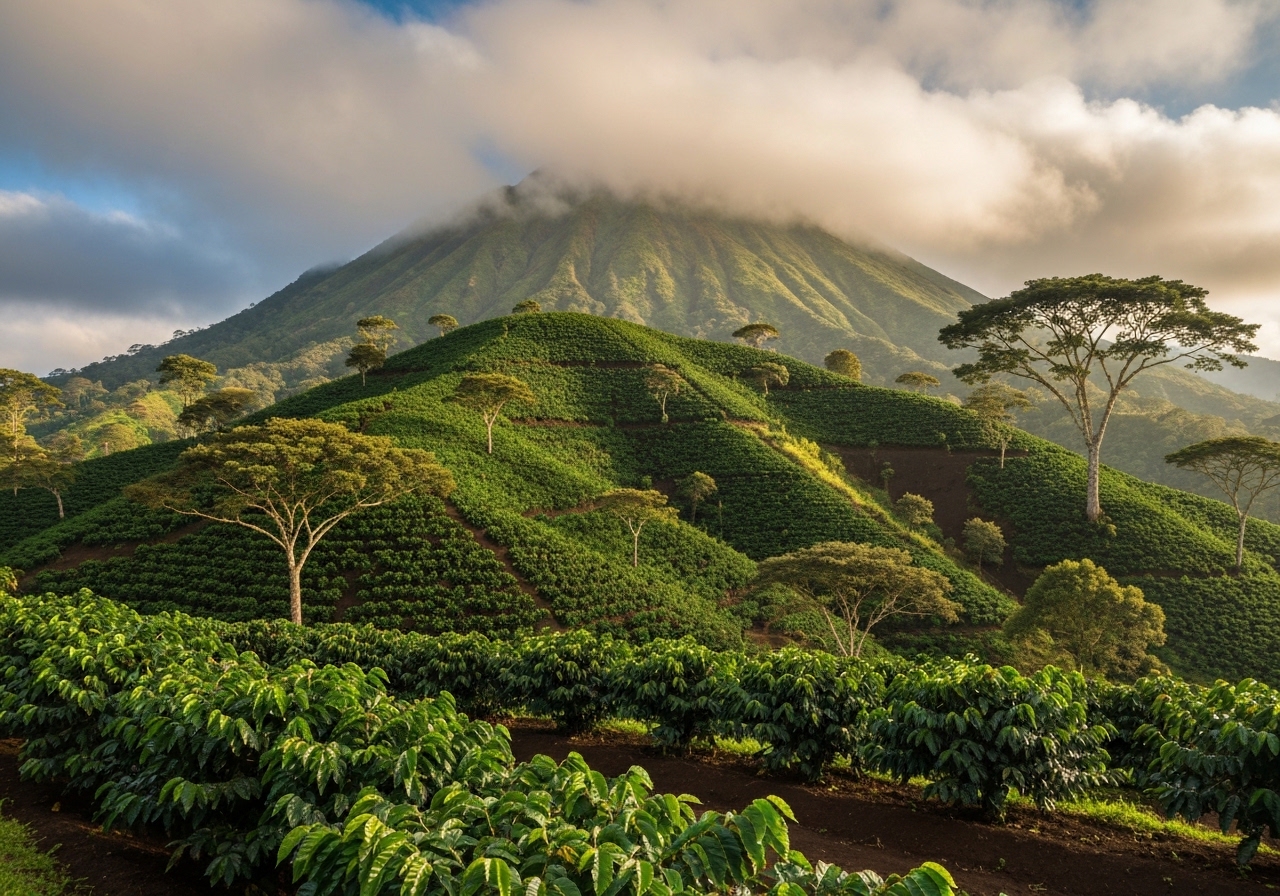
Costa Rica’s volcanic highlands — rich soils and cool temperatures create ideal conditions for growing dense, flavourful Arabica
As James Hoffmann writes in The World Atlas of Coffee, Costa Rica “has arguably done more to push the boundaries of coffee processing than any other producing country,” a distinction earned through decades of farmer-led experimentation at the mill level.
The Micro-Mill Revolution
For most of the twentieth century, Costa Rican coffee followed a familiar path: smallholder farmers picked cherries and delivered them to large centralised wet mills (beneficios), which processed, dried, and sold the coffee — often blending lots from dozens of farms into a single exportable grade. Farmers had little control over how their coffee was processed and even less visibility into where it ended up or what price it commanded on the specialty market.
That model began to crack in the early 2000s. Falling commodity prices forced farmers to find new ways to capture value, and a wave of entrepreneurial producers invested in their own small-scale processing equipment — depulpers, fermentation tanks, raised drying beds — creating what the industry now calls micro-mills. A single farm or a small collective of neighbouring farms could now control the entire chain from cherry to exportable green bean, experimenting with fermentation times, drying methods, and processing styles lot by lot.
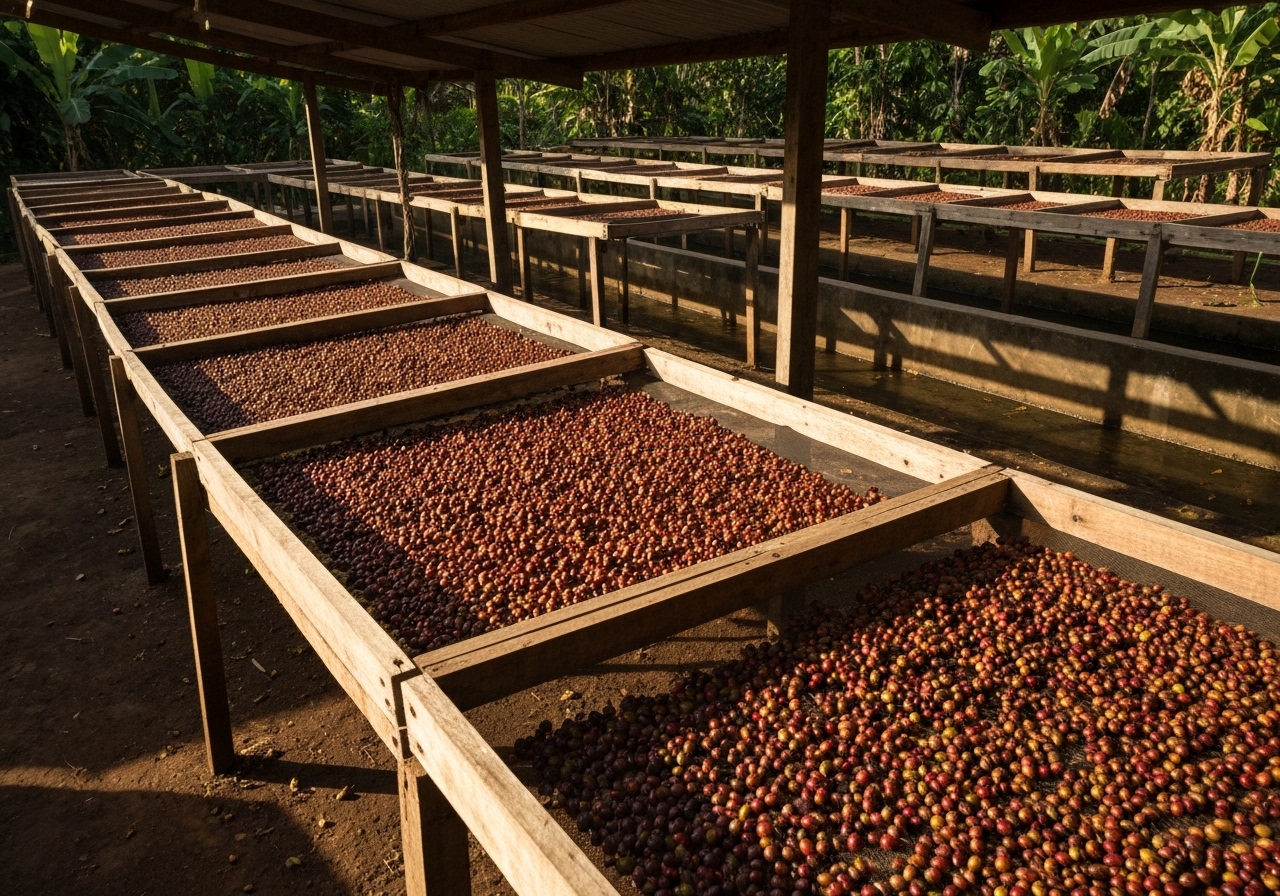
Raised drying beds at a Costa Rican micro-mill — small-scale processing allows farmers to experiment with each harvest lot individually
The results were transformative. By the 2010s, Costa Rica had more micro-mills per capita than any other coffee-producing nation, and the quality curve had shifted decisively upward. Names like Helsar de Zarcero, Hacienda La Minita, and the Monge family’s Don Mayo micro-mill became fixtures on specialty roasters’ offering lists worldwide. The micro-mill revolution didn’t just change Costa Rica’s coffee — it offered a blueprint that producers in Guatemala, Honduras, and beyond would later follow.
Growing Regions
Costa Rica’s compact geography belies its diversity. Eight official coffee regions span the country’s volcanic mountain ranges, each offering distinct altitude bands, microclimates, and soil profiles that shape the cup in measurable ways.
Tarrazú, south of the capital San José, is the most celebrated and commercially significant region. Farms here climb from 1,200 to over 1,900 metres on the slopes of the Cerro de la Muerte, producing dense beans with bright, citric acidity, a syrupy body, and notes of dark chocolate, orange, and brown sugar. Tarrazú’s reputation is so strong that its name has occasionally been misused on lower-quality blends — prompting the region to pursue denomination-of-origin protections. As Mark Pendergrast observes in Uncommon Grounds, Tarrazú has become “shorthand for the best Costa Rica has to offer.”
Central Valley (Valle Central), surrounding San José, is the historic heart of Costa Rican coffee. Lower altitudes (1,000–1,400 metres) and rich volcanic soils from the Poás and Barva volcanoes produce balanced, clean cups with honey sweetness, milk chocolate, and soft stone fruit. Many of the country’s oldest estates and most established mills are found here, and the region remains a reliable source of consistently excellent washed coffees.
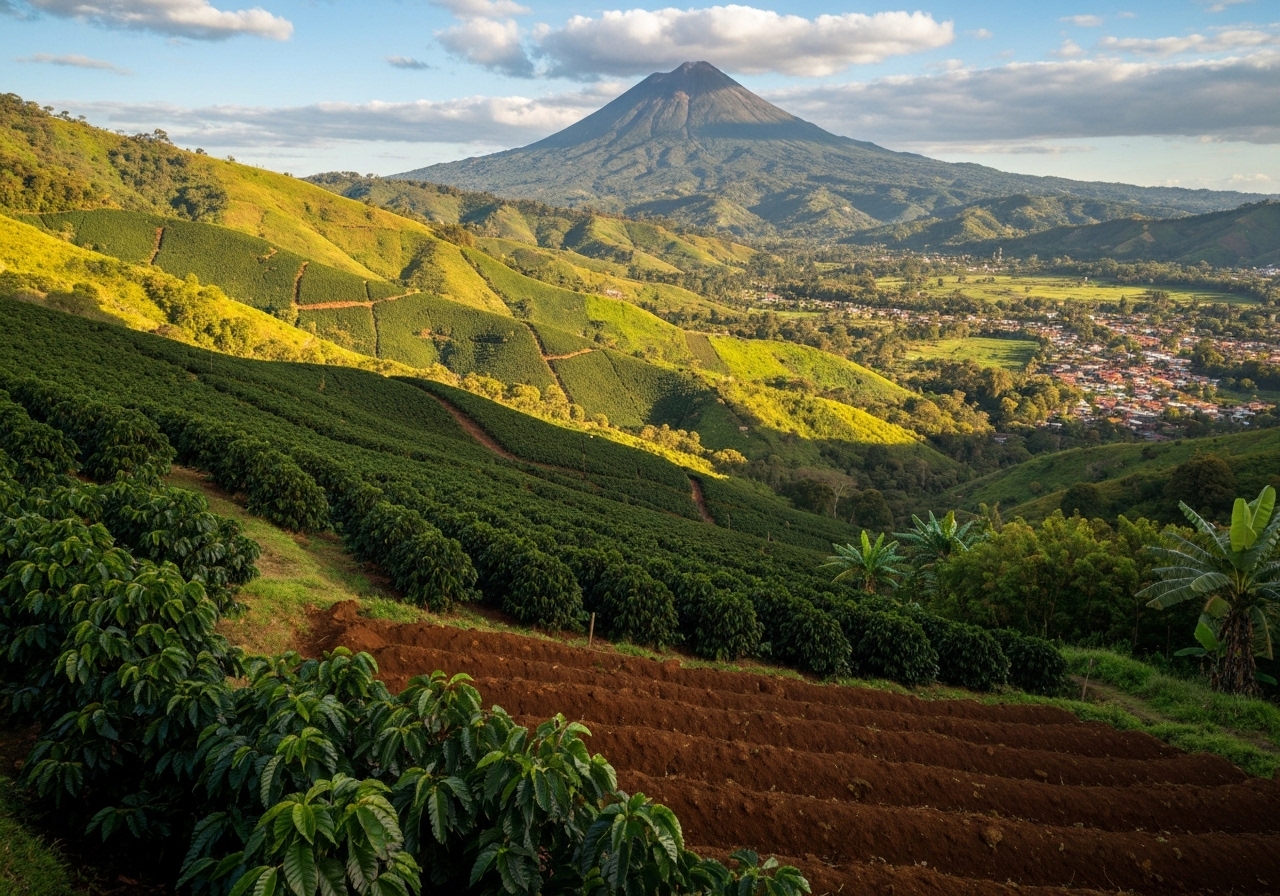
The Central Valley — volcanic soils from Poás and Barva create the foundation for some of Costa Rica’s most balanced and approachable coffees
West Valley (Valle Occidental), including the towns of Naranjo and Grecia, is a hotbed of micro-mill innovation. Altitudes range from 1,200 to 1,700 metres, and producers here have been particularly aggressive in experimenting with honey and natural processing. West Valley coffees tend to show bright acidity, tropical fruit notes, and a clean, complex sweetness that reflects both the region’s terroir and its processing ambition.
Brunca, in the country’s remote southern highlands near the Panamanian border, is the wild card. Less commercially developed than Tarrazú or the valleys, Brunca offers high altitudes, cool cloud-forest microclimates, and a growing number of quality-focused producers. Coffees from Brunca often display floral aromatics, juicy acidity, and a delicate body — a profile that has attracted increasing attention from specialty buyers looking beyond the established regions.
Costa Rica’s harvest runs roughly from November to March, with peak picking in December and January. The relatively short, concentrated season means mills operate at high intensity — and that every processing decision carries outsized consequences for the final cup.
Honey Process Innovation
If Costa Rica has given the specialty coffee world one transformational gift, it is the refinement and popularisation of honey processing. In honey processing, the coffee cherry’s skin is removed but some or all of the sticky mucilage — the sweet, sugary fruit layer surrounding the bean — is left intact during drying. The result sits somewhere between a clean washed coffee and a fruity natural: body and sweetness increase, acidity softens slightly, and new flavour dimensions — stone fruit, caramel, tropical sweetness — emerge.
Costa Rican producers took honey processing further than anyone, developing a colour-coded spectrum based on how much mucilage is retained: white honey (minimal mucilage, dried quickly), yellow honey, red honey, and black honey (maximum mucilage, dried slowly in shade). Each level produces a distinct cup profile, giving roasters and consumers an unprecedented range of flavour expressions from a single farm’s harvest.
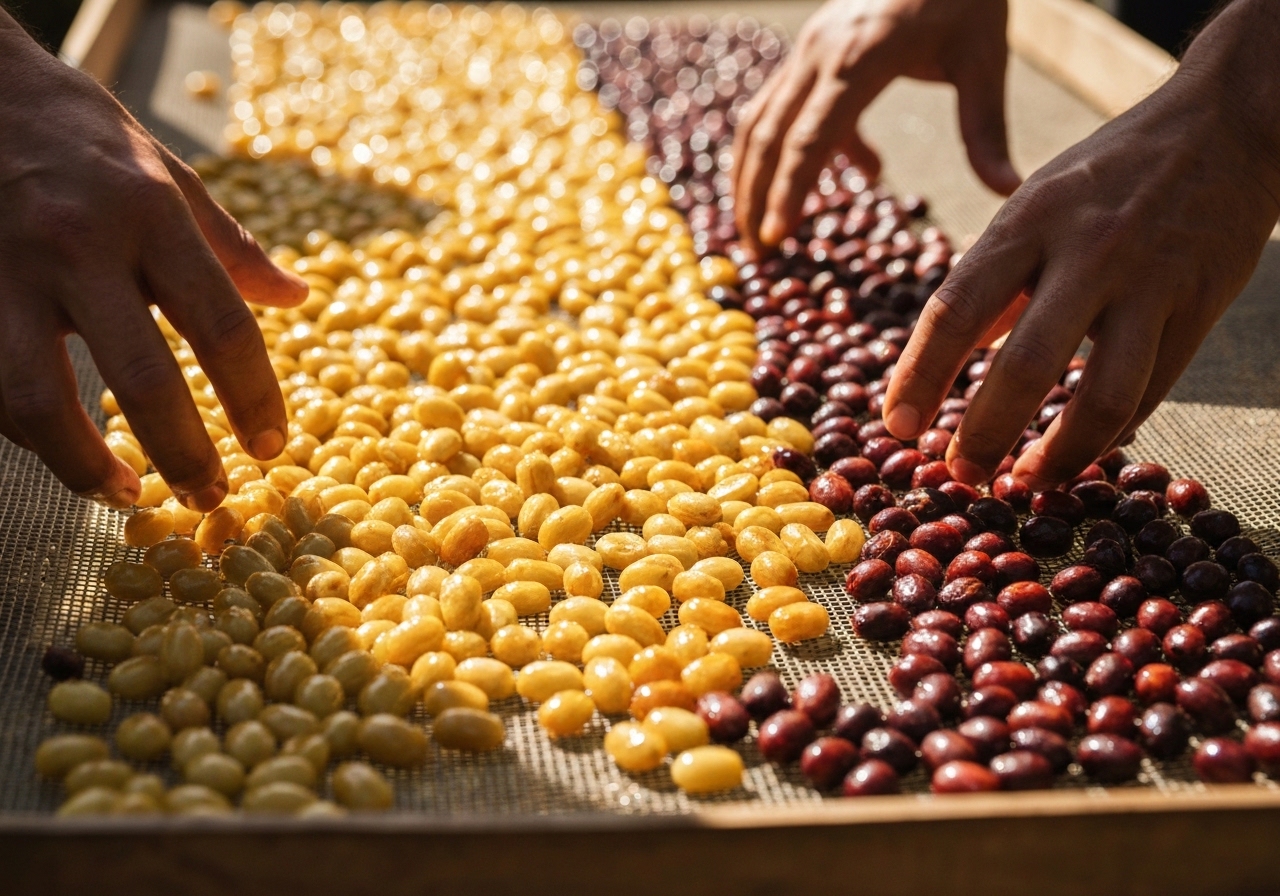
The honey process spectrum — from white to black — gives Costa Rican producers an extraordinary palette of flavour possibilities from a single harvest
As Hoffmann notes, this systematic approach to mucilage management “turned a processing method into a creative tool,” enabling producers to craft flavour profiles with the precision of a winemaker blending grape varietals. The technique has since spread across Latin America and beyond, but Costa Rica remains its spiritual home.
Only Arabica, by Law
In 1989, Costa Rica passed legislation banning the cultivation of Robusta coffee — making it one of the only countries in the world to enforce quality at the statutory level. The law reflected both a pragmatic calculation (Costa Rica could never compete on volume with Brazil or Vietnam) and a cultural conviction that the country’s future lay in the premium segment of the market.
The restriction means that every bean grown in Costa Rica is Arabica, predominantly the Caturra and Catuaí varieties, with increasing plantings of Villa Sarchi (a Bourbon mutation native to Costa Rica’s Sarchi valley) and SL-28. This varietal focus, combined with the micro-mill model and processing innovation, has positioned Costa Rica as a laboratory for specialty coffee — a place where quality is not an aspiration but an operating principle.
Why It Matters
Costa Rica’s influence on specialty coffee extends far beyond its borders. The micro-mill model demonstrated that smallholder farmers could capture more value by controlling their own processing. The honey process spectrum showed that post-harvest handling is not merely a technical step but a creative act. And the Arabica-only legislation proved that a producing country could choose quality over quantity and build a sustainable industry around that choice.
For roasters, Costa Rica offers reliability — clean, sweet, well-processed coffees that perform beautifully as single origins and in blends alike. For the adventurous drinker, it offers a masterclass in how processing shapes flavour: buy a washed, a yellow honey, and a black honey from the same farm, and the differences in the cup will tell you more about coffee processing than any textbook.
In a global industry that often struggles with the tension between scale and quality, Costa Rica stands as proof that small, disciplined, and innovative can win.
Further Reading
- The World Atlas of Coffee by James Hoffmann — detailed profiles of Costa Rican regions and the micro-mill movement
- Uncommon Grounds by Mark Pendergrast — historical context of Central American coffee production and trade
- Specialty Coffee Association (SCA) — research on processing methods and quality standards
- ICAFE (Instituto del Café de Costa Rica) — Costa Rica’s national coffee institute, data on regions, varieties, and harvest statistics
- Cup of Excellence Costa Rica — annual competition highlighting the country’s finest micro-lots
Related Topics
Honey Processing
Honey coffee processing retains mucilage on the bean, producing cups that blend washed clarity with natural sweetness and stone-fruit body. White to black honey.
getting-startedWhat is Coffee Origin?
Coffee origin is the story of place — altitude, soil, and climate shape every flavour note. From Ethiopian florals to Colombian caramel and Kenyan citrus.
processWashed (Wet) Processing
Washed coffee processing removes all fruit before drying to reveal clean, bright cups — floral, terroir-transparent, and prized by the specialty world. The benchmark method.
originGuatemala
Guatemala's volcanic soils and high altitudes — from Antigua to Huehuetenango — produce some of Central America's most complex coffees, rich with chocolate, citrus, and spice.